Artwork
Torello Saraina
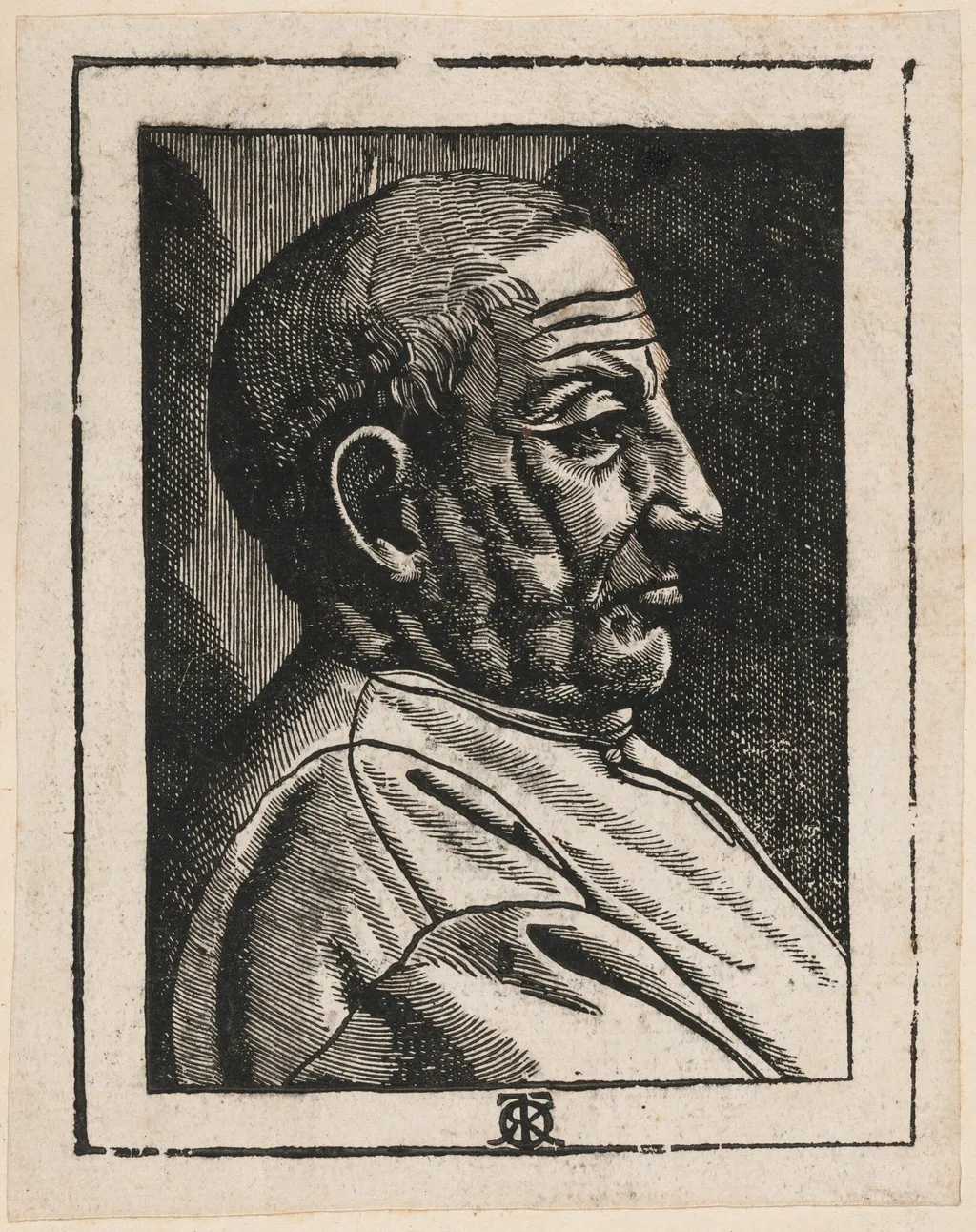
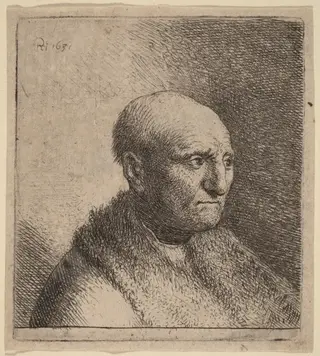
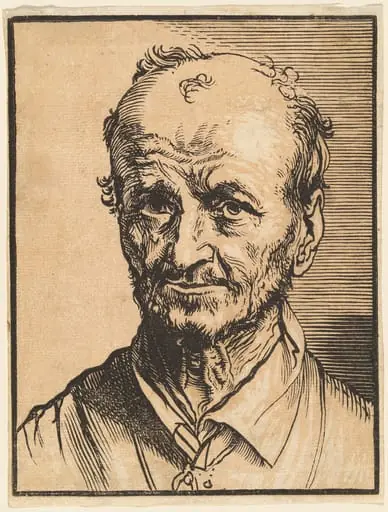
Torello Saraina is an ink print by the Renaissance artist Giovanni Francesco Caroto. It dates from 1540 and is held in the collection of the National Gallery of Art.
- Inscription
- Inscribed:by later hand, lower center of mount in pen and brown ink: Ritratto di Torello Saraina la cui [not deciphered]... / il nome che non e quello dell'incisione [not deciphered] / questo ritratto e premsso alla storia di Verona.
About this work
Overview
Giovan Francesco Caroto’s Torello Saraina is a woodcut proof executed in 1540. The image presents a bearded male figure, his hair curled, dressed in a loose, draped robe. Rendered in stark black and white, the composition relies on dense cross‑hatching to model form and suggest depth, characteristic of early printmaking.
Subject & Meaning
The portrait depicts an individual whose identity is not recorded, but the dignified bearing and elaborate beard suggest a person of status or scholarly inclination. The simplicity of the attire and the emphasis on facial features focus the viewer’s attention on the sitter’s character rather than narrative context.
Technique & Style
The print’s strong chiaroscuro results from meticulous cross‑hatching, a technique that allows subtle gradations despite the medium’s binary color scheme.
Caroto employed the traditional woodcut method, incising lines into a wooden block, inking the surface, and pressing it onto laid paper. The print’s strong chiaroscuro results from meticulous cross‑hatching, a technique that allows subtle gradations despite the medium’s binary color scheme. Stylistically, the work reflects a transition from local Veronese conventions toward the more sculptural modeling seen in Mantegna and the graceful lines associated with Raphael.
History & Provenance
Created as a proof, a preliminary impression used to assess the carved block, the print remained in Caroto’s workshop before entering the collection of the National Gallery of Art in Washington, D.C. Its acquisition provides a rare example of the artist’s print activity, which is otherwise less documented than his painted oeuvre.
Context
Caroto trained under Liberale da Verona and, during the mid‑16th century, traveled to artistic centers such as Mantua and Casale Monferrato. These journeys exposed him to the works of Mantegna, Raphael, and other contemporaries, influences that are evident in the refined anatomical rendering and compositional balance of the Torello Saraina woodcut.
Own this work as a print
Artist & collection
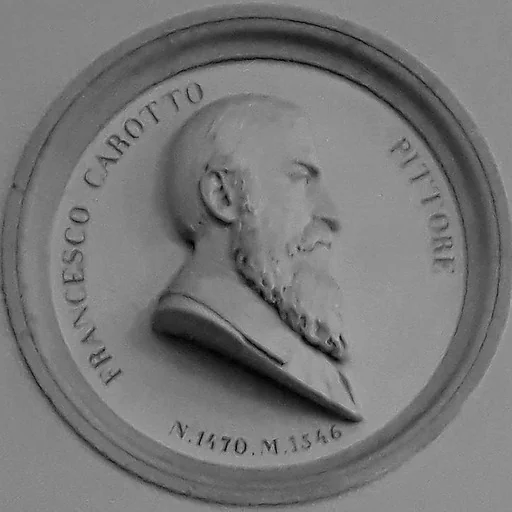
Artist
Giovan Francesco Caroto (Verona, c. 1480 – Verona, 1555) was an Italian painter. A pupil of Liberale da Verona, following his travels to Mantua and, especially, to Casale Monferrato, Giovan Francesco Caroto gradually…