Artwork
Llangrannog
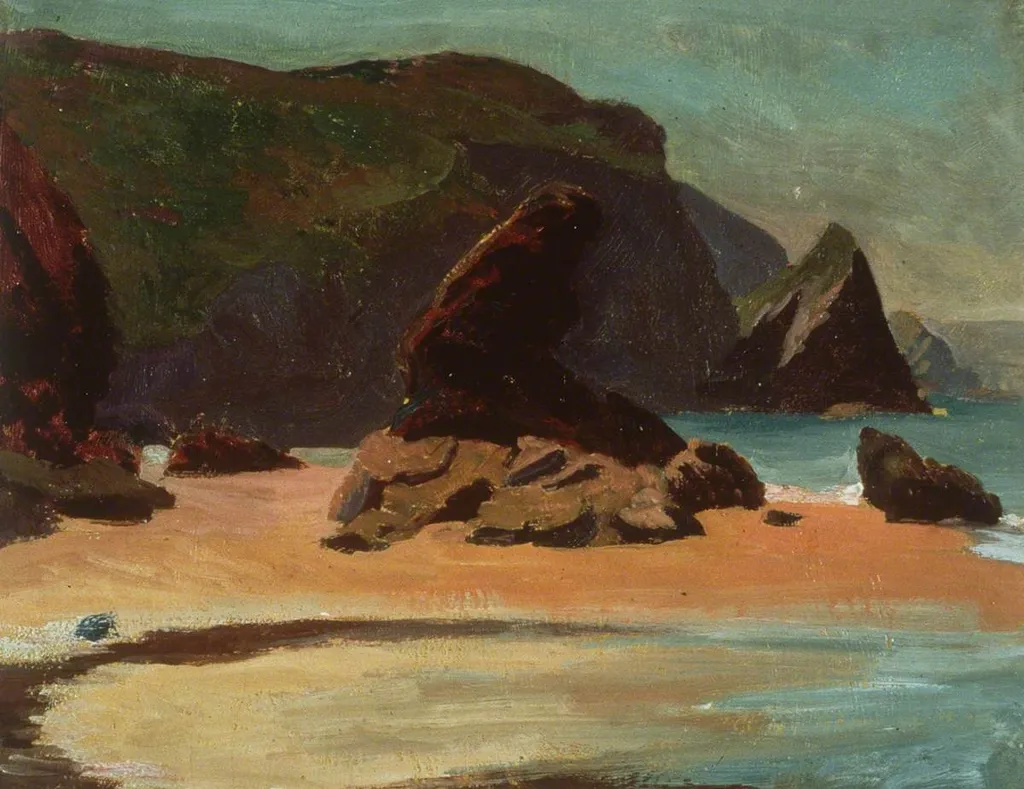
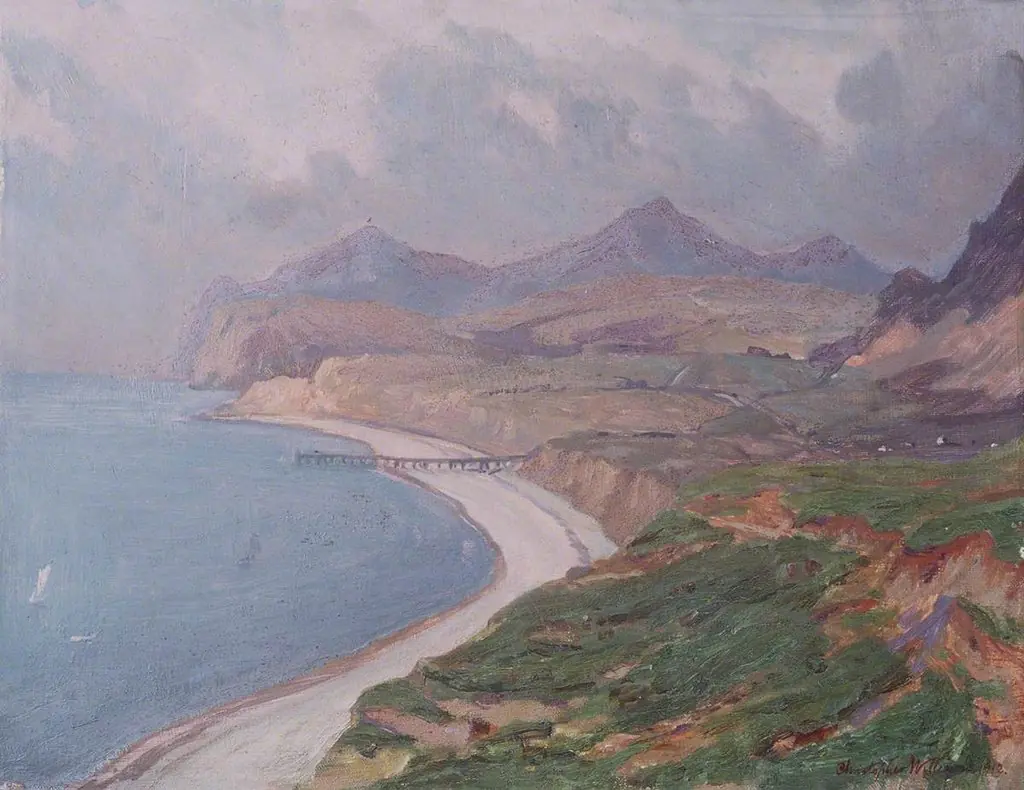
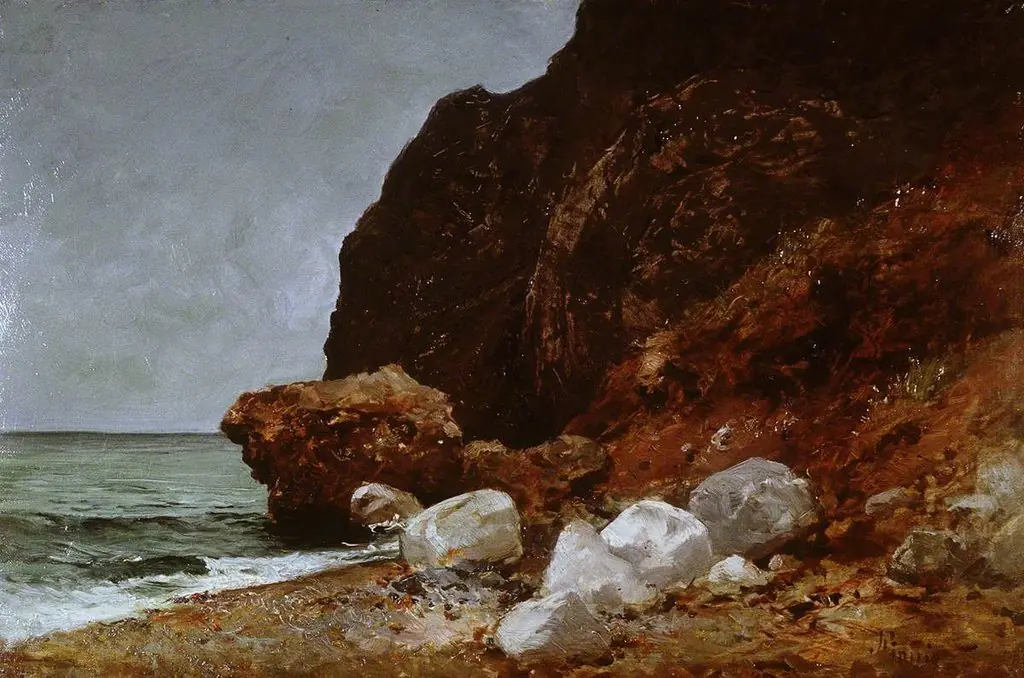
Llangrannog is an oil painting by the American Impressionist artist Christopher Williams. It dates from 1915 and is held in the collection of the National Library of Wales.
About this work
Overview
Llangrannog is an oil on board landscape painting by the Welsh artist Christopher Williams, dated to circa 1915.
Llangrannog is an oil on board landscape painting by the Welsh artist Christopher Williams, dated to circa 1915. Measuring 29 by 37.4 centimetres, the work depicts the coastal village of Llangrannog in Ceredigion, Wales, and is held in the framed works of art collection at the National Library of Wales, where it is catalogued under accession number PB00742. The painting exemplifies Williams's practice as a landscape painter working in Wales during the early twentieth century, contributing to the documentation of Welsh coastal scenery at a moment when national cultural identity was being actively asserted through the arts.
Subject & Meaning
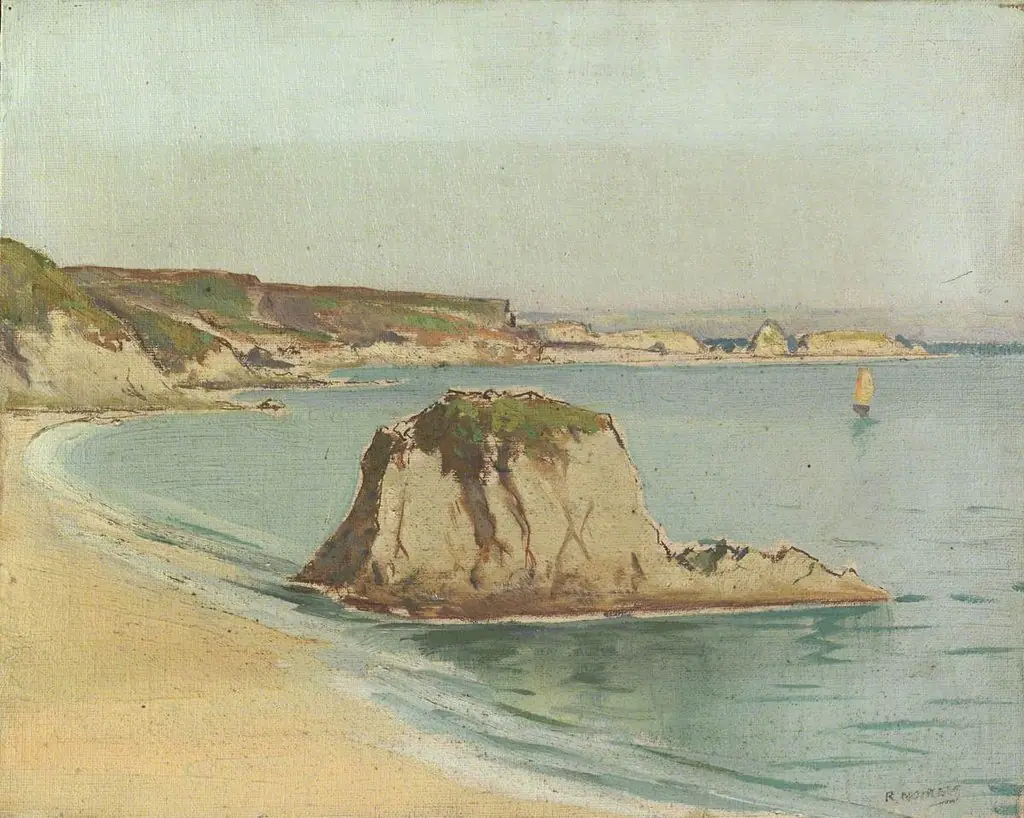
The painting portrays a beach scene at Llangrannog on the Ceredigion coast, with no human or animal figures present. In the foreground, wet sand reflects light across the shore, while a large dark rock formation with a prominent arched cave dominates the centre of the composition. This formation is likely Carreg Bica, a stack of Ordovician rock that stands between Llangrannog and Cilborth Beaches, a landmark steeped in local legend as the tooth of the giant Bica. Additional rocks scatter across the sand, and turquoise and blue sea stretches to the right with small white waves breaking near the shore. Steep cliffs rise behind the central rock, covered in dark green and brown vegetation, while a distant rocky outcrop appears near the horizon. The muted blue-grey sky and shadows falling from the upper left suggest particular atmospheric conditions. The absence of figures directs attention to the raw geological and maritime character of the Welsh coast, aligning with a broader tradition of landscape painting that celebrates specific national topography.
Technique & Style
Williams executed Llangrannog in oil paint on board, a support that provided rigidity for plein-air work or studio completion. The paint application is visible and somewhat loose, with broad brushstrokes defining the cliffs while smoother blending characterises the sand and water areas. This differential handling creates textural contrast between the rugged cliff faces and the more fluid, reflective surfaces of the shore and sea. The palette is restrained, dominated by muted blue-greys in the sky, turquoise and blue in the water, and dark green and brown vegetation on the cliffs. Light from the upper left casts shadows across the beach from the rocks, demonstrating Williams's attention to the effects of natural illumination on coastal forms. The composition balances the monumental central rock formation against the horizontal expanse of sea and sky, a structuring principle common in nineteenth and early twentieth-century landscape painting.
History & Provenance
The painting was created around 1915, during a period when Williams was already an established artist with regular exhibitions at the Royal Academy and the Royal Society of British Artists. The National Library of Wales acquired the work in 1950 through purchase from Mr Ivor Williams, who was the artist's son. The accession number PB00742 records this transaction. The painting is now part of the National Library of Wales Framed works of art collection, where it remains accessible as part of the institution's public holdings. No specific exhibition history for this individual work is recorded in the available sources, though Williams's broader exhibition record included significant institutional shows during and after his lifetime.
Context
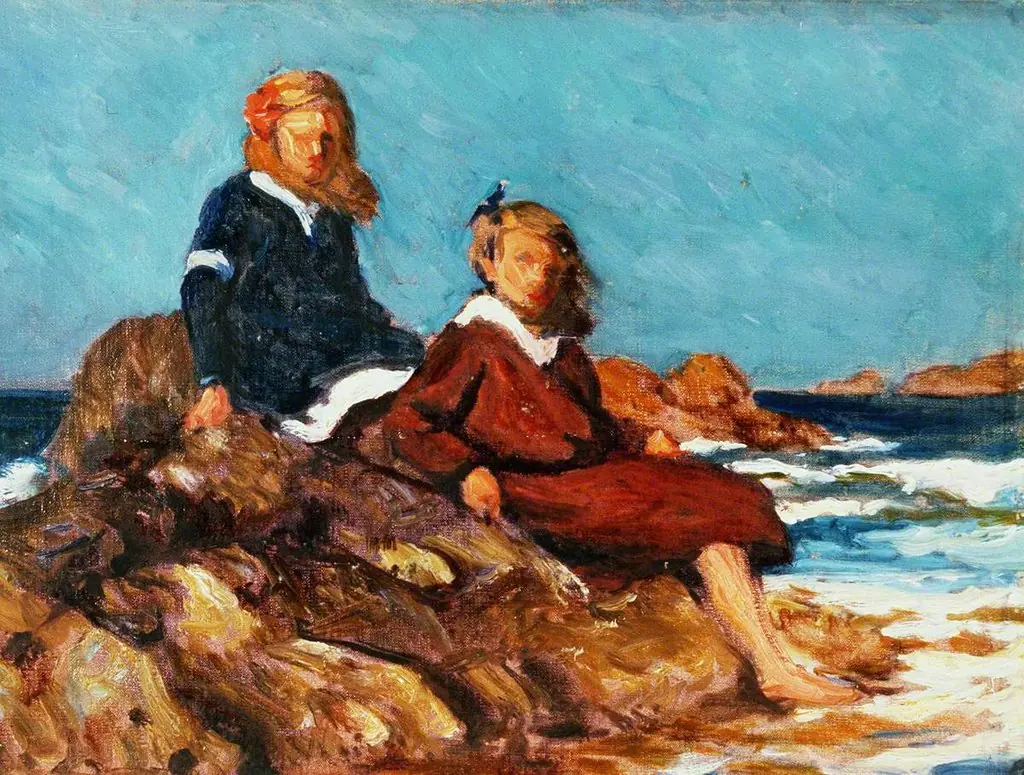
Christopher Williams (1873-1934) was born in Maesteg, Wales, and trained at the Royal College of Art and the Royal Academy Schools before establishing himself as a painter of portraits, historical subjects, and landscapes. By 1915, he had already received commissions from King George V and painted portraits of prominent Welsh figures including David Lloyd George, who described him as one of the most gifted artists Wales had produced. Williams's landscape practice extended across Wales, Switzerland, Italy, France, Spain, Morocco, and Holland, yet his Welsh subjects held particular significance within his oeuvre. The painting Holidays, Village Girls at Llangrannog, also in the National Library of Wales collection, indicates that Llangrannog was a site of repeated artistic engagement for Williams. His coastal landscapes participated in a wider project of documenting Welsh scenery during a period when Welsh cultural institutions were actively collecting and promoting national art. The work sits within a tradition of early twentieth-century British landscape painting that combined observational naturalism with expressive brushwork, while its specific Welsh subject matter aligned with Williams's role as a prominent advocate for Welsh art, including his service as an adjudicator at the National Eisteddfod and membership of the Arts Committee of the National Museum of Wales.
Legacy
While Llangrannog itself has not achieved the prominence of Williams's major historical or portrait commissions, it forms part of a significant body of Welsh landscape painting that has received renewed institutional attention. Williams's reputation rests primarily on his portraits of Welsh public figures and his large-scale historical works such as The Welsh at Mametz Wood, yet his landscapes contribute to the visual record of Welsh coastal geography in the early twentieth century. The painting's preservation in the National Library of Wales ensures its continued availability for study and public engagement. Major retrospective exhibitions of Williams's work, including the centenary exhibition organised in 1973 at the National Museum of Wales, Glynn Vivian Art Gallery, and Maesteg Town Hall, and a further retrospective at the National Library of Wales in 2012 that subsequently toured to Bangor, have sustained scholarly and public interest in his practice. The 2012 exhibition in particular, held at the institution that now houses Llangrannog, demonstrated the continued institutional commitment to assessing Williams's contribution to Welsh art. The painting thus remains a document of both a specific coastal location and the broader cultural project of Welsh landscape representation in the early twentieth century.
Artist & collection
Artist
Christopher Williams (born 1956 in Los Angeles) is an American conceptual artist and fine-art photographer who lives in Cologne and works in Düsseldorf.