Artwork
Reflections, Venice
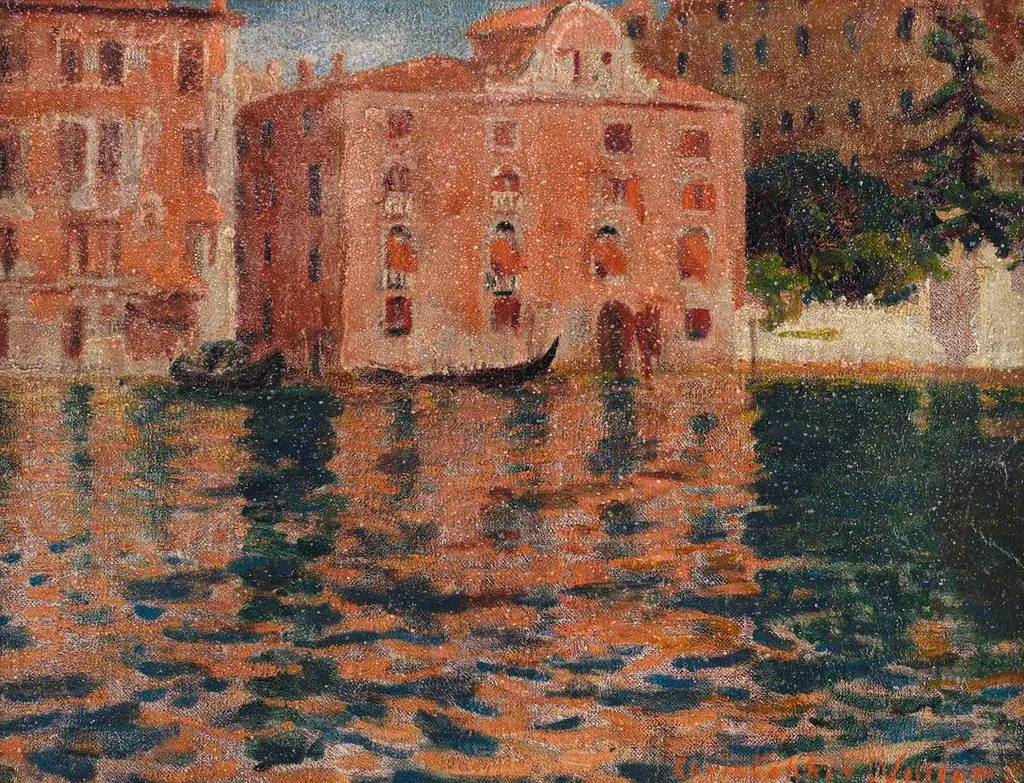
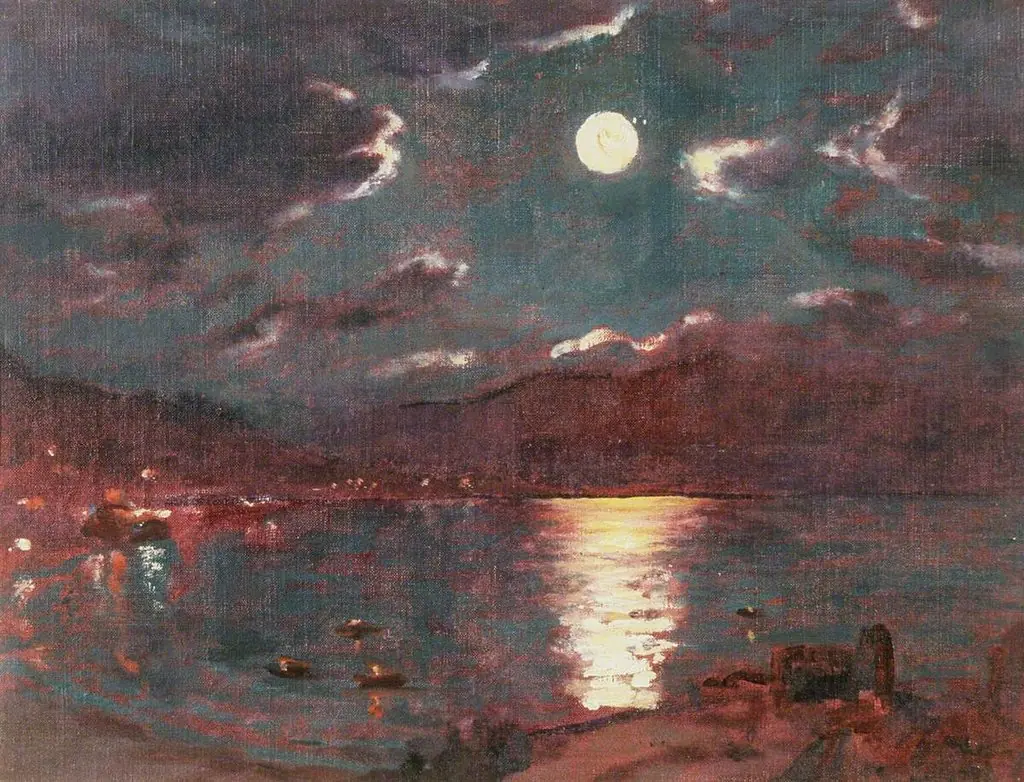
Reflections, Venice is an oil painting by the American Impressionist artist Christopher Williams. It dates from 1921 and is held in the collection of the National Library of Wales.
About this work
Overview
5 centimetres, the work depicts a Venetian canal scene rendered in a distinctive pointillist technique.
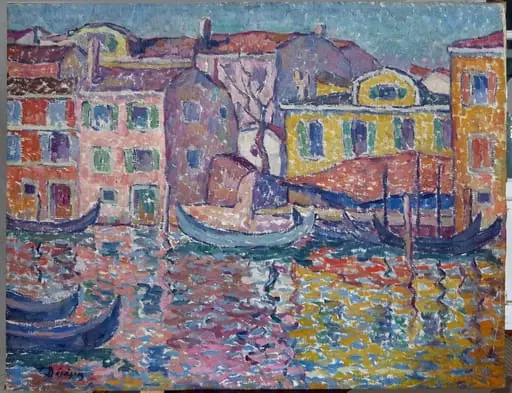
Reflections, Venice is an oil on board painting by the Welsh artist Christopher Williams, dated 1921. Measuring 28.5 by 38.5 centimetres, the work depicts a Venetian canal scene rendered in a distinctive pointillist technique. The painting is held in the collection of the National Library of Wales, having been deposited by Coleg Harlech in 1996, and is catalogued under accession number PG06904. It represents a significant example of Williams's landscape output from his extensive travels, demonstrating his engagement with European modernist techniques while maintaining a commitment to observational painting. The work is in the public domain and accessible through Art UK.
Subject & Meaning
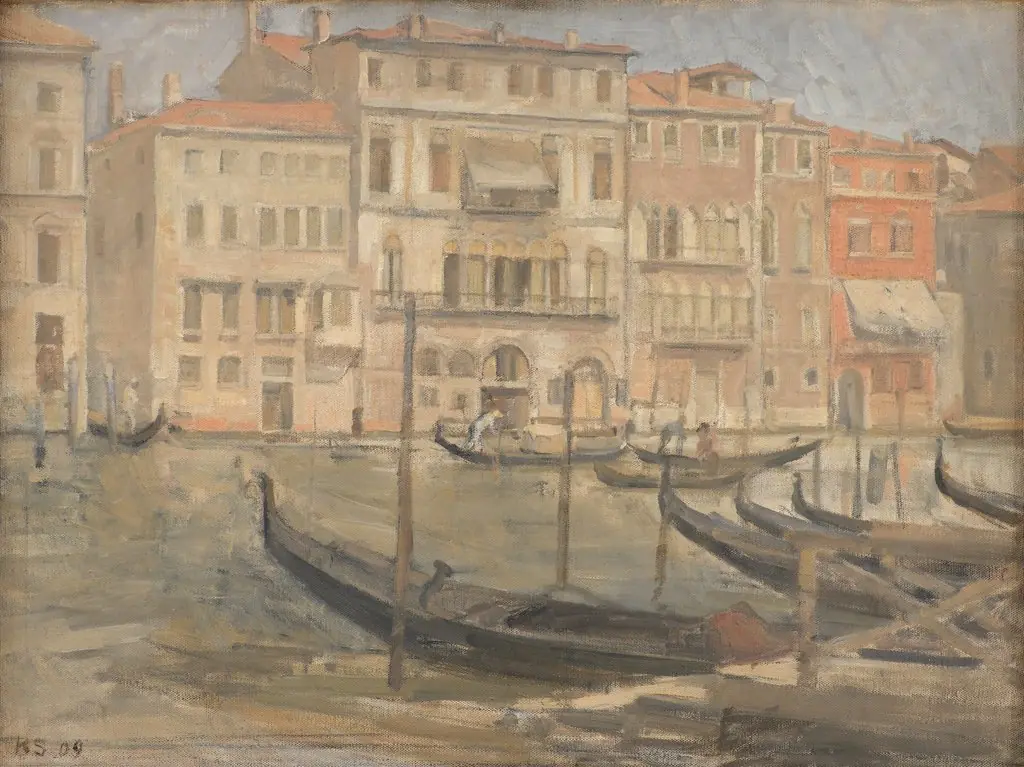
The painting presents a horizontally divided composition featuring three buildings facing a canal, with their reflections occupying roughly the lower half of the canvas. On the left stands a tall pinkish structure, flanked by a central peach-coloured building with arched windows and a decorative roofline, and a darker brown building partially obscured by foliage on the right. A small dark gondola floats near the central building's doorway, anchoring the scene in recognisably Venetian topography. The imagery evokes the dualities of Venice as experienced by many artists: the interplay between architecture and water, solidity and fluidity, permanence and transience. The diffused, overcast light and the fragmented reflection suggest a contemplative, almost melancholic atmosphere rather than a touristic spectacle. The absence of human figures, apart from the implied presence of the gondola, directs attention to the formal and sensory qualities of light, colour, and reflection.
Technique & Style
Williams employed a distinct pointillist technique in this work, applying small, separate dots and dabs of colour throughout the surface to achieve optical mixing. The palette consists of warm terracottas, pinks, and oranges set against deep blue-green water with touches of white. The water reflection is rendered with fragmented, horizontal strokes of complementary colours, creating a shimmering, unstable surface that contrasts with the more solid architectural forms above. The handling of paint produces a hazy, atmospheric effect with no strong shadows, suggesting overcast conditions. An orange signature appears in the lower right corner. The support is board, measuring 28.5 by 38.5 centimetres, and the medium is oil paint. The surface condition and preservation of the pointillist texture are consistent with the work's date and materials.
History & Provenance
The painting was created in 1921, during a period when Williams was actively producing landscapes from his travels across Europe. The work was deposited by Coleg Harlech in 1996 to the National Library of Wales, where it became part of the National Library of Wales Framed works of art collection under accession number PG06904. No earlier provenance or exhibition history prior to this deposit is recorded in the available sources. The painting is currently accessible as a public domain image through Art UK, with the collection requesting photo credit for use.
Context
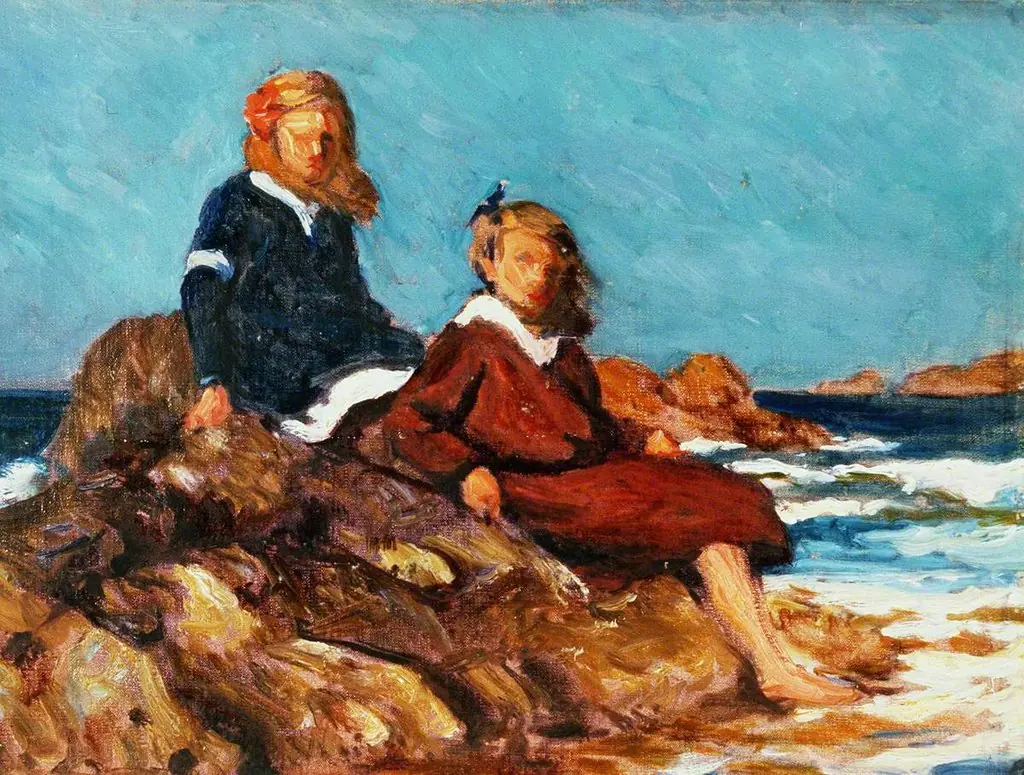
Christopher Williams (1873-1934) was a Welsh artist born in Maesteg, whose career spanned portraiture, history painting, and landscape. He studied at the Royal College of Art and the Royal Academy Schools, and exhibited regularly at the Royal Academy from 1902. While best known for his portraits of Welsh public figures including David Lloyd George and for his commemorative and mythological subjects, Williams maintained a consistent practice as a landscape painter across Wales, Switzerland, Italy, France, Spain, Morocco, and Holland. Reflections, Venice belongs to this latter category of his output. The choice of Venice placed Williams within a long tradition of British and European artists drawn to the city, from J.M.W. Turner and John Ruskin to James McNeill Whistler. The adoption of pointillism in this work suggests Williams's awareness of Post-Impressionist and Neo-Impressionist developments, though applied with a characteristically British restraint. The work's presence in the National Library of Wales collection aligns with the institution's holdings of Welsh artistic production, including Williams's Holidays, Village Girls at Llangrannog.
Legacy
Reflections, Venice remains a relatively modest but telling example of Christopher Williams's versatility as an artist. While his reputation rests primarily on his portraits and his wartime commission The Welsh at Mametz Wood, his landscapes demonstrate a sustained engagement with European subjects and techniques. The painting's accessibility through Art UK and its public domain status have facilitated its use as a representative work from his oeuvre. Williams's broader legacy was consolidated by a centenary exhibition in 1973 at the National Museum of Wales, Glynn Vivian Art Gallery, and Maesteg Town Hall, and more recently by a major retrospective at the National Library of Wales in 2012, which toured to Bangor. In 2024, six of his pieces were refurbished for public display at Maesteg Town Hall as part of a wider refurbishment project. The work's current location in the National Library of Wales ensures its preservation within the principal repository of Welsh cultural heritage.
Artist & collection
Artist
Christopher Williams (born 1956 in Los Angeles) is an American conceptual artist and fine-art photographer who lives in Cologne and works in Düsseldorf.