Artwork
Print from Drawing Book
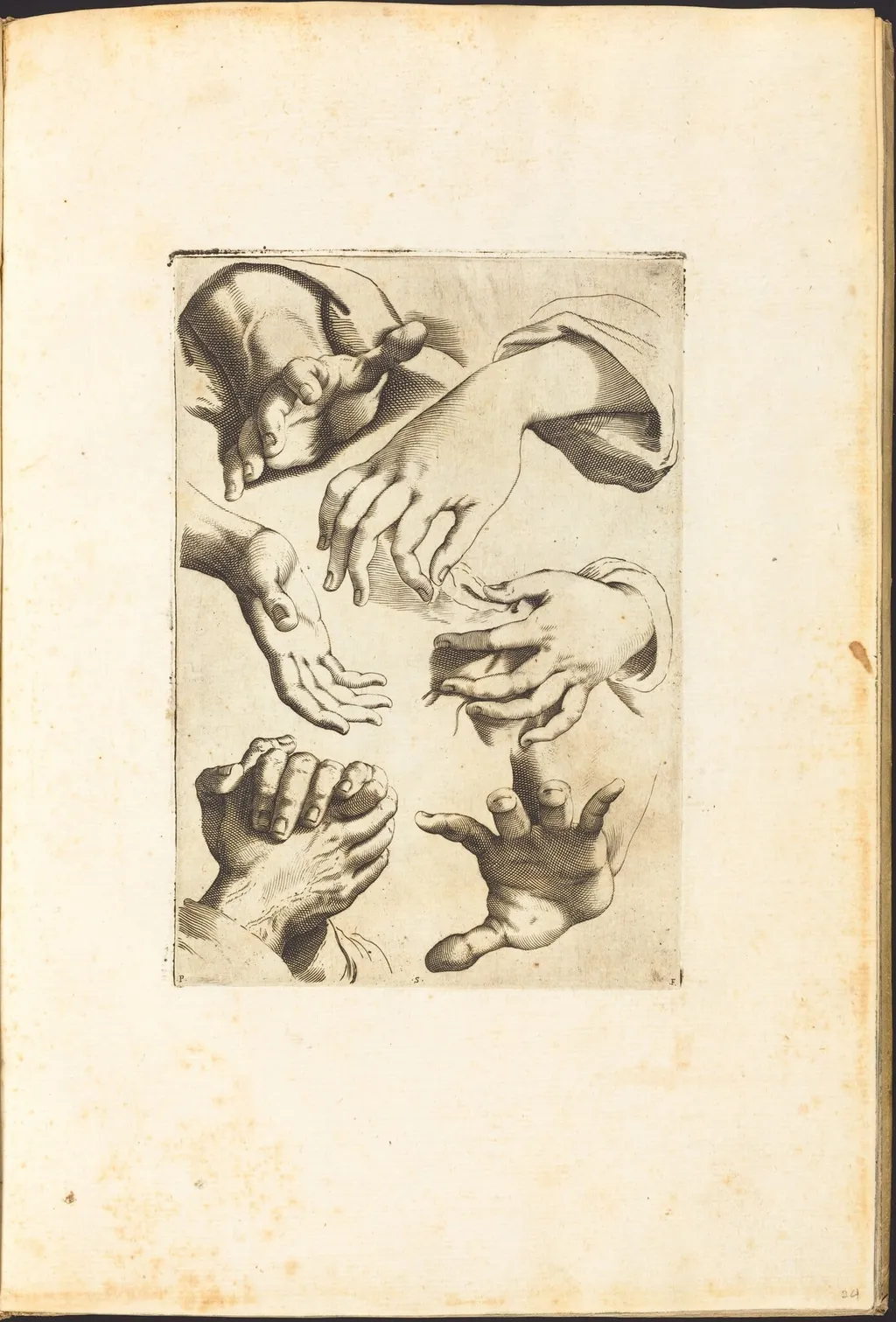
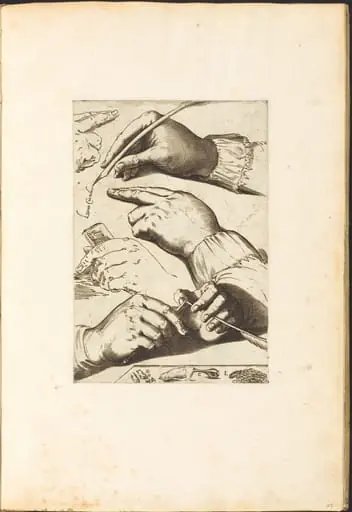
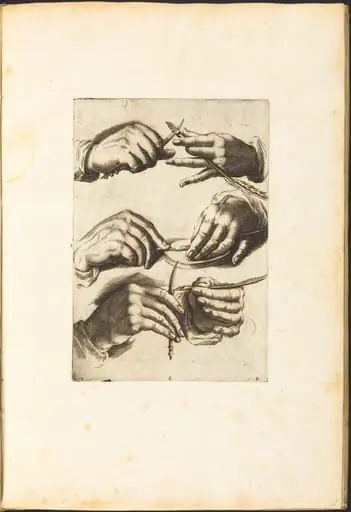
Print from Drawing Book is an ink print by the Baroque artist Luca Ciamberlano. It dates from 1615 and is held in the collection of the National Gallery of Art.
About this work
Overview
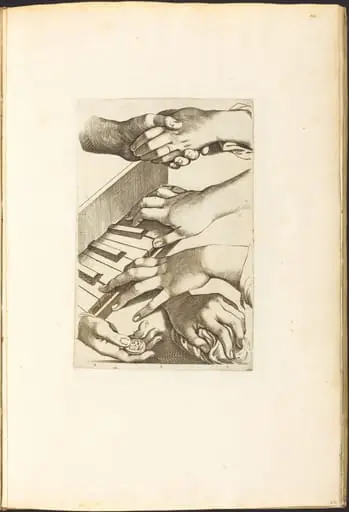
The sharp, dark lines create a high-contrast effect that emphasizes the three-dimensional form of the hands and the tension within the tendons and knuckles.
Print from Drawing Book is an engraving by the Italian artist Luca Ciamberlano, created in 1615. The work functions as an instructional study, depicting five distinct hands arranged to demonstrate various anatomical positions and gestures. The composition isolates these extremities against a plain background, presenting them in a range of states from open palms to clenched fists.
Ciamberlano employs a rigorous linear technique characteristic of early 17th-century printmaking, utilizing dense, parallel hatching and cross-hatching to model volume and define the texture of the skin. The sharp, dark lines create a high-contrast effect that emphasizes the three-dimensional form of the hands and the tension within the tendons and knuckles. Produced during the artist's mature period, this piece reflects the pedagogical traditions of the era, where artists and students utilized such prints to master the complexities of human anatomy.
As part of a drawing book series, the work served a practical purpose for training, offering a clear visual reference for rendering the hand in different dynamic poses. The engraving stands as a representative example of Ciamberlano's contribution to didactic art literature in Baroque Italy.
Subject & Meaning
The print isolates the hand as its sole subject, allowing viewers to contemplate the range of human expression conveyed through gesture. By presenting multiple poses within a single frame, Ciamberlano emphasizes the versatility of the hand as both a functional tool and a symbolic element in artistic practice.
Technique & Style
Ciamberlano employs dense cross‑hatching, layering fine parallel strokes to model volume and surface texture. The intersecting lines generate subtle gradations of shadow, giving the skin a tactile, slightly rough appearance. This meticulous approach to line work reflects the engraver’s command of chiaroscuro within the constraints of the medium.
History & Provenance
Created in the early Baroque period, the engraving likely originated as a study for a larger drawing book intended for artists’ reference. Surviving copies are found in several European collections, indicating that the image circulated among print dealers and served as a pedagogical example of hand anatomy.
Own this work as a print
Artist & collection