Artwork
A Lady in Her Bath
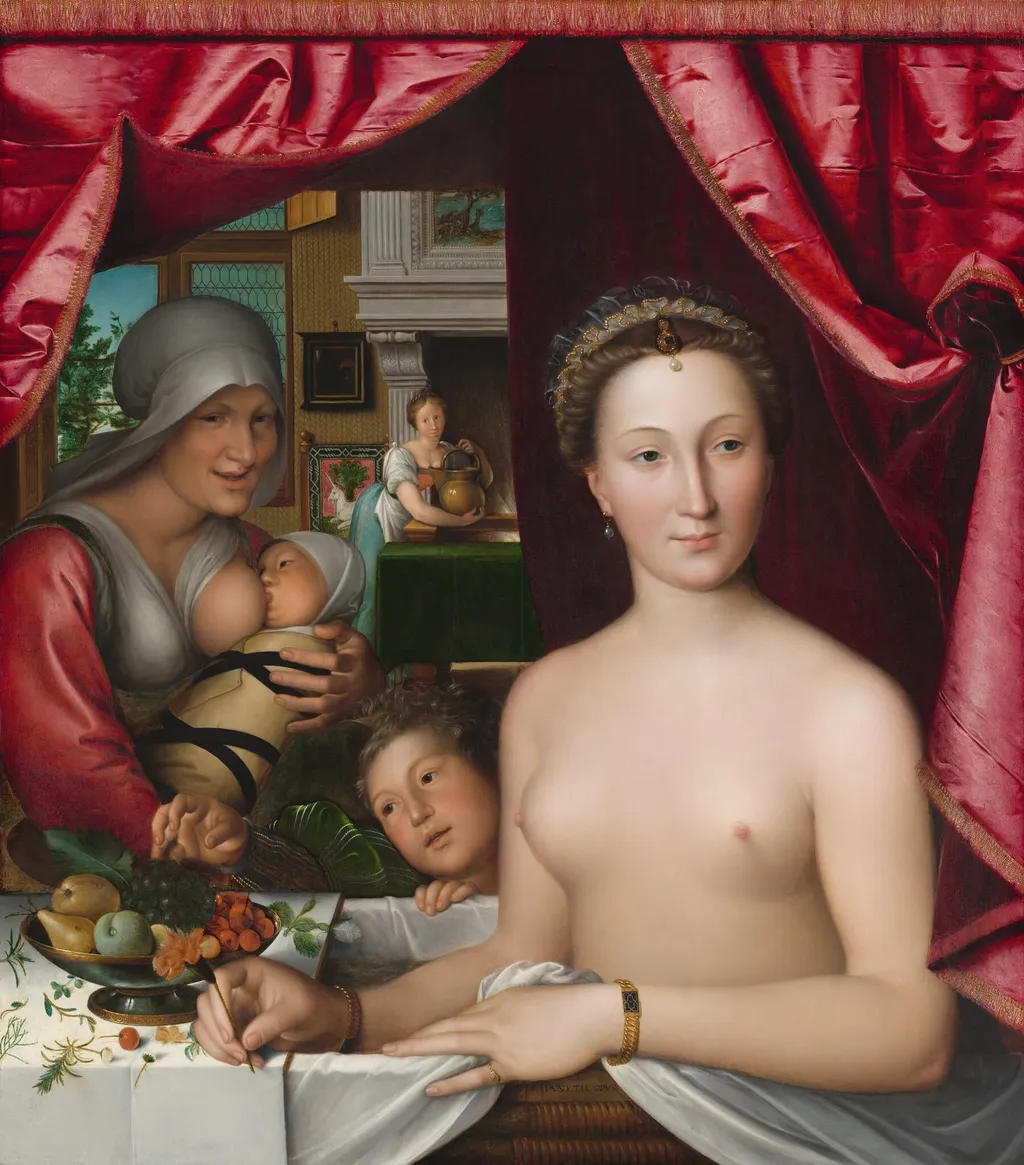
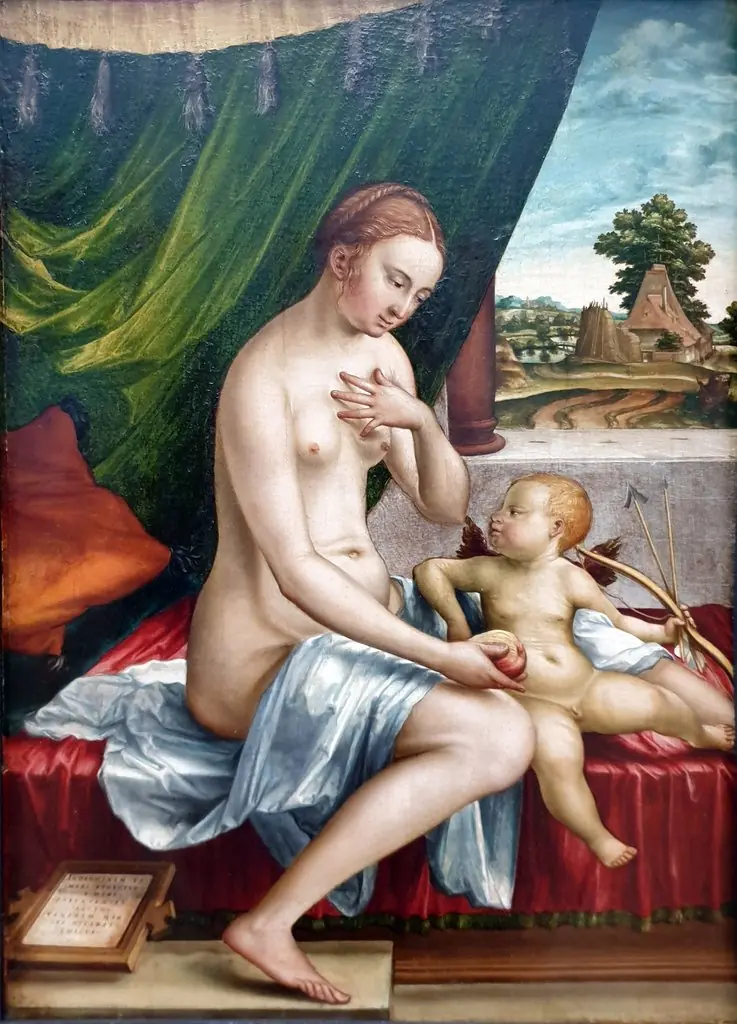
A Lady in Her Bath is an oil painting by the Mannerist artist François Clouet. It dates from 1571 and is held in the collection of the National Gallery of Art.
- Inscription
- Inscribed:lower center on edge of bathtub: FR.IANETII.OPVS
About this work
Technique & Style
It stands as one of the few surviving paintings signed by François Clouet, with the artist's monogram revealed on the cartellino of the bath's wooden rim.
Created in 1571, the work is executed in oil on an oak panel, measuring 92.3 cm in height and 81.2 cm in width. It stands as one of the few surviving paintings signed by François Clouet, with the artist's monogram revealed on the cartellino of the bath's wooden rim. The composition synthesizes Flemish and Italian artistic traditions, evident in the union of meticulous surface details against the figure.
The nude bather is rendered with a smooth, masklike symmetry, creating a stark contrast to the intricate textures of the surrounding fruit, jewelry, and draperies. This formal approach, characterized by the juxtaposition of an idealized, uniformly painted body with richly detailed foreground elements, exemplifies the stylistic qualities of French courtly art in the late sixteenth century.
History & Provenance
François Clouet painted A Lady in Her Bath in 1571 in oil on oak. The provenance begins with Sir Richard Frederick, 6th Baronet, of Burwood Park, Walton-on-Thames, Surrey, whose estate sale at Christie, Manson & Woods in London on 7 February 1874 (lot 83) offered the work as a portrait of Diane de Poictiers by "Fr. Janetii."
Thibeaudeau, apparently acting for Sir John Charles Robinson, acquired it at that sale, and Sir Francis Cook, 1st Baronet, purchased it from Robinson in 1874 for £350, bringing it to Doughty House, Richmond, Surrey.
The painting descended by inheritance through the Cook baronetcy: to Sir Frederick Lucas Cook, 2nd Baronet; to Herbert Frederick Cook, 3rd Baronet; and to Sir Francis Ferdinand Maurice Cook, 4th Baronet, who held it at Doughty House and Cothay Manor, Somerset. In July 1954 it was sold to Margaret Drey of London, then handled by Rosenberg and Stiebel in New York. The Samuel H. Kress Foundation purchased it in May 1955 and gave it to the National Gallery of Art in 1961.
The painting is held by the National Gallery of Art in Washington, D.C., as part of the Samuel H. Kress Collection. It was gifted to the NGA in 1961 by the Samuel H. Kress Foundation, which had purchased it in May 1955 through the New York dealer Rosenberg and Stiebel; the foundation had acquired it the previous July from Margaret Drey, London. Before that, the work descended through the Cook family at Doughty House, Richmond, from Sir Francis Cook, 1st bt., who bought it in 1874, through three successive heirs to Sir Francis Ferdinand Maurice Cook, 4th bt.
Its earlier provenance includes Sir Richard Frederick, 6th bt., Burwood Park, from whose estate sale at Christie's on 7 February 1874 (lot 83, as "Portrait of Diane de Poictiers" by "Fr. Janetii") it was purchased, with Sir John Charles Robinson acting through an agent. The painting's documented exhibition history includes the Exposition des primitifs français.
Context
The painting has attracted scholarly attention since the 20th century; Roger Trinquet proposed 1966 identifications (Diane de Poitiers, Mary Queen of Scots) and suggested a Huguenot satire. Scholars note its blend of Flemish detail and Italian idealism, reflecting French courtly art of the mid‑16th century. Its composition inspired a fashion for bourgeois bather portraits, evident in works like Gabrielle d’Estrées and her sister and copies at Chantilly and the Louvre.
As one of only three signed works by François Clouet, it holds a key place in assessing his court portraiture and the diffusion of Renaissance motifs in France.
Legacy
The painting’s intimate domestic scene and refined fusion of Flemish detail with Italian form helped establish a vogue for "ladies in bath" portraits among the French court in the late sixteenth century. This compositional template resurfaced in later works such as Gabrielle d’Estrées and One of Her Sisters, which reprises the crimson drapery, seated bathers, and attendant motifs. Copies and variants, including versions at the Museo del Prado, Musée Condé at Chantilly, and the Louvre, attest to the original’s influence on subsequent generations of French portraiture through the seventeenth century.
Overview
A Lady in Her Bath is an oil painting on an oak panel, created around 1571 by the French artist François Clouet. This work depicts a woman engaged in a private moment of bathing within a domestic setting. The composition emphasizes a sense of tranquility, presenting the figure amidst ordinary objects that suggest a personal, intimate space rather than a grand or idealized tableau.
Subject & Meaning
The painting portrays a woman immersed in a bath, her expression serene and composed. Her relaxed demeanor contributes to the peaceful atmosphere of the scene. The inclusion of common household items, such as towels and a bucket, grounds the intimate act of bathing in a relatable, everyday context, inviting viewers into a private moment without overt drama or narrative.
Own this work as a print
Artist & collection

Artist
François Clouet (c. 1510 – 22 December 1572), son of Jean Clouet, was a French Renaissance miniaturist and painter, particularly known for his detailed portraits of the French ruling family.