Artwork
The Triumph of Patience
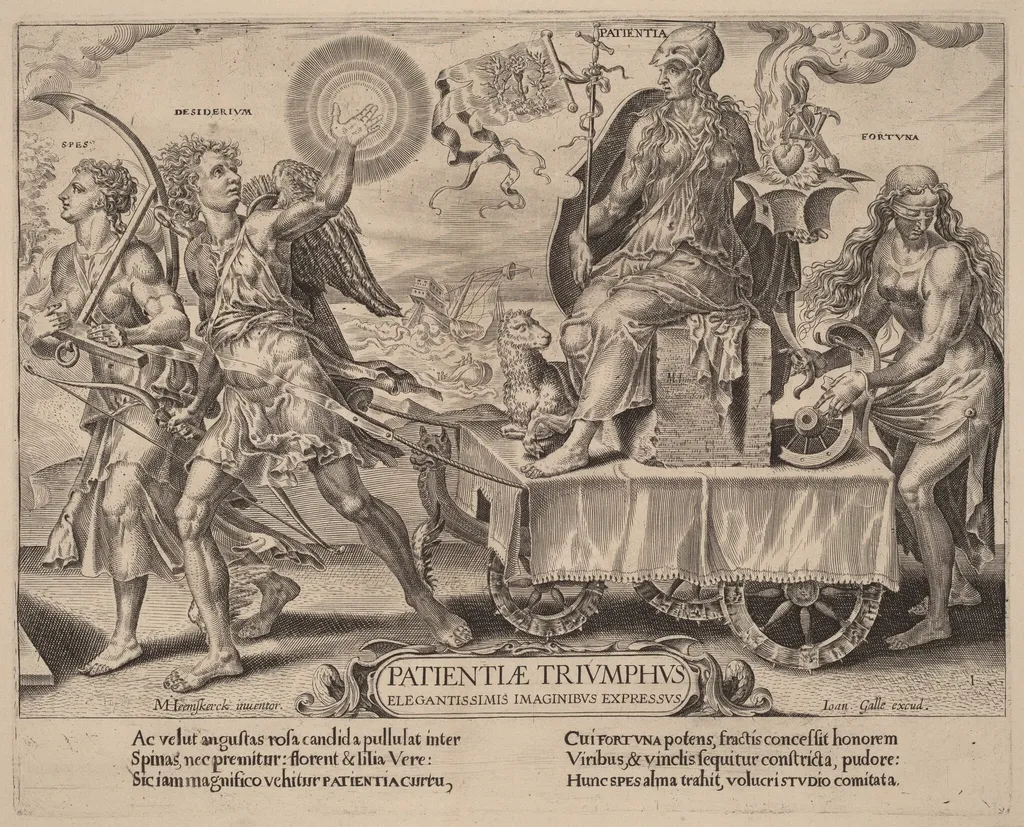
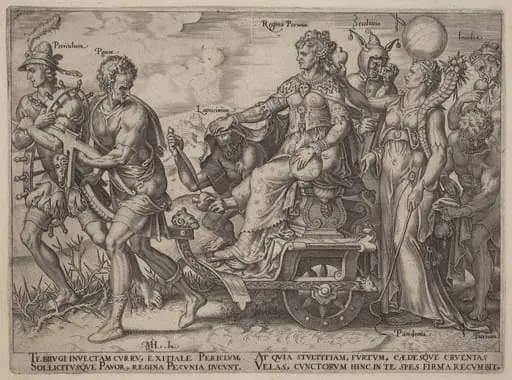
The Triumph of Patience is an ink print by the Renaissance artist Dirck Volckertz Coornhert. It dates from 1559 and is held in the collection of the National Gallery of Art.
- Inscription
- Inscribed:lower center, in plate, in image, engraved series title: PATIENTIÆ TRIVMPHUS / ELEGANTISSIMIS IMAGINIBUS EXPRESSUS. (The triump of Patience / Portrayed in most elegant images.); lower left, in plate, in image: MHeemskerck inventor. (MH interlaced); lower right, in plate, in image: Ioan Galle excud.; in upper zone, names of personifications engraved in plate: SPES, DESIDERIUM, PATIENTIA, and FORTUNA (Hope, Desire, Patience, and Fortune); lower right, in plate, numbered in image: 1; below image, in plate: Ac velut angustas rosa candida pullulat inter / Spinas, nec premitur: fiorent & lilia Vere: / Sic iam magnifico vehitur PATIENTIA curru, / Cui FORTVNA potens, fractis concessit honorem / Viribus, & vinclis sequitur constricta, pudore: / Hunc SPES alma trahit, volucri STVDIO comitata. (And just as a white rose burgeons among the dense thickets of thorns and is not shouldered aside by them, and as the lilies bloom in the spring, so Patience now rides forth on a splendid car. Mighty Fortune, whose powers are not broken, has had to yield honor to her and follows, shamed, in chains. Sweet Hope draws the car, accompanied by winged Desire. [translation from Veldman, Ilja. "Dirck Volkertsz. Coornhert and Heemskerck's allegories." In Maarten van Heemskerck and Dutch humanism in the sixteenth century, p.62. Maarssen: Gary Schwartz, 1977.]); lower left, in graphite by a later hand: Maarten van Heemskerck. 8 plates. Hollstein, VIII, nos. 120-127 II, p.240 also Hollstein, IV, nos 151-158, p.230; lower left, in graphite by a later hand: W53418 / DKM
- Markings
- Marked:none
About this work
Overview
Dirck Volckertz Coornhert’s print, titled The Triumph of Patience, was executed in 1559 using both engraving and etching techniques on laid paper. The work presents an allegorical scene that combines symbolic figures with a maritime landscape, rendered in a balanced interplay of light and shadow.
Subject & Meaning
At the centre sits a woman representing Patience, seated upon a chariot. She cradles a heart, while a lion rests at her feet, both traditional emblems of steadfastness and courage. Flanking her are two men, one pulling, the other pushing the vehicle, suggesting the forces that test endurance, while a third figure stands nearby, observing the tableau.
Technique & Style
Coornhert employs a combination of engraving’s crisp lines and etching’s softer tonal washes, creating a nuanced gradation of dark and light. Fine hatching defines the figures and the distant sea, while broader strokes suggest the texture of the chariot’s wheel and the draped tablecloth, giving the composition depth and a calm, measured rhythm.
Context
The print belongs to the mid‑sixteenth‑century tradition of moral allegory, where virtues were personified for didactic purposes. Its maritime backdrop, complete with ships and a radiant sun, reflects contemporary interests in exploration and the notion of a steady course through life’s uncertainties.
Legacy
Although not as widely reproduced as other allegorical prints of its era, The Triumph of Patience illustrates Coornhert’s skill in merging narrative content with technical mastery, offering insight into the visual language of virtue that circulated in Northern European print culture.
Own this work as a print
Artist & collection