Artwork
Ruined Tomb Inscribed "A.M.G."
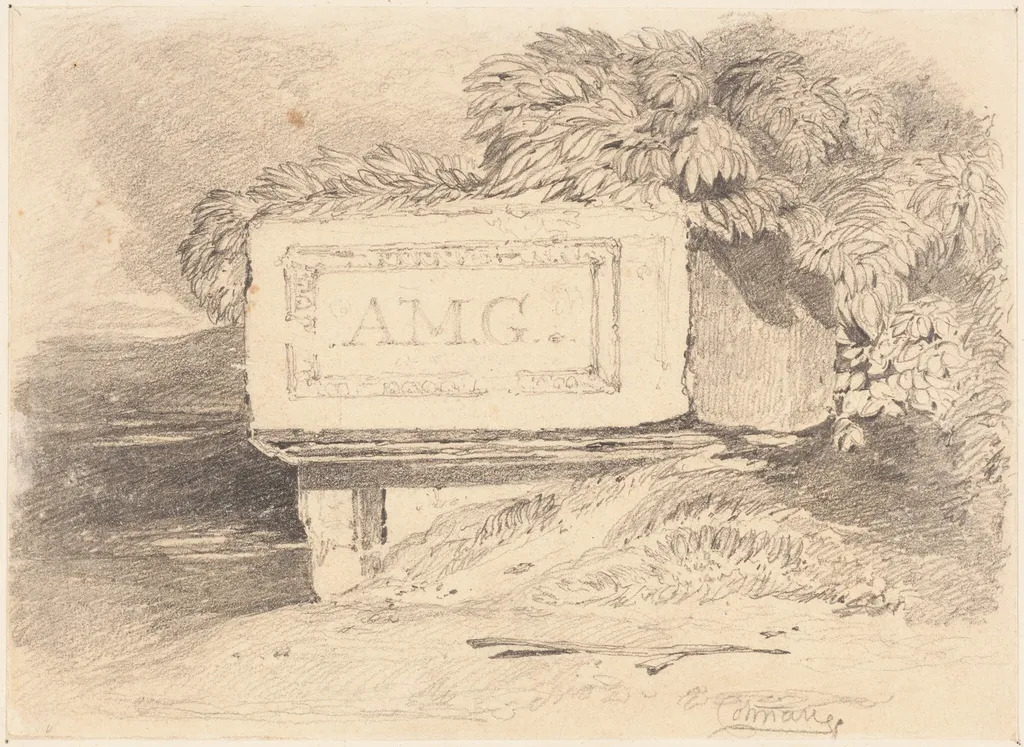
Ruined Tomb Inscribed "A.M.G." is a graphite drawing by the Romanticist artist John Sell Cotman. It dates from 1812 and is held in the collection of the National Gallery of Art.
- Inscription
- Inscribed:lower right: Cotman
About this work
Overview
' The work belongs to a series of topographical sketches Cotman made during travels in England, reflecting his interest in architectural decay.
Created in 1812, this graphite drawing on tan paper by John Sell Cotman captures a weathered funerary monument bearing the initials 'A.M.G.' The work belongs to a series of topographical sketches Cotman made during travels in England, reflecting his interest in architectural decay. Executed with restrained precision, the piece avoids dramatic flourish, instead emphasizing quiet erosion and the passage of time through subtle tonal variations.
Subject & Meaning
The tomb, partially collapsed and inscribed with faded letters, suggests a forgotten individual or family. A single palm branch rests against its upper corner, a classical symbol of victory or remembrance, now isolated and fragile. The uneven ground and chipped stonework reinforce themes of neglect and impermanence.
Rather than commemorating a specific person, the image evokes the anonymity of time’s erosion on memory and identity.
Technique & Style
Cotman employed fine graphite lines to model the tomb’s surface, using varying pressure to suggest texture, cracks, weathering, and moss-stained stone. The tan paper’s natural warmth grounds the composition, allowing muted grays to imply shadow and age. His method avoids heavy shading, relying instead on delicate hatching and negative space to convey decay. This restrained approach aligns with the Norwich School’s emphasis on observational clarity over emotional intensity.
History & Provenance
Cotman produced this drawing during a period of extensive sketching in eastern England, following his early training in London under the influence of Turner and Girtin. Though the exact location of the tomb remains unconfirmed, it likely stems from a journey through Norfolk or Suffolk, regions rich in medieval ecclesiastical remains. The work was probably kept in his personal sketchbook, later entering institutional collections through posthumous acquisitions.
Context
In early 19th-century Britain, interest in ruins reflected broader cultural engagement with history, mortality, and the sublime. While Romantic painters often dramatized decay, Cotman’s approach was more documentary, rooted in topographical tradition. His focus on unadorned, unheroic fragments aligned with the Norwich School’s quiet realism, distinguishing his work from the theatrical ruins of contemporaries like Turner.
Legacy
Cotman’s drawings, including this one, helped redefine British watercolor and graphic art by elevating modest subjects to serious artistic inquiry. His precise yet understated renderings of architectural decay influenced later generations of topographical artists and contributed to the development of archaeological illustration. Though less celebrated than his watercolors, these graphite studies remain vital records of his observational discipline.
Own this work as a print
Artist & collection
Artist
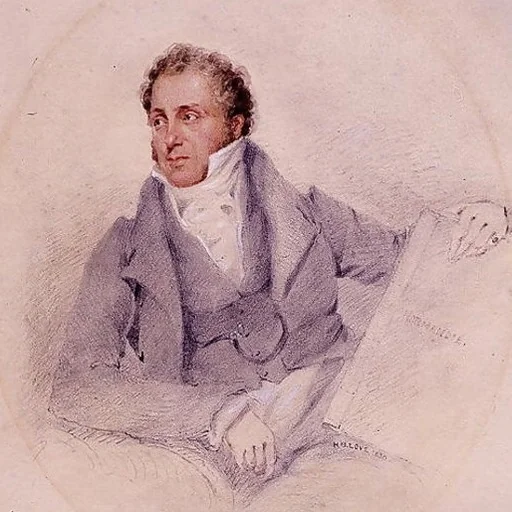
John Sell Cotman (16 May 1782 – 24 July 1842) was an English marine and landscape painter, etcher, illustrator, and a leading member of the Norwich School of painters.

 Quissett, Barnstable County, Massachusetts
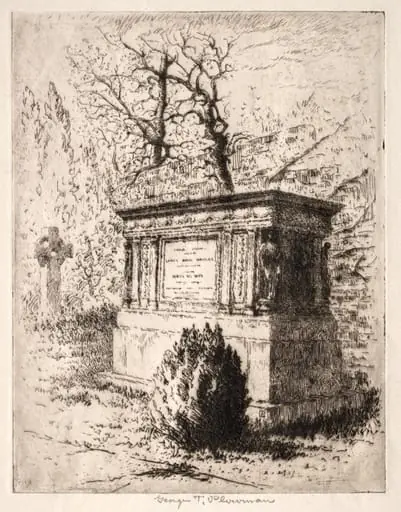 Whistler's Tomb, Chiswick, London
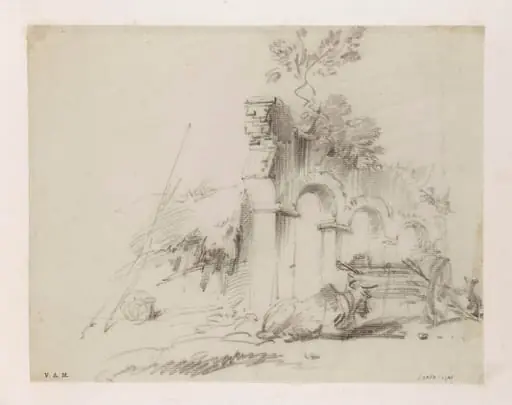 An ox and cart by a ruined building, Bengal
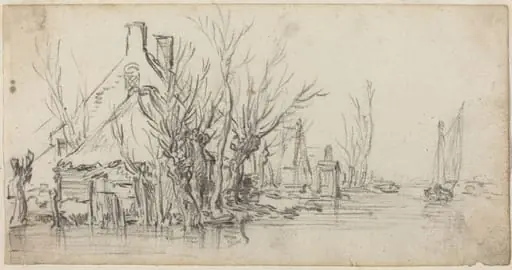 Cottages by a River
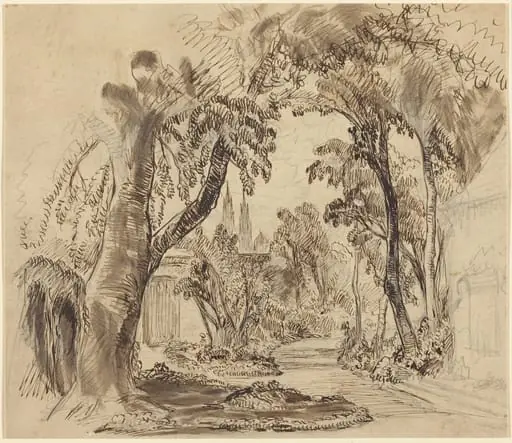 A Tree-lined Garden Path (Preliminary Sketch for "Sleeping Beauty and the Beast"?)
 Capriccio with Antique Ruins
 Salmon Fisher (Le pecheur du saumon)
 Fountain of Pomona in the Gardens of the Villa d'Este, Tivoli
 Jason
Jason The Little Park (Le petite parc)
 Roman Walls
- An Ancient Wall with a Ruined Gate