Artwork
The wounded monkey bites the hand of the prince, his chessmate, in the presence of guests, from a Tuti-nama (Tales of a Parrot): Fifth Night
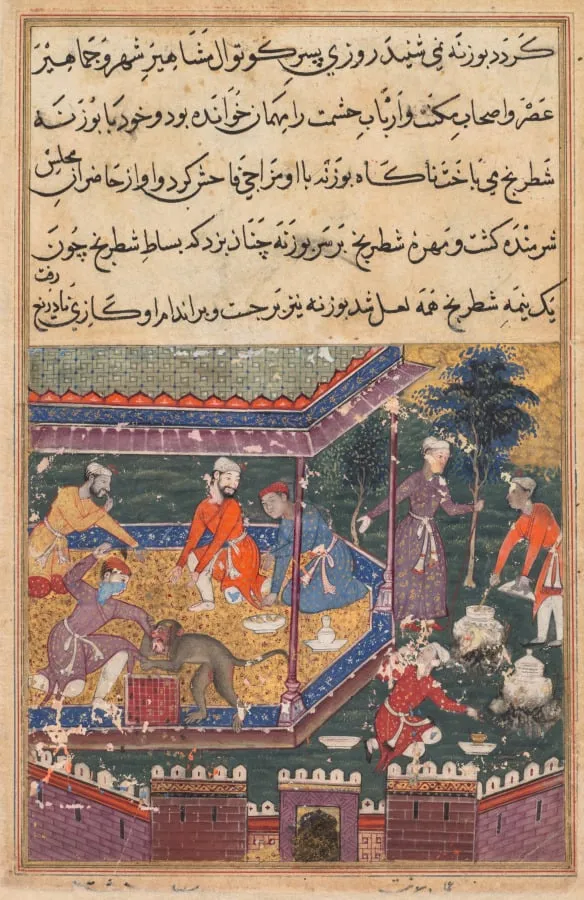
The wounded monkey bites the hand of the prince, his chessmate, in the presence of guests, from a Tuti-nama (Tales of a Parrot): Fifth Night is an unspecified painting by the Mughal Painting artist Dasavanta. It dates from 1560 and is held in the collection of the Cleveland Museum of Art. The miniature illustrates a dramatic episode from the fifth night of the Tuti‑nama, a collection of parrot stories.
- Accession no.
- 1962.279.32.b
- Credit line
- Gift of Mrs. A. Dean Perry
About this work
The story warns that friendships across species, like a monkey and a prince, can turn sour fast.
A monkey in a red coat bites a prince’s hand while nobles gasp. The prince just slapped the monkey for a bad joke. Servants chop meat in the corner, ignoring the chaos.
This tiny painting was part of a book of parrot tales meant to teach lessons. The story warns that friendships across species, like a monkey and a prince, can turn sour fast. The artist worked in Emperor Akbar’s court, where painters mixed Persian and Indian styles.
To see more art from this time, look up mughal india, court of akbar (reigned 1556–1605).
Overview
The miniature illustrates a dramatic episode from the fifth night of the Tuti‑nama, a collection of parrot stories. A monkey dressed in a red coat bites the hand of a princely figure who has just struck him, while surrounding courtiers react with shock. In the background, servants continue to carve meat, oblivious to the conflict unfolding at the banquet table.
Subject & Meaning
The narrative serves as a moral warning about the perils of friendships that cross natural boundaries. In the tale, a parrot mother cautions her chicks by recounting how a chess‑playing monkey, once favored by a prince, fell out of favor after a crude joke, leading to a slap and a retaliatory bite. The scene underscores the fragile nature of alliances between different species.
Technique & Style
Executed in the Mughal miniature tradition, the work combines Persian compositional balance with Indian decorative richness. The figures are rendered with fine brushwork, the monkey’s red coat and the prince’s attire highlighted by delicate gold leaf accents. The crowded interior space is organized through layered planes, allowing the viewer to follow the action from the central confrontation to the peripheral kitchen activity.
History & Provenance
The painting is attributed to an artist who later achieved prominence as a court painter under Emperor Akhbar. Though the original manuscript’s ownership history is sparse, the miniature’s inclusion in the Tuti‑nama indicates its role as an instructional illustration for elite audiences in the late 16th‑early 17th century.
Context
Produced during Akhbar’s reign, the work reflects the empire’s synthesis of Persian artistic conventions with indigenous Indian motifs. The moralizing content aligns with the didactic purpose of many Mughal manuscripts, which often used animal allegories to convey ethical lessons to the royal household and its extended network of nobles.
Artist & collection

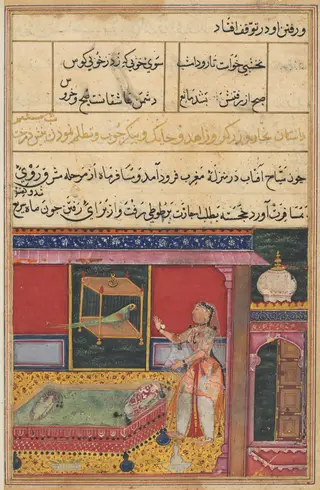 The Parrot Addresses Khujasta at the Beginning of the Sixth Night, from a Tuti-nama (Tales of a Parrot)
 The Parrot Addresses Khujasta at the Beginning of the Sixth Night, from a Tuti-nama (Tales of a Parrot)
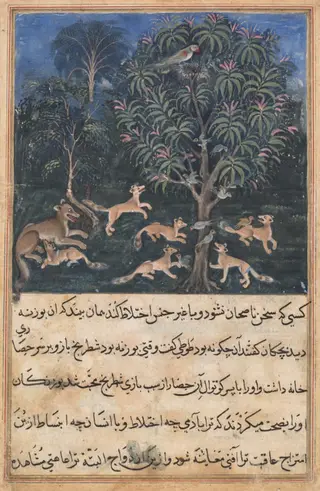 The parrot mother cautions her young on the danger of playing with foxes, from a Tuti-nama (Tales of a Parrot): Fifth Night
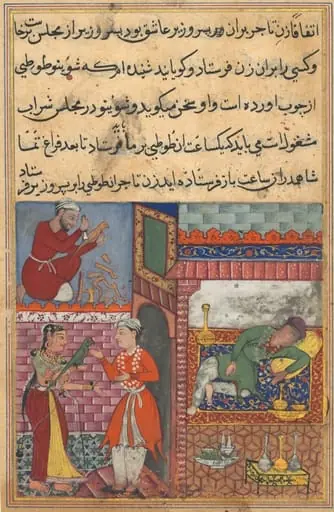
- The vizier’s son receives the magic wooden parrot from the wife of the merchant, who is drunk, and has a replica made by a carpenter, from a Tuti-nama (Tales of a Parrot): Tenth Night
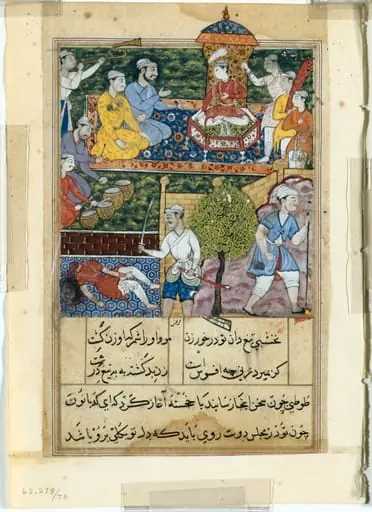 The young prince is crowned and the wicked handmaiden is executed, from a Tuti-nama (Tales of a Parrot): Eighth Night
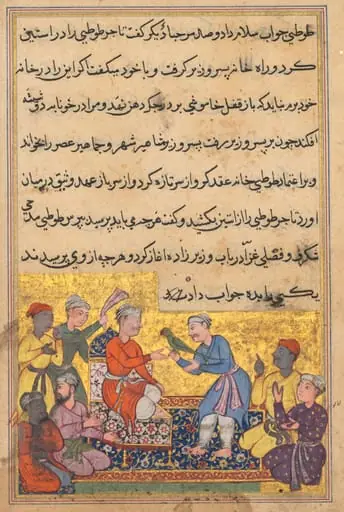 The magic parrot of the merchant talks to the vizier’s son, from a Tuti-nama (Tales of a Parrot): Tenth Night
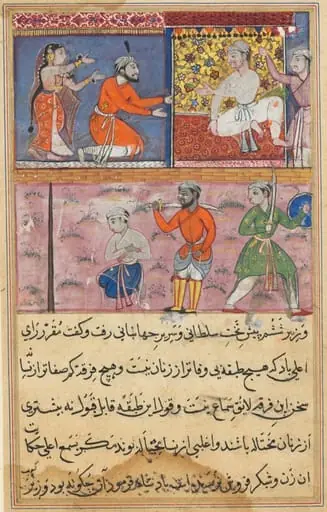 The prince sent back to the place of execution for the sixth time, from a Tuti-nama (Tales of a Parrot): Eighth Night
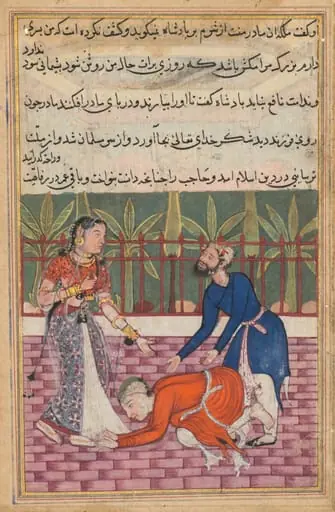 The guard restores the son who falls at his mother’s feet, from a Tuti-nama (Tales of a Parrot): Fiftieth Night
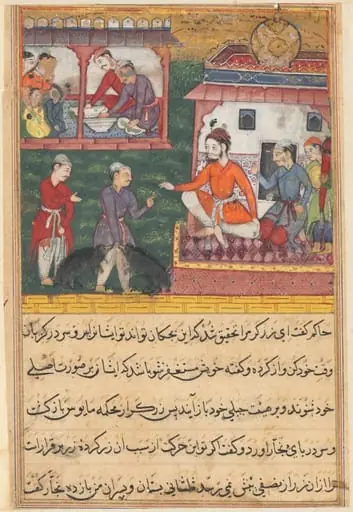 The goldsmith judged; the bear cubs trained by the carpenter as though they were his sons, from a Tuti-nama (Tales of a Parrot): Third Night