Artwork
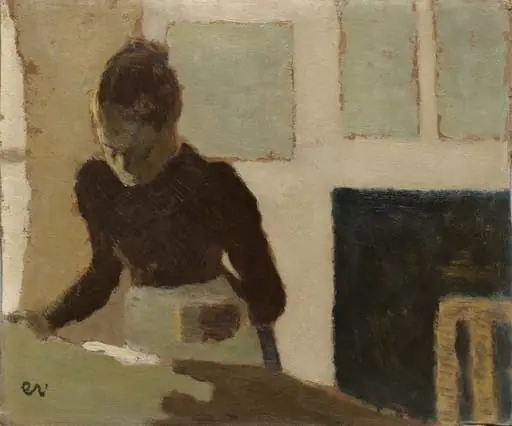
Woman Ironing
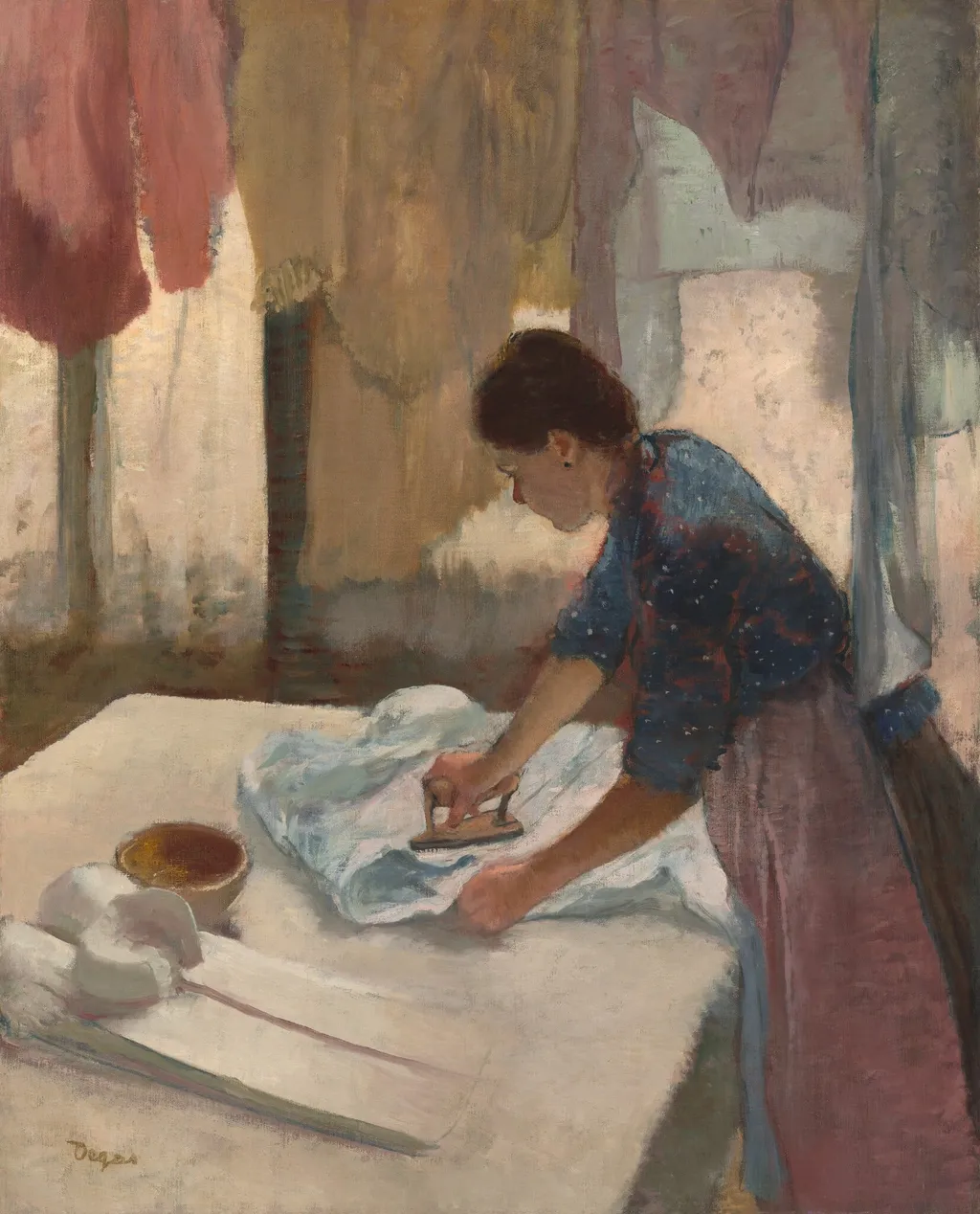
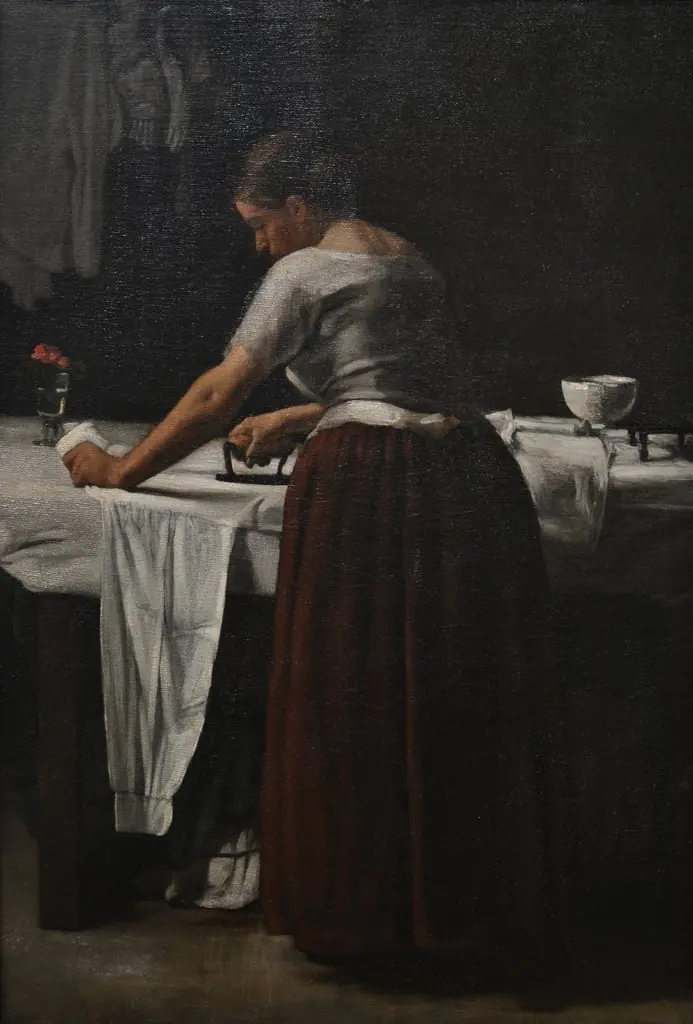
Woman Ironing is an oil painting by the Impressionist artist Edgar Degas. It dates from 1876 and is held in the collection of the National Gallery of Art.
- Inscription
- Inscribed:lower left: Degas
About this work
Technique & Style
The work is an oil painting executed on canvas, employing the Impressionist technique of loose brushwork and nuanced chiaroscuro to render the figure in three dimensions. Degas captures the domestic moment through careful modeling of light and shadow, emphasizing the quiet intensity of the sitter's labor.
History & Provenance
in New York handled the next transfer, selling it in 1972 to Paul Mellon of Upperville, Virginia, who gave it to the National Gallery of Art that same year.
Woman Ironing was begun around 1876 and completed around 1887. Its earliest documented owner was the Parisian tenor and collector Jean-Baptiste Faure, after whom it passed to James F. Sutton. The work was sold from Sutton's holdings at the American Art Association in New York on 25 April 1895 (lot 164), where Georges Durand-Ruel acquired it, apparently for his private collection.
It remained with the Durand-Ruel family for decades; after Georges's death in 1931 it passed to his widow, Margaret Tierney Durand-Ruel, in Neuilly-sur-Seine, and then to her niece, Mme. Jacques Lefébure, in Paris. During this period it was lent to a 1936 exhibition in Philadelphia and shown at the Durand-Ruel Gallery in New York in 1947. Wildenstein and Co. in New York handled the next transfer, selling it in 1972 to Paul Mellon of Upperville, Virginia, who gave it to the National Gallery of Art that same year.
Context
Woman Ironing is regarded as a sophisticated exploration of labor and domestic routine within Degas' broader body of genre scenes, reflecting his interest in contemporary bourgeois life while extending Impressionist concerns with movement and compositional asymmetry. Scholarship emphasizes its nuanced handling of light and spatial cropping, situating the work alongside other private paintings of women at work that prefigure the artist's late focus on solitary female figures. The painting's provenance through the Durand-Ruel gallery and subsequent acquisition by the National Gallery of Art underscores its recognized importance within Degas' oeuvre and the transatlantic market for French modernism.
Legacy
The painting Woman Ironing helped shape Impressionist depictions of everyday domestic labor, influencing later artists' focus on women's private moments and the quiet physicality of routine tasks. It has been cited as a key example of Degas' innovative composition and his interest in movement within stillness, contributing to broader discussions of gender and labor in art history. The work's provenance through major dealers and collectors, including the Durand-Ruel family and Paul Mellon, reinforced its prominence in 20th-century art markets and institutional collections.
Today, Woman Ironing is part of the National Gallery of Art's permanent collection in Washington, D.C., where it is studied for its technical mastery and role in advancing modern approaches to realism and impressionistic brushwork.
Overview
Created circa 1876, Woman Ironing is an oil on canvas by French painter Edgar Degas. Although often linked to Impressionism, Degas identified himself more with realism, focusing on the unembellished aspects of daily existence. This work belongs to the genre‑scene tradition, portraying a solitary figure engaged in a routine household chore.
Subject & Meaning
The composition centers on a lone woman bent over a low table, iron in hand, absorbed in the act of smoothing fabric. Dressed in modest attire, she is rendered without idealization, emphasizing the quiet concentration and dignity of ordinary labor. The blurred surroundings keep attention on her physical effort and inner focus.
Own this work as a print
Artist & collection
Artist
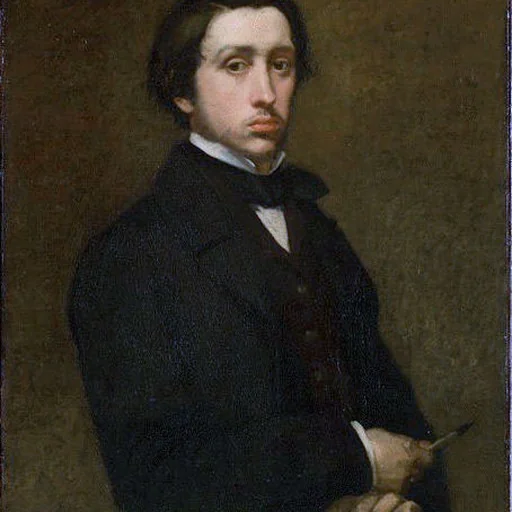
Born Hilaire-Germain-Edgar De Gas on 19 July 1834 in Paris, Edgar Degas came from an affluent banking family with aristocratic roots and spent his childhood among the cultivated circles of the French capital.