Artwork
Alf Dunn. Kinetic Sculptures, Paintings
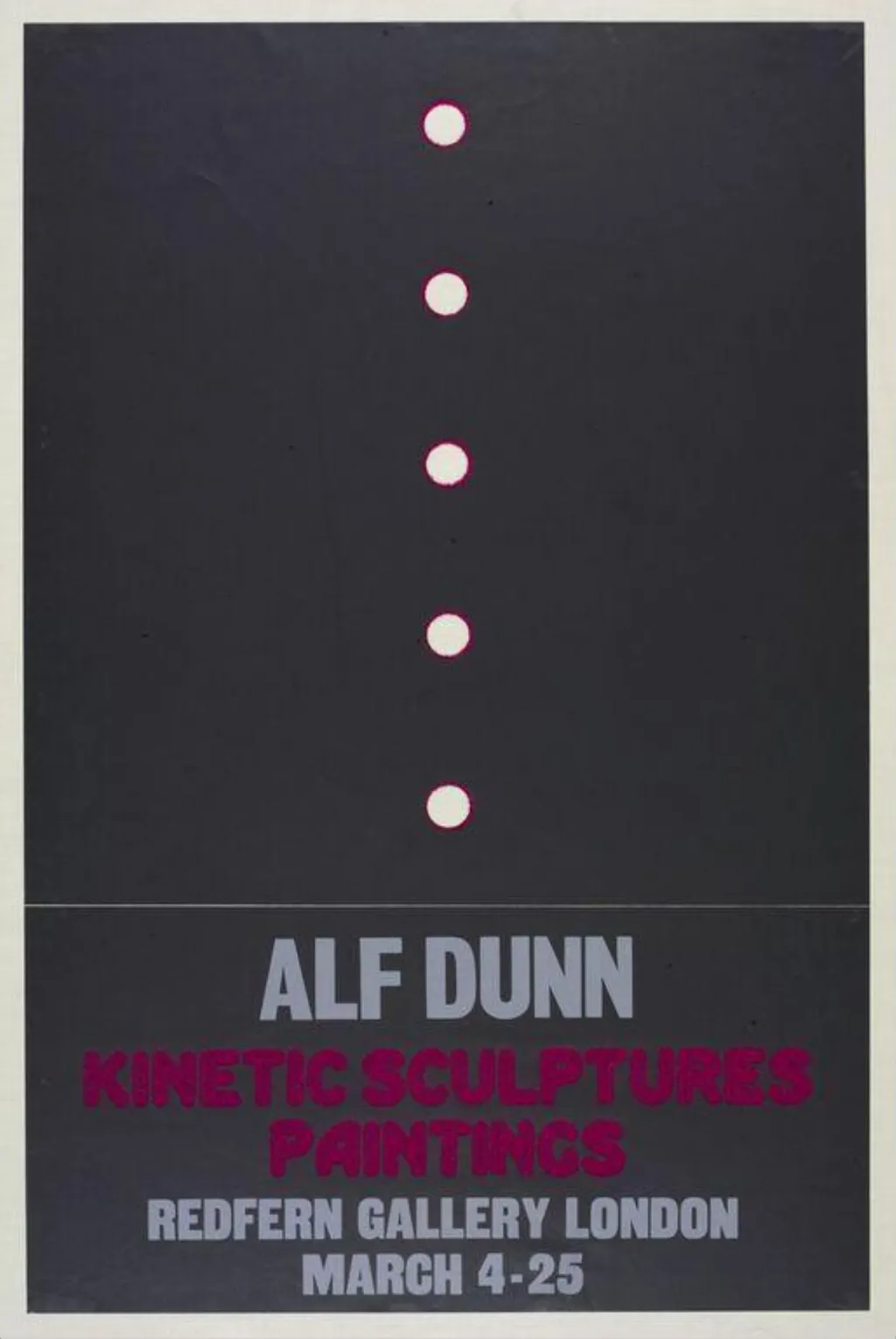
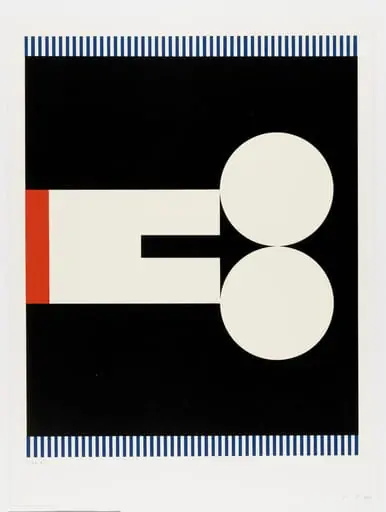
Alf Dunn. Kinetic Sculptures, Paintings is a poster by Alf Dunn. It dates from 1975 and is held in the collection of the Victoria and Albert Museum.
About this work
Overview
Rendered in grey and black ink, the design incorporates cut-out circular voids filled with red flocking, creating five luminous dots aligned horizontally.
A 1975 lithographic poster by Alf Dunn promotes an exhibition of his kinetic sculptures and paintings. Rendered in grey and black ink, the design incorporates cut-out circular voids filled with red flocking, creating five luminous dots aligned horizontally. The stark contrast between the dark ground and the textured red accents draws immediate visual attention, while minimal typography anchors the composition with clarity.
Subject & Meaning
The five red dots suggest motion or energy, evoking the dynamic qualities of Dunn’s kinetic works without depicting them literally. They function as abstract indicators of movement, perhaps referencing mechanical or optical effects in his sculptures. The absence of figurative elements shifts focus to the experience of perception and change, central themes in his artistic practice.
Technique & Style
The poster combines lithographic printing with tactile red flocking applied through cut-out shapes, blending flat graphic design with subtle texture. The use of high-contrast colors, deep background against vivid red and white-pink text, enhances legibility and visual impact. Simplicity in form and restraint in composition reflect the modernist aesthetic of 1970s exhibition graphics.
History & Provenance
Produced for the Redfern Gallery in London, the poster advertised Dunn’s exhibition from March 4 to 25, 1975. As a promotional object, it was likely printed in limited quantities for gallery distribution. Its survival reflects its role in documenting the British art scene of the period, particularly the intersection of kinetic art and gallery promotion in the mid-1970s.
Context
Dunn’s work emerged within a broader British interest in kinetic and op art during the 1960s and 70s, where movement and perception were explored through non-representational forms. The poster’s design aligns with contemporaneous gallery materials that favored clean lines and material experimentation, positioning Dunn’s practice within a dialogue between art, technology, and viewer engagement.
Legacy
The poster remains a tangible artifact of Dunn’s exhibition history and the Redfern Gallery’s role in promoting experimental artists. Its restrained design and use of texture offer insight into how kinetic art was communicated to the public before digital media. It is now held in institutional collections, including the Victoria and Albert Museum, as part of Britain’s graphic design heritage.
Artist & collection
Artist
Alf Dunn’s studio smelled like turpentine and old motor oil because he salvaged gears from broken lawnmowers to make his kinetic sculptures spin.