Artwork
Portrait of Rembrandt
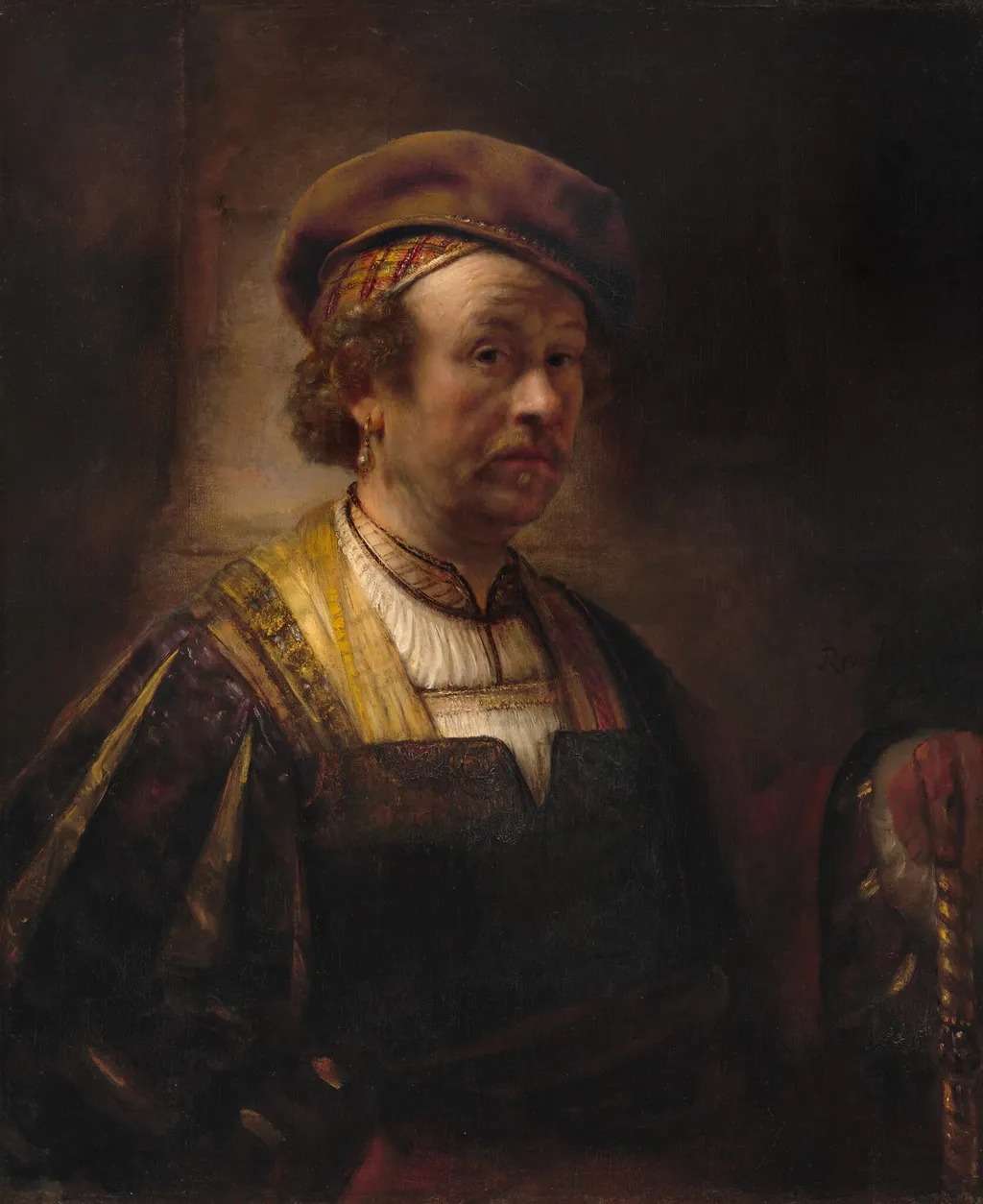
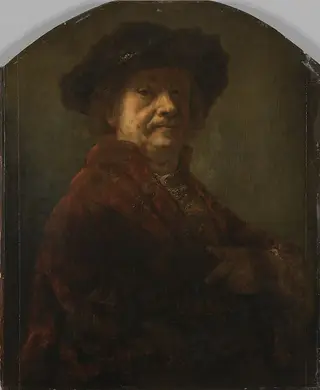
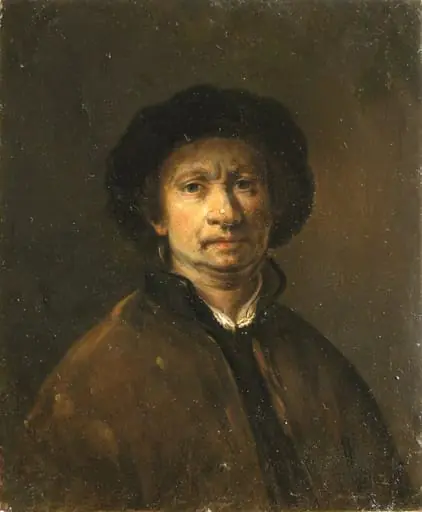
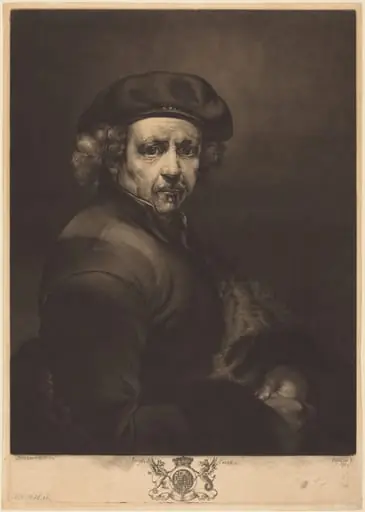
Portrait of Rembrandt is an oil painting. It dates from 1650 and is held in the collection of the National Gallery of Art.
- Inscription
- Inscribed:center right: Rembrandt f. / 1650
About this work
Technique & Style
The work is attributed to the workshop of Rembrandt van Rijn rather than the master himself, depicting the artist as a man.
Created in 1650, this portrait is executed in oil paint on a canvas support, measuring 92 by 75.5 centimeters. The work is attributed to the workshop of Rembrandt van Rijn rather than the master himself, depicting the artist as a man. Stylistically, the painting functions as a self-portrait within the broader genre of portraiture, capturing the subject's likeness through the medium of oil on canvas.
The physical dimensions and material composition align with standard Dutch 17th-century painting practices, utilizing the durability of canvas to render the figure. While the attribution places the hand of execution within the artist's circle, the formal qualities reflect the workshop's engagement with Rembrandt's iconic image and stylistic conventions of the mid-17th century.
History & Provenance
The Portrait of Rembrandt is dated 1650 and executed in oil on canvas. According to the corpus provenance record, the earliest documented owner is Chevalier Sébastien Érard, who held the painting at the Château de la Muette near the Bois de Boulogne in Paris. It appeared at his estate sale, conducted by Lacoste and Coutelier at his residence from 7–14 August 1832 (originally scheduled for 23 April and following days), as lot 119, titled Portrait de Martin-Kappertz-Tromp.
The work subsequently passed to William Williams Hope at Rushton Hall, Northamptonshire, by 1836, and was offered at his Christie & Manson sale on 14–16 June 1849, lot 116, described as a Portrait of Admiral Van Tromp. Sir Anthony Nathan de Rothschild, 1st Bt., later owned the painting at his London residence and Aston Clinton House, Buckinghamshire, after which it passed by inheritance to his wife, Lady Anthony de Rothschild. Through Thos.
Agnew & Sons in London, the work was sold on 13 May 1908 to Peter A.B. Widener at Lynnewood Hall, Elkins Park, Pennsylvania. It descended through the Estate of Peter A.B. Widener by gift through the power of appointment of Joseph E. Widener, and was given in 1942 to the National Gallery of Art.
Context
The 1650 oil on canvas portrait, recorded in the National Gallery of Art, has a documented provenance that traces from Chevalier Sébastien Érard through William Williams Hope, the Rothschild family, and Peter A. B. Widener before its 1942 donation to the museum. Early scholarship, notably John Smith's 1836 catalogue, listed the work as a portrait of Admiral Van Tromp, reflecting contemporary misattributions that later scholarship corrected. Modern catalogues attribute the piece to Rembrandt's workshop and identify it as a self‑portrait, situating it within the artist's broader exploration of likeness and status. Its exhibition history and provenance illustrate the painting's movement across European collections into an American institutional context.
Overview
This oil on canvas painting, titled Portrait of Rembrandt, is a self-representation by the Dutch master. It captures the artist seated, engaging directly with the viewer. This work forms part of a significant series of self-portraits Rembrandt created throughout his career, each offering a glimpse into his evolving persona and artistic journey. The painting serves as a testament to his consistent practice of self-observation.
Subject & Meaning
The artwork depicts Rembrandt himself, seated and adorned in what appears to be everyday or older attire, including a hat. His direct gaze establishes an immediate connection with the observer. Throughout his life, Rembrandt frequently used himself as a subject, meticulously documenting his physical and emotional transformations across various stages.
This particular self-portrait contributes to that extensive visual autobiography, reflecting a specific moment in his personal and artistic development.
Artist & collection