Artwork
The Standard Bearer
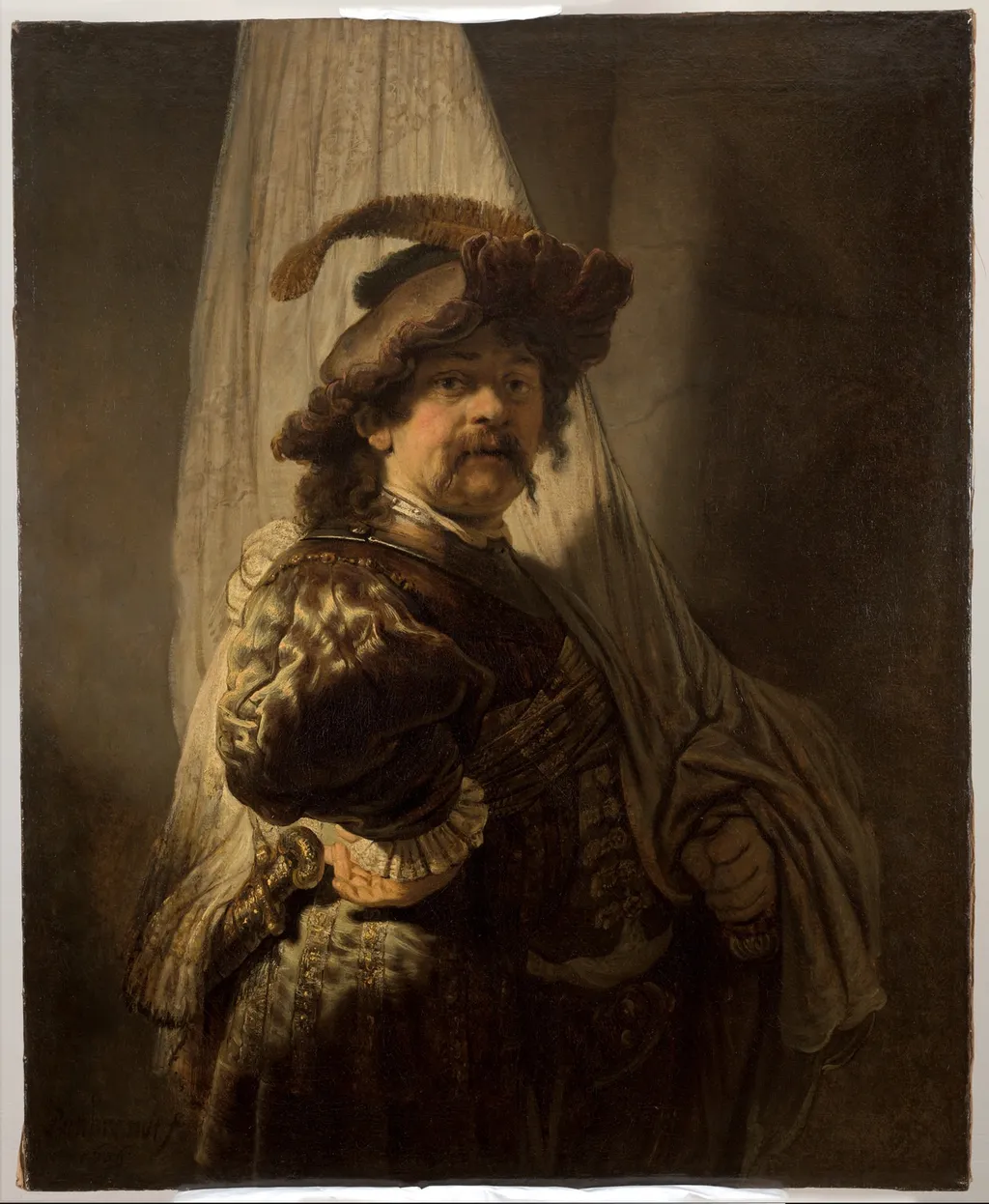
The Standard Bearer is an oil painting by the Dutch Golden Age artist Rembrandt van Rijn. It dates from 1636 and is held in the collection of the Rijksmuseum.
About this work
The Standard Bearer is a three‑quarter‑length self‑portrait by Rembrandt, painted in 1636 with oil paint. It was created when the artist moved from Leiden to Amsterdam.
The work was once in the Paris collection of Elie de Rothschild and was bought by the Rijksmuseum in 2021 for 175 million euros, helped by the Dutch state and Vereniging Rembrandt. It shows Rembrandt’s
Subject & Meaning
The Standard Bearer depicts a half-length figure holding a banner, traditionally identified as a self-portrait of Rembrandt in the guise of an ensign.
The Standard Bearer depicts a half-length figure holding a banner, traditionally identified as a self-portrait of Rembrandt in the guise of an ensign. Painted in 1636, the work is interpreted as a demonstration of the artist's ambition to secure prestigious militia commissions in Amsterdam. The subject's attire is anachronistic, combining sixteenth-century elements like puffed sleeves and a codpiece with a beret rather than the fashionable plumed hat expected of a contemporary standard-bearer.
Only the gorget, sash, and feathers authentically reference the militia role. While many historians view the face as Rembrandt, others argue the features are exaggerated with a thick chin and large drooping mustache, suggesting a dubious or theatrical character rather than a literal likeness. The figure possesses a commanding presence, often compared to an actor captivating an audience.
Technique & Style
The Standard Bearer is an oil painting on canvas created in 1636. Measuring 118.8 cm in height and 96.8 cm in width, the work depicts a three-quarter-length figure. Art historian Piet van Thiel notes that while the composition suggests a rich variety of colors, the palette is actually restricted to a few accents, primarily consisting of browns and grays, with touches of pink and green.
The figure is rendered with 16th-century stylistic elements, including a puffed sleeve and codpiece, alongside period-specific armor like a steel gorget and sash. The handling of light is dramatic, with strong illumination from the left striking the subject's back, face, and the large white banner held on the shoulder. Critics have described the execution as astonishingly virtuosic, capturing an aura comparable to a captivating stage actor.
History & Provenance
Painted in Amsterdam in 1636, this work marks Rembrandt's relocation from Leiden and reflects his ambition to secure militia commissions. Early provenance records suggest possible appearances in 17th-century Delft and Amsterdam inventories, with more definitive tracking beginning in Paris during the 1760s. The painting passed through the collections of Gabriel François Joseph van Verhulst, Pierre Joseph Lafontaine, and François-Antoine Robit before entering the possession of King George IV of the United Kingdom.
Following an exchange with Lafontaine, it was acquired by Sir Simon Haughton Clarke and subsequently sold at auction in 1840 to James Mayer de Rothschild. The work remained in the Rothschild family lineage, eventually held by Élie de Rothschild, until 2022. After a French export ban expired in 2021, the Dutch State purchased the painting for €175 million with support from the Rembrandt Association, transferring ownership to the Rijksmuseum.
The Standard Bearer is currently held by the Rijksmuseum in Amsterdam, where it was acquired on January 21, 2022, for 175 million euros. The work entered the museum's collection following a purchase by the Dutch state, supported by the Vereniging Rembrandt and the Rijksmuseum itself, from the Rothschild family trust. Prior to this acquisition, the painting was part of the Paris collection of Élie de Rothschild.
The artwork was classified as a French national treasure in 2019, which triggered a 30-month export ban while French institutions attempted to secure funding. Before its permanent installation in the Rijksmuseum's Gallery of Honour, the painting toured twelve museums across all Dutch provinces between April 2022 and 2023. Earlier exhibition history includes appearances at the British Institution in London in 1819 and 1836.
Context
The Standard Bearer (1636) is a three‑quarter‑length self‑portrait in oil that marks Rembrandt’s move from Leiden to Amsterdam and his ambition to secure a major militia commission. Contemporary scholarship notes its rich colour scheme limited to muted browns, grays, pinks and greens, and debates whether the figure represents a generic standard‑bearer or a self‑portrait, with art historian Eric Jan Sluijter rejecting the identification while Piet van Thiel praises its ‘actor‑like’ presence. The work entered the Rothschild collection, was classified as a French national treasure, and was acquired by the Dutch state in 2022 for €175 million, later touring the Netherlands.
Its provenance spans 18th‑century sales, royal ownership, and a contested export bar, underscoring its significance in both art‑historical and market contexts.
Legacy
Since its first recorded appearance in mid-eighteenth-century Paris sales, The Standard Bearer has been treated as a self-portrait in character, cited by early cataloguers including John Smith and later by Cornelis Hofstede de Groot, though modern scholars remain divided on its status as a literal self-representation. The work’s dramatic staging and bravura handling were praised by Piet van Thiel, who in 1991 called it one of Rembrandt’s most brilliant creations and likened its effect to an actor’s magnetic stage presence.
Its reputation as an early milestone in Rembrandt’s Amsterdam ambitions was reinforced in recent decades, but Eric Jan Sluijter contested this view in 2022, arguing that the painting is not a breakthrough work or an unchallenged masterpiece and lacks the status often claimed for it. The painting’s 2021–2022 acquisition by the Rijksmuseum for €175 million, facilitated by the Dutch state and the Vereniging Rembrandt, transformed its legacy into a focal point of twenty-first-century cultural policy debates about public value, cost, and national patrimony.
Overview
Rembrandt's 1636 oil painting, The Standard Bearer, is a three-quarter-length self-portrait. Created around the time of his relocation from Leiden to Amsterdam, this work is considered a significant early example of his artistic development. It signals his aspirations within the Amsterdam art scene, particularly his interest in securing prestigious commissions for civic guard portraits.
Own this work as a print
Artist & collection

Artist
Rembrandt Harmenszoon van Rijn, known mononymously as Rembrandt, was a Dutch Golden Age painter, printmaker, and draughtsman.