Artwork
Geese
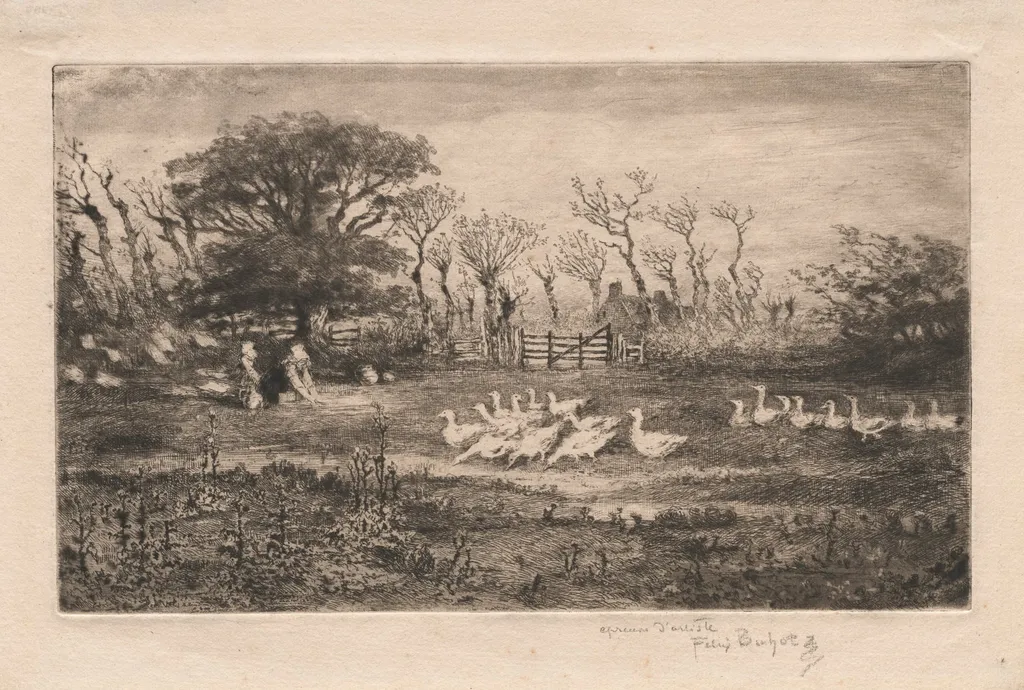
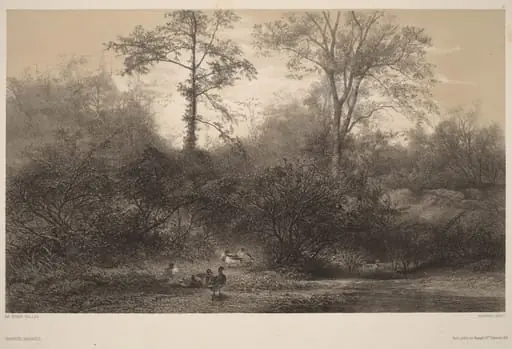
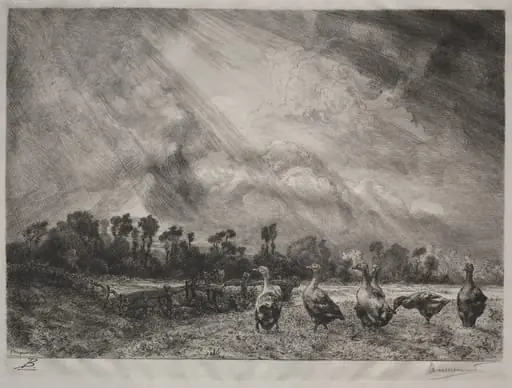
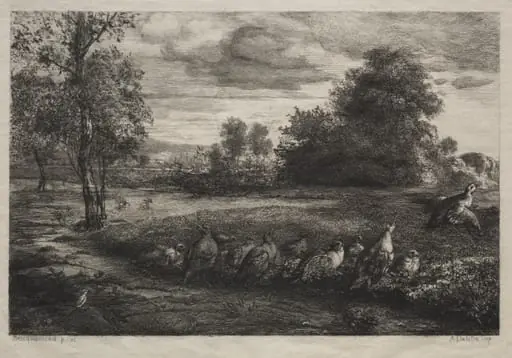
Geese is a print by the Impressionist artist Félix-Hilaire Buhot. It dates from 1887 and is held in the collection of the Cleveland Museum of Art.
- Accession no.
- 2009.523
- Credit line
- Gift of John Bonebrake
About this work
Overview
Geese is a monochrome print by Félix Hilaire Buhot, dated 1887. Executed in ink or charcoal, the work captures a rural moment with minimal detail and no color. It resides in The Cleveland Museum of Art’s collection, reflecting Buhot’s interest in quiet, unidealized scenes of French countryside life. The composition avoids dramatic elements, favoring stillness and observation.
Subject & Meaning
The print centers on a flock of geese gathered near a wooden fence, their forms rendered with subtle, flowing lines. Behind them, sparse trees and a distant building suggest a working farm, while the muddy ground grounds the scene in physical reality. There is no narrative or symbolism, only the ordinary rhythm of animals in their environment, emphasizing the dignity of everyday rural existence.
Technique & Style
Buhot employed soft, dark linear strokes to define forms without shading or tone gradients. The absence of color and the restrained line work create a sense of immediacy, as if the scene were sketched on-site. The technique prioritizes clarity and economy, allowing the arrangement of figures and structures to convey spatial depth without embellishment.
History & Provenance
Created in 1887, the print emerged during Buhot’s mature period, when he focused on urban and rural scenes through printmaking. It entered The Cleveland Museum of Art’s collection through established acquisition channels, likely as part of a broader interest in 19th-century French graphic art. Its preservation reflects its value as a representative example of the artist’s observational approach.
Context
Buhot worked alongside other Realist and Naturalist artists who turned away from romanticized subjects in favor of ordinary life. In an era of industrial change, his prints documented fading rural routines with quiet precision. Geese aligns with this movement, offering a non-idealized view of agricultural life that resonated with contemporary audiences seeking authenticity.
Legacy
The print endures as a quiet example of late 19th-century French graphic art, valued for its restraint and attention to detail. While not widely reproduced, it contributes to scholarly understanding of Buhot’s role in elevating printmaking as a medium for everyday observation. Its presence in a major museum underscores its significance within the broader context of Realist visual culture.
Own this work as a print
Artist & collection
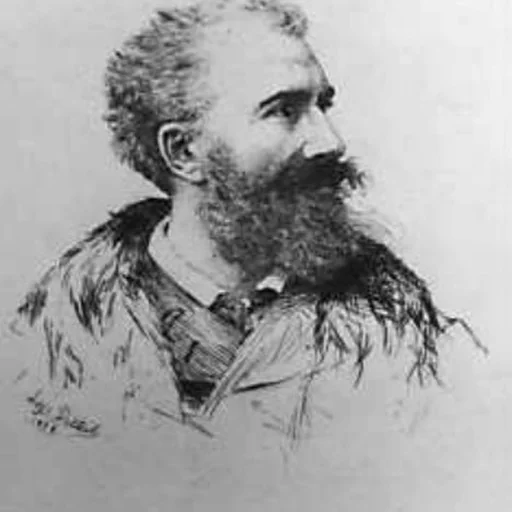

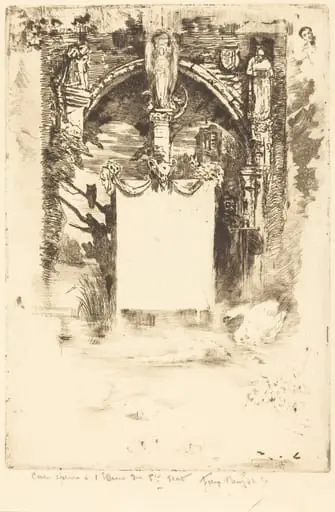 Ex-Libris pour "L'Ensorcelée" (Bookplate for "L'Ensorcelée")
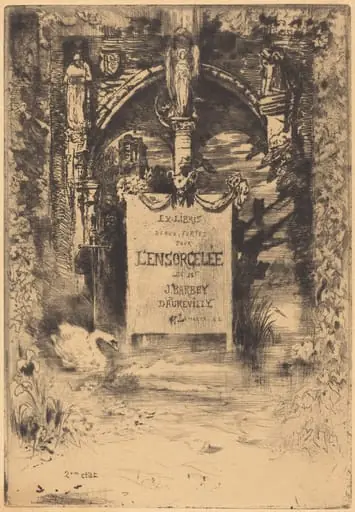 Ex-Libris pour "L'Ensorcelée" (Bookplate for "L'Ensorcelée")
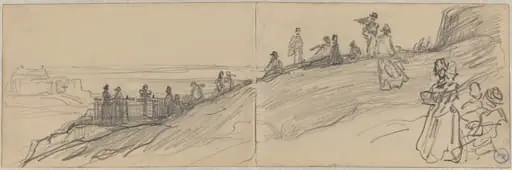 Figures on Top of a Hill, Overlooking the Sea
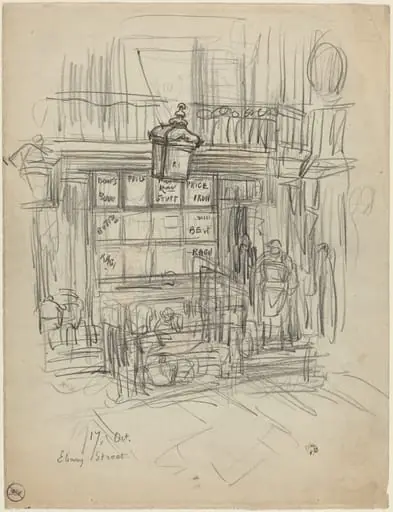 Ebury Street
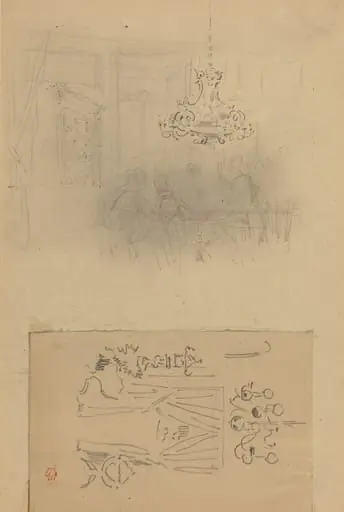 A Gathering in an Interior; A Curtained Doorway
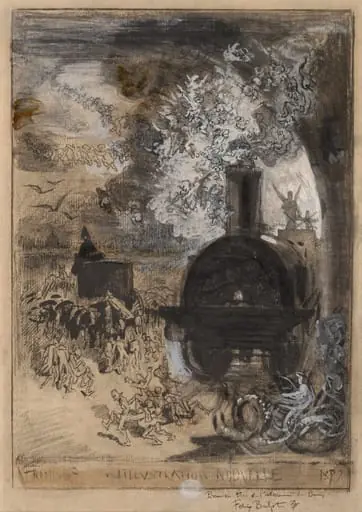 Frontispiece for L'Illustration Nouvelle: The Burial of the Burin
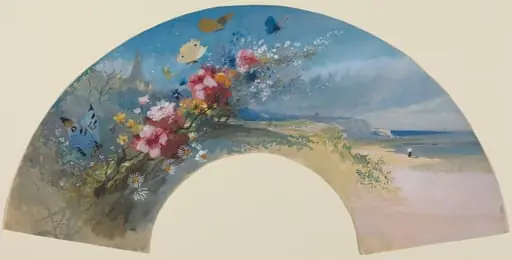 Fan with Wildflowers and Butterflies against the Norman Coast
![Gillingham Pier, London [verso], by Félix-Hilaire Buhot](https://artifactworldgallery.com/img/felix-hilaire-buhot--gillingham-pier-london-verso--641e03dd7de8217b-w320.webp) Gillingham Pier, London [verso]
Gillingham Pier, London [verso]