Artwork
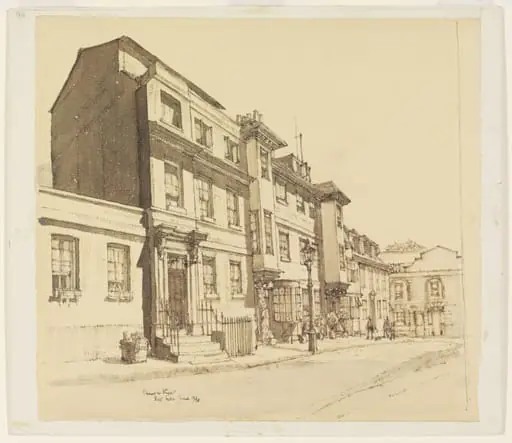
Brunswick Terrace, Windsor
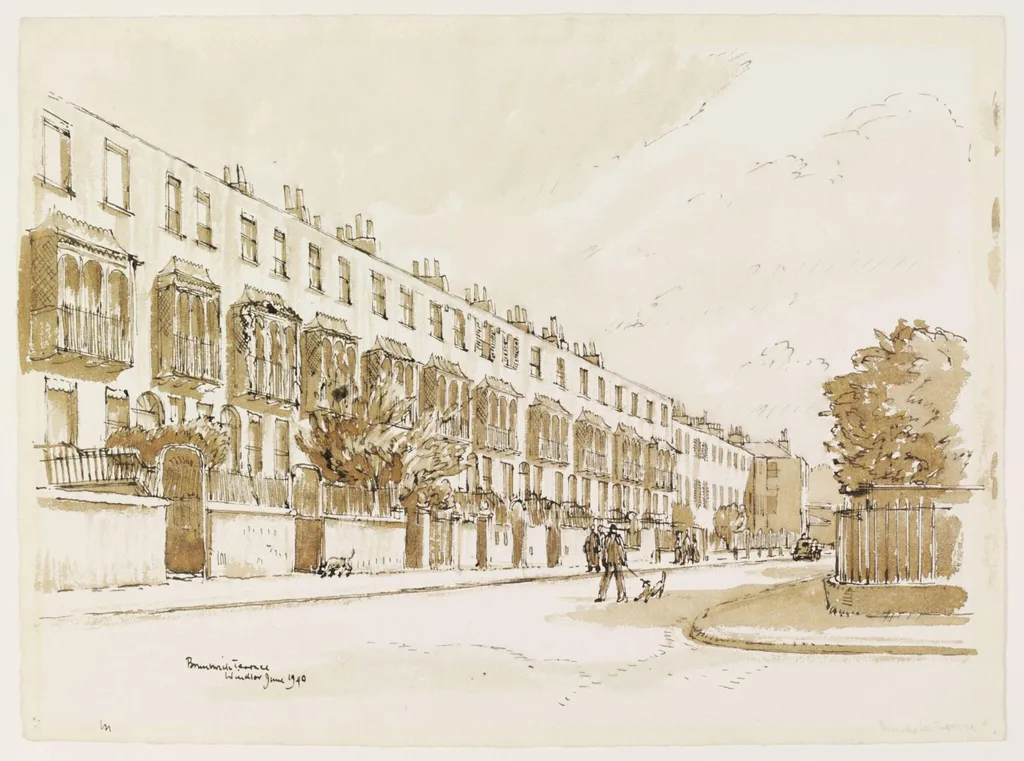
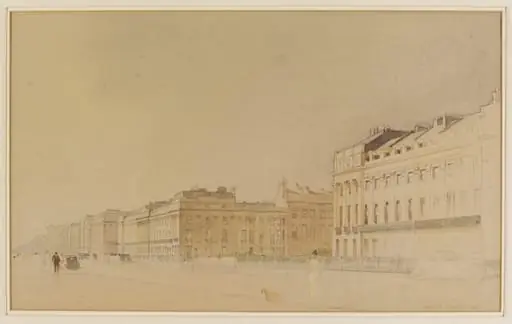
Brunswick Terrace, Windsor is a watercolor work on paper by the Social Realist artist Fairclough. It dates from 1940 and is held in the collection of the Victoria and Albert Museum. The work is a watercolour executed in June 1940 that records Brunswick Terrace, a row of Georgian townhouses on a Windsor street.
About this work
Trees with sparse branches line the street, and the whole scene feels calm and a little old-fashioned.
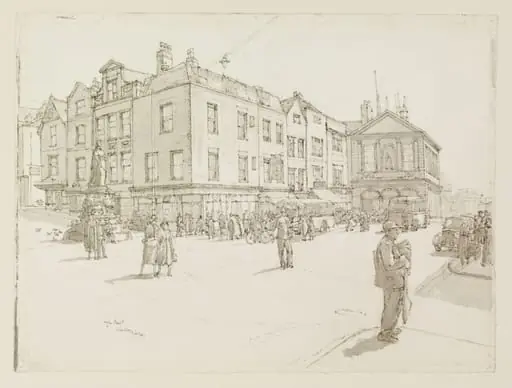
This sketch shows a quiet street lined with tall, narrow houses. Each building has three floors, big windows with shutters, and small balconies. A few people walk on the sidewalk, and a horse-drawn carriage sits parked. Trees with sparse branches line the street, and the whole scene feels calm and a little old-fashioned.
The artist signed it "Brunswick Terrace, Windsor" in June 1940, so this is a real place in England. The loose, sketchy lines make it feel like a quick snapshot rather than a polished drawing.
Next, check out the Victoria and Albert Museum to see more works like this.
Overview
The work is a watercolour executed in June 1940 that records Brunswick Terrace, a row of Georgian townhouses on a Windsor street. Rendered with swift, sketch‑like lines, the image captures a tranquil urban scene: three‑storey façades with large windows, shutters and modest balconies, a few pedestrians, a stationary horse‑drawn carriage, and sparsely leafed trees lining the road.
Subject & Meaning
The composition presents a quiet, slightly nostalgic view of a historic residential street, emphasizing the orderly rhythm of the terrace and the everyday life of its occupants. By focusing on ordinary architecture and a calm street atmosphere, the picture underscores the value of preserving commonplace yet culturally significant environments.
Technique & Style
Executed in watercolour, the artist employs loose, gestural strokes that convey immediacy rather than meticulous detail. The palette is restrained, allowing the tonal contrasts of light and shadow to define the building masses. The sketchy handling suggests a rapid on‑site study, typical of wartime documentary art.
History & Provenance
Created as part of the Recording Britain project, the piece was commissioned by the Pilgrim Trust and overseen by Sir Kenneth Clark. The initiative mobilised nearly a hundred artists between 1940 and 1943 to document sites thought vulnerable to wartime damage or social change, resulting in over 1,500 works.
Context
During the early years of the Second World War, many British locales faced the threat of aerial bombing and urban transformation. Recording Britain aimed to capture a visual archive of the nation’s architectural heritage before it could be altered or destroyed, providing a reference for future generations.
Artist & collection
Artist
Fairclough is a surname. A variant form is Faircloth. Notable people with the surname include:Adam Fairclough (historian), British historian of the United States Anna Fairclough, member of the Alaska House of…