Artwork
The Massacre of the Innocents
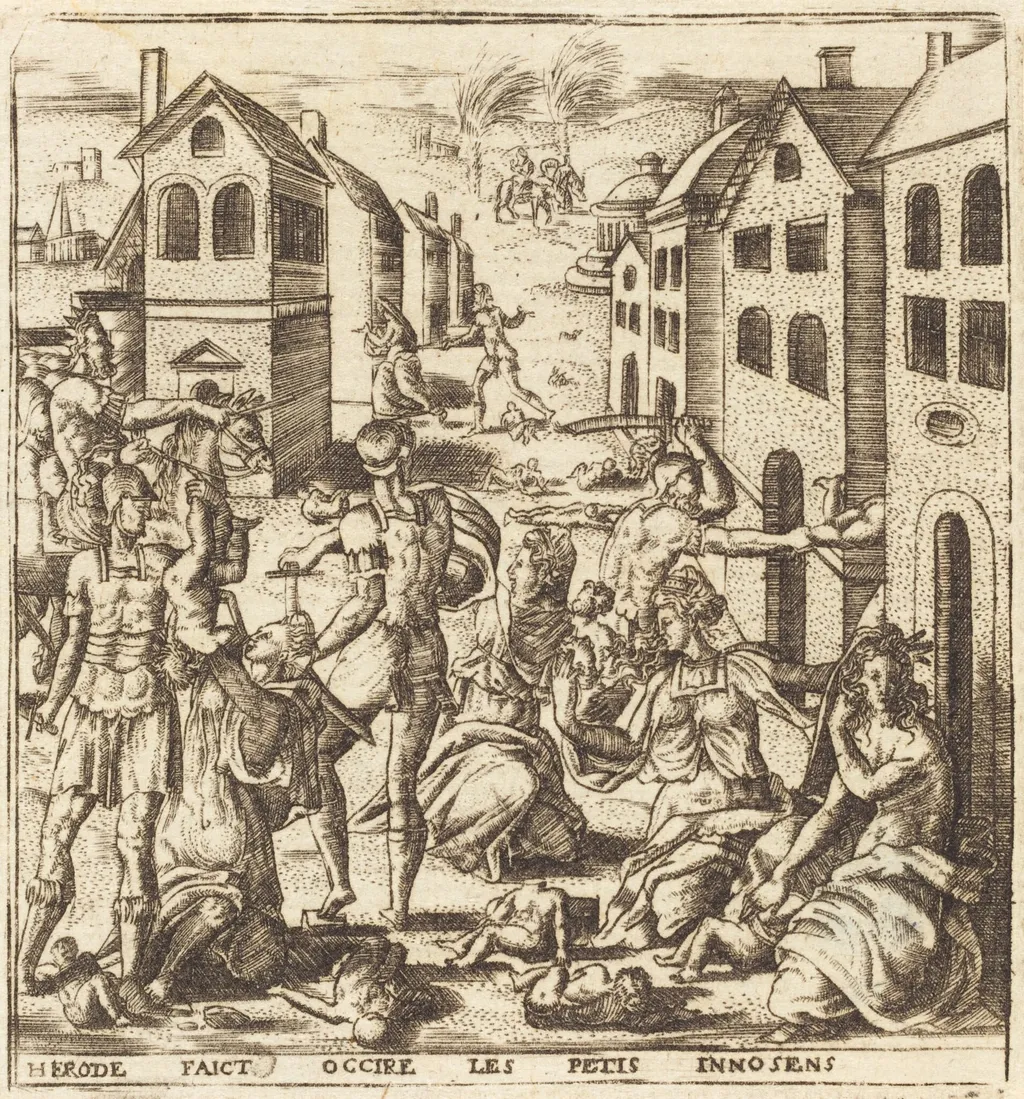
The Massacre of the Innocents is an ink print by the Renaissance artist Léonard Gaultier. It dates from 1578 and is held in the collection of the National Gallery of Art.
- Inscription
- Inscribed:in plate in lower margin: HERODE FAICT OCCIRE LES PETIS INNOSENS
About this work
Overview
Around 1578 Léonard Gaultier, a French engraver active in Paris, produced an engraving titled The Massacre of the Innocents. Executed entirely with a graver, the print measures a modest size yet conveys a densely populated urban scene in which soldiers on horseback storm a town, while civilians scramble, collapse, and clutch one another amid tightly packed architecture.
Subject & Meaning
The image visualises the biblical episode in which King Herod orders the killing of newborn children in Bethlehem. Gaultier emphasizes the chaos and brutality of the event: soldiers trample the streets, a mother clings to her infant, a basket bearing a baby drifts in the river, and bodies lie scattered, underscoring the tragic loss of innocence.
Technique & Style
The work is rendered in precise, incised linework characteristic of late‑sixteenth‑century Northern European engraving. Gaultier employs a formal, somewhat rigid composition reminiscent of the Wierix and Crispyn van de Passe families, filling the plate with intricate details, individual faces, armor, and architectural elements, through careful manipulation of the graver.
History & Provenance
Born near Mainz in 1561, Gaultier spent most of his career in Paris, where he produced a range of religious and portrait prints. He signed his plates in several variations of his name, a practice common among printmakers of the period. The Massacre of the Innocents survives in several museum collections, reflecting its circulation among collectors of devotional imagery.
Context
The engraving belongs to a broader tradition of Reformation‑era visualizations of biblical violence, intended both as moral instruction and as a demonstration of the engraver’s technical skill. By depicting a well‑known scriptural narrative with vivid detail, Gaultier aligned his work with contemporary devotional prints that circulated widely across Europe.
Own this work as a print
Artist & collection
Artist
Léonard Gaultier, or, as he sometimes signed himself, Galter, a French engraver, was born at Mainz about 1561, and died in Paris in 1641.