Artwork
Visitation - Saint Benedict altarpiece
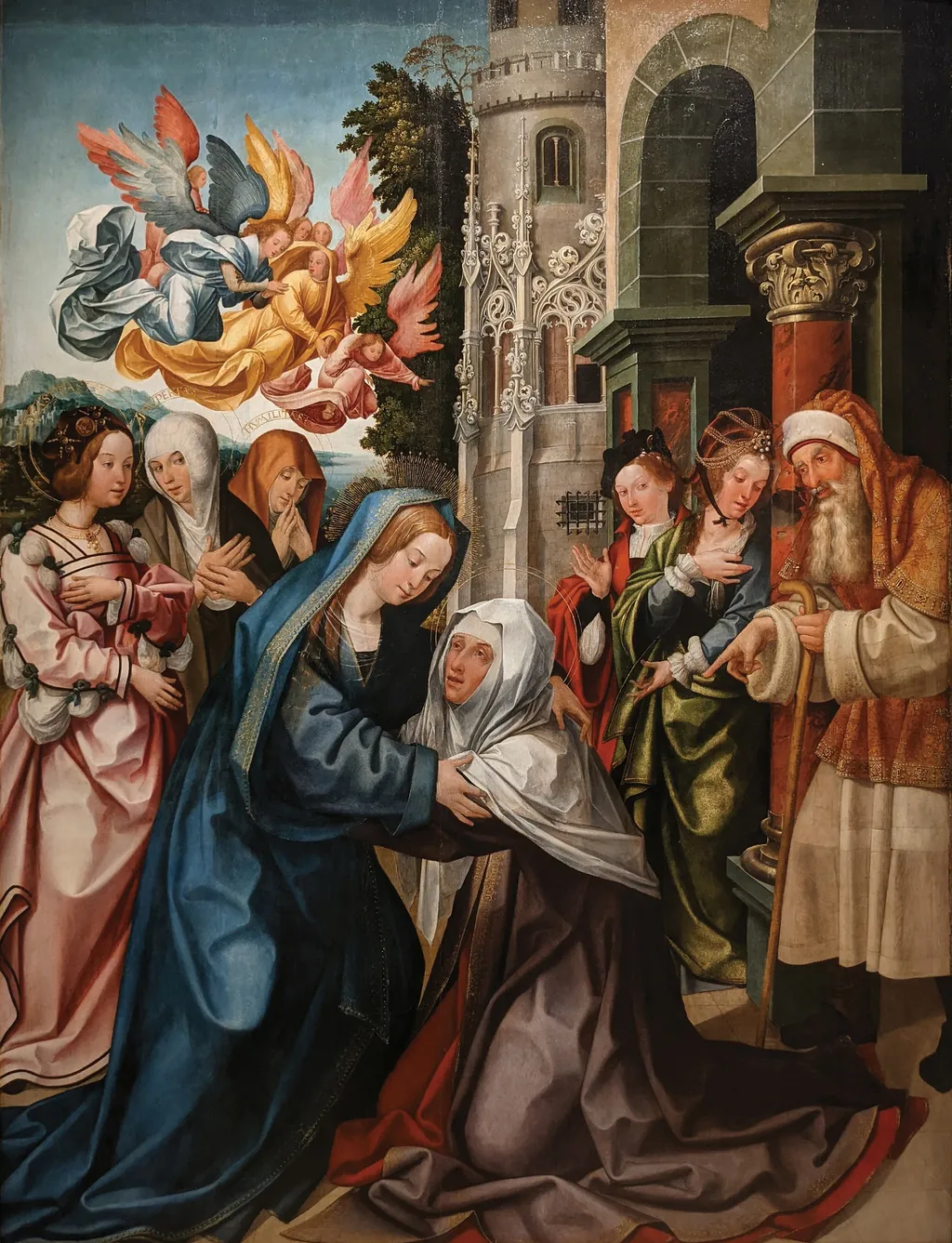
Visitation - Saint Benedict altarpiece is an unspecified painting by the Northern Renaissance artist Gregório Lopes. It dates from 1520 and is held in the collection of the National Museum of Ancient Art.
About this work
Overview
Gregório Lopes's 'Visitation,' executed in 1520 as part of the Saint Benedict altarpiece, illustrates the biblical encounter between the Virgin Mary and her cousin Elizabeth. The composition adheres to the High Renaissance ideals prevalent in Portuguese painting of the early 16th century, balancing religious narrative with a structured, architectural setting. The figures are positioned before a stone building featuring an arched doorway, with a tower visible in the distant landscape, grounding the sacred event in a tangible, albeit idealized, environment.
Lopes renders the two central women with a focus on their physical states; Mary is depicted as pregnant, while Elizabeth, also expecting, receives her visitor with a gesture of recognition and reverence. The artist employs a palette characteristic of his workshop, utilizing rich earth tones and deep blues to define the drapery and distinguish the holy figures from the surrounding attendants. This work exemplifies Lopes's role as the leading court painter of King Manuel I, demonstrating his ability to synthesize Flemish attention to detail with Italianate compositional harmony.
As a key panel of the Saint Benedict altarpiece, it served a liturgical function within a monastic context, reinforcing the spiritual significance of the Visitation for the Benedictine order.
Subject & Meaning
At the centre of the composition stand Mary and Elizabeth, their gestures conveying mutual reverence and anticipation. Surrounding them are attendants, including an elderly bearded figure and a woman cradling an infant, underscoring the familial and communal dimensions of the encounter.
Technique & Style
Lopes employs a restrained palette of blues, greens and earth tones, allowing subtle tonal shifts to model the figures. Light falls from the left, casting gentle shadows that give the stone architecture and the figures a three‑dimensional presence, while the balanced arrangement creates a calm, harmonious visual field.
History & Provenance
Originally commissioned for the Saint Benedict altar, the panel remained in ecclesiastical use before entering the national collection. Its transfer to the National Museum of Ancient Art reflects the broader 20th‑century effort to preserve Portugal’s Renaissance heritage within a public institution.
Context
The Visitation was a popular subject in Portuguese liturgical art, symbolising the fulfillment of prophecy and the link between the Old and New Testaments. Lopes, a leading painter of the Lisbon school, integrated Italianate influences with local devotional conventions, situating the scene within a recognizable architectural setting.
Own this work as a print
Artist & collection