Artwork
The Death of Cleopatra
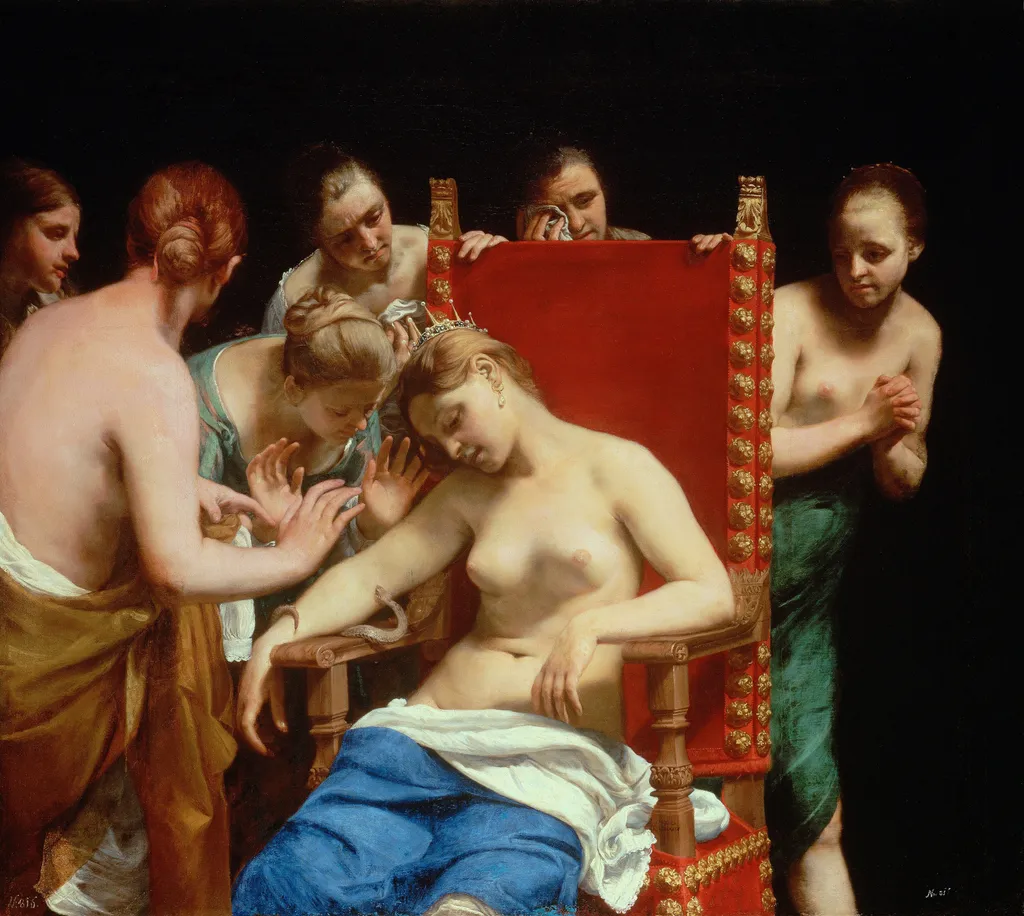
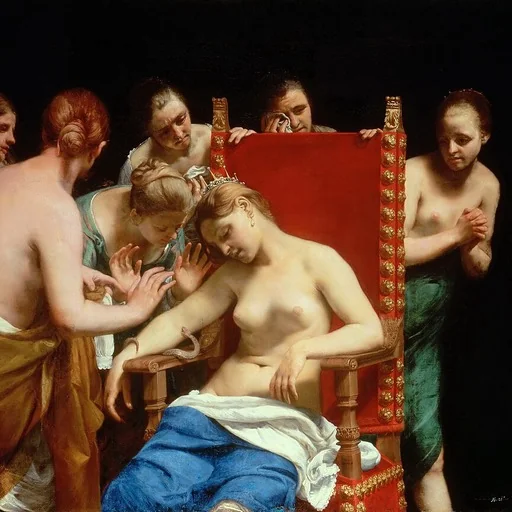
The Death of Cleopatra is an oil painting by Guido Cagnacci. It dates from 1661 and is held in the collection of the Kunsthistorisches Museum.
About this work
Subject & Meaning
The composition emphasizes Cleopatra’s exposed torso, rendered bare to the waist as she sits in a red fauteuil, her body angled forward in agony.
Cagnacci’s The Death of Cleopatra (1661) depicts the queen’s suicide, aligning with historical accounts of her death by asp bite. The composition emphasizes Cleopatra’s exposed torso, rendered bare to the waist as she sits in a red fauteuil, her body angled forward in agony. A venomous serpent coils around her right arm, biting her breast, a detail consistent with ancient descriptions of her fatal embrace of the asp.
Six female attendants surround her, their expressions conveying sorrow and shock, reinforcing the scene’s emotional weight. The stark black background isolates the figures, heightening the drama of the moment. The painting’s iconography, Cleopatra’s nudity, the asp, and her regal crown, conveys themes of power, mortality, and the tragic consequences of political defeat. The work’s composition and symbolism reflect Baroque sensibilities, merging historical narrative with heightened emotional intensity.
Technique & Style
Executed between 1661 and 1662, this history painting by Guido Cagnacci is realized in oil on canvas. The work features a nearly square horizontal format, measuring 153 by 169 centimeters. Stylistically, the composition employs a stark contrast between a deep black background and the illuminated figures, focusing attention on the central narrative.
The scene depicts the suicide of Cleopatra seated in a red armchair, her upper body exposed, surrounded by six attendants. The artist renders the moment the venomous snake coils around the queen's right arm, capturing a specific instance of agony. The handling of the medium allows for detailed representation of textures, from the fabric of the dress to the physical distress of the subjects, characteristic of the genre's dramatic intensity.
History & Provenance
Guido Cagnacci executed this oil on canvas history painting, titled The Death of Cleopatra, in Vienna during 1661, with some accounts extending the creation period into 1662. The work was commissioned for or acquired by the collection of Archduke Leopold Wilhelm of Habsburg. It has remained within the holdings of the Kunsthistorisches Museum in Vienna, Austria, since its inception.
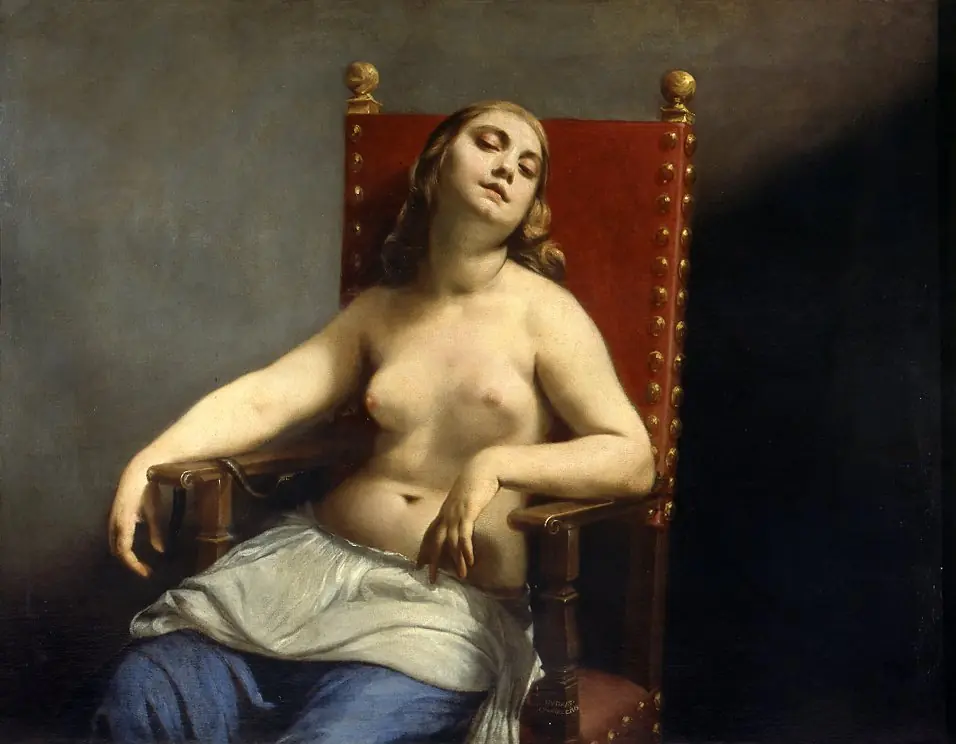
This specific composition, which depicts the Egyptian queen surrounded by six attendants, is distinct from a slightly earlier version by Cagnacci housed in the Pinacoteca di Brera in Milan that portrays the subject in isolation.
Overview
This oil painting, titled The Death of Cleopatra, depicts a pivotal moment from antiquity. At its center, a woman reclines on a red couch, seemingly lifeless, enveloped in blue fabric. Five other figures surround her, their postures conveying a range of emotions from concern to profound grief.
The composition uses dramatic illumination to highlight the central drama, drawing attention to the pale figure and the reactions of those present. A small serpent near her arm subtly indicates the cause of the tragic event.
Own this work as a print
Artist & collection
Artist
Guido Cagnacci (Italian:; 13 January 1601 – 1663) was an Italian Baroque painter originally from Santarcangelo di Romagna.