Artwork
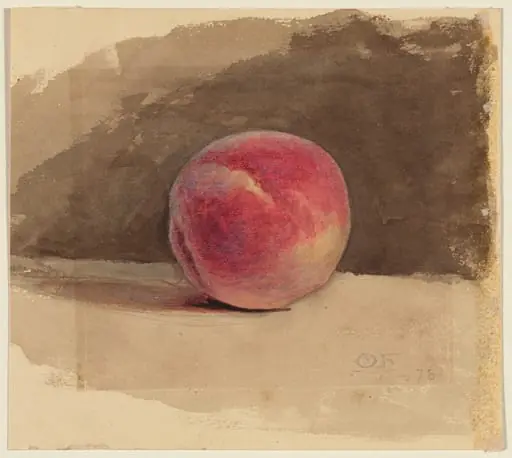
A Peach, Seville
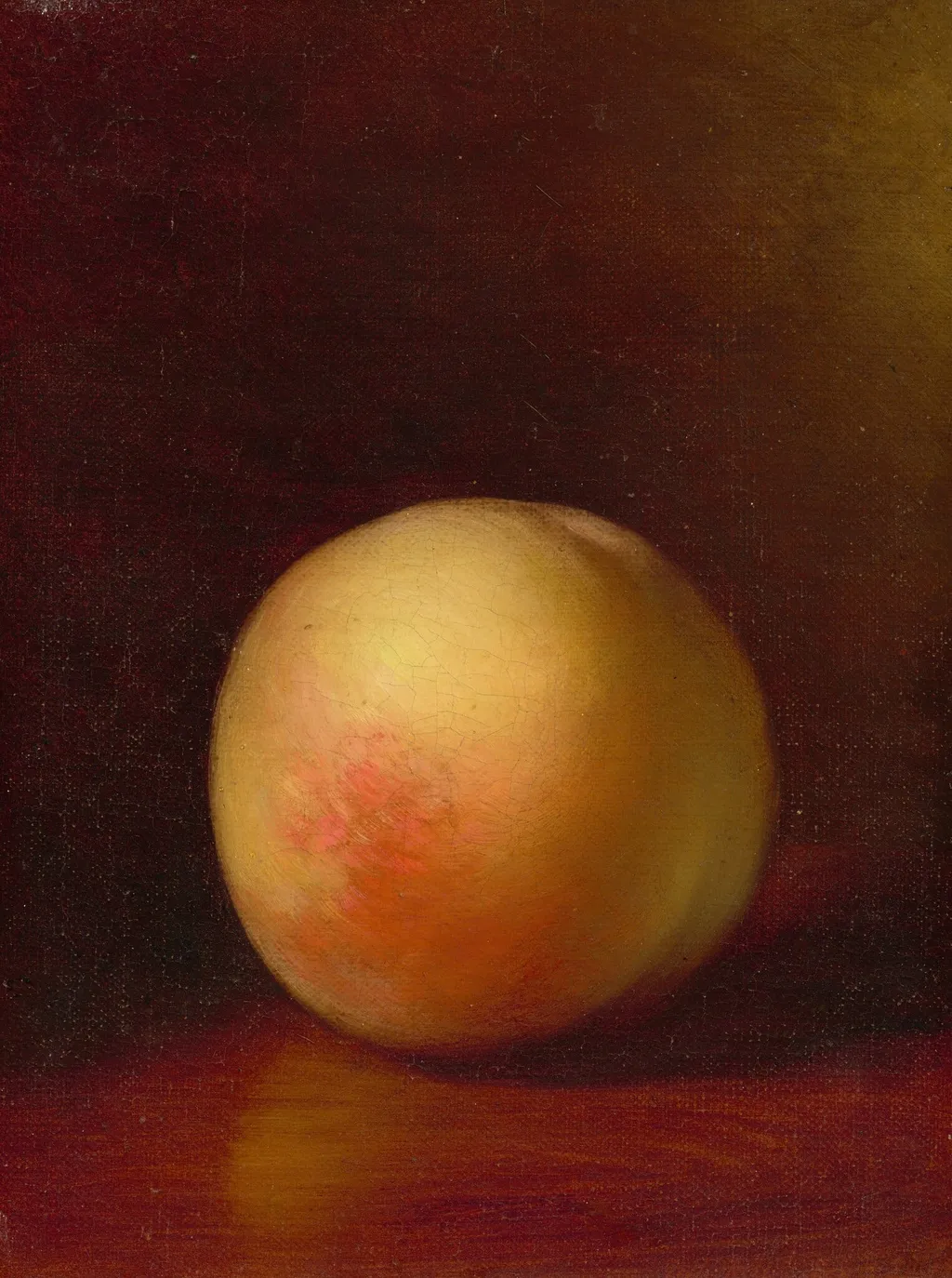
A Peach, Seville is an oil painting by the Impressionist artist George Henry Hall. It dates from 1866 and is held in the collection of the National Gallery of Art.
- Inscription
- Inscribed:lower right: H. Hall Sept. 24th, Seville 1866
About this work
Technique & Style
The handling of the medium demonstrates a smooth finish, emphasizing the texture and color of the fruit through careful modulation of light and shadow.
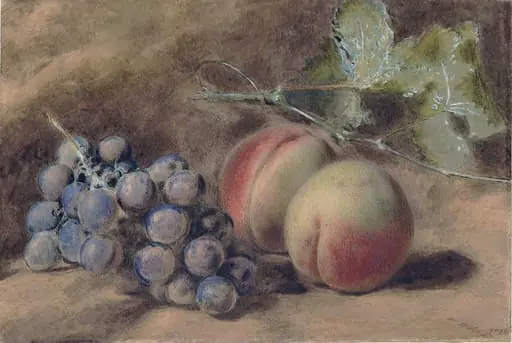
Executed in 1866, this work is an oil painting on canvas. The composition features a solitary peach rendered with precise naturalism against a dark, undefined background, characteristic of the artist's still-life approach. The support measures approximately 20.32 cm in height and 15.56 cm in width.
The handling of the medium demonstrates a smooth finish, emphasizing the texture and color of the fruit through careful modulation of light and shadow.
History & Provenance
The painting was owned by William H. Gerdts by at least 1965 and later gifted to the National Gallery of Art in 2018, where it remains in the collection. It was created by George Henry Hall in 1866 as an oil on canvas work, and was exhibited around 1965 at the American Federation of the Arts in New York according to Gerdts' records.
A Peach, Seville has been in the collection of the National Gallery of Art in Washington, D.C. since 2018, when it was given as a gift by William H. Gerdts [1929–2020] of New York, who had owned the painting by at least 1965. Before entering the National Gallery, the work was lent by Gerdts to an exhibition held circa 1965 at the American Federation of Arts in New York, according to documentation in the NGA curatorial files.
The painting's dimensions are recorded as 20.32 cm in height by 15.56 cm in width.
Overview
George Henry Hall’s 1866 oil painting titled A Peach, Seville presents a solitary peach perched on a flat stone ledge. Rendered in a modestly sized canvas, the work exemplifies the Realist focus on everyday subjects, capturing the fruit with precise, naturalistic detail.
Subject & Meaning
The composition isolates a single, ripe peach, allowing the viewer to contemplate its texture, color, and form. By emphasizing the fruit’s tactile qualities, Hall invites a quiet, meditative engagement with an ordinary object, a common aim of 19th‑century realist still lifes.
Context
In the mid‑1800s, still‑life paintings of food served both as demonstrations of technical skill and as reflections on the material world. Hall’s focus on a single fruit aligns with this tradition, positioning the work within a broader realist discourse that valued accurate observation over allegorical content.
Own this work as a print
Artist & collection

Artist
George Henry Hall (1825–1913) was an American still-life and landscape artist. He studied art in Düsseldorf and Paris and he worked and lived in New York City, the Catskills of New York and in Europe. His works are in…