Artwork
Lemons
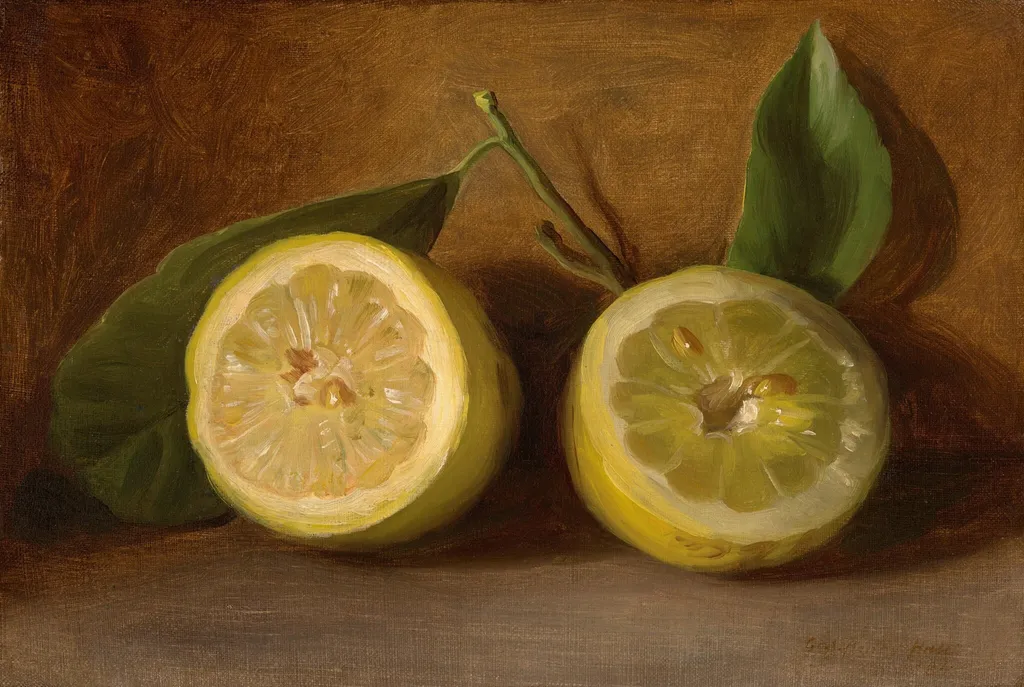
Lemons is an oil painting by the Impressionist artist George Henry Hall. It dates from 1884 and is held in the collection of the National Gallery of Art.
- Inscription
- Inscribed:lower right: Geo. Henry Hall / '84
About this work
George Henry Hall painted three bright lemons on a wooden table in 1884. The skin looks ready to burst with juice. One sits in full light. The other two half hide in shadow.
Hall loved still lifes like this. He often painted everyday foods. Some say his work feels like a quiet study of abundance.
Want more like this? Check out Hall, George Henry.
Technique & Style
No further specific details regarding the artist's handling, brushwork, or current physical condition are provided in the available records.
George Henry Hall executed Lemons in 1884 using oil paint on a canvas support. The work measures 16.51 cm in height and 24.13 cm in width. The painting underwent conservation treatment in 1990 or 1991 while in the collection of William H. and Abigail Booth Gerdts before being gifted to the National Gallery of Art in 2018.
No further specific details regarding the artist's handling, brushwork, or current physical condition are provided in the available records.
History & Provenance
George Henry Hall completed the oil painting Lemons in 1884. The work entered the collection of William H. and Abigail Booth Gerdts in New York no later than 1991, a timeframe supported by documentation noting conservation treatment during those years. In 2018, the Gerdts family gifted the painting to the National Gallery of Art in Washington, D.C., where it remains part of the permanent collection.
The painting Lemons by George Henry Hall is held in the collection of the National Gallery of Art in Washington, D.C., with the accession number 2018.143.1. It entered the museum through a gift from Abigail Booth Gerdts in 2018, following its provenance from William H. Gerdts and Abigail Booth Gerdts by 1990/1991. The work has not been documented in major exhibition histories beyond its acquisition and conservation treatment noted in 1990/1991.
Legacy
The painting Lemons by George Henry Hall exerted quiet influence on American still-life developments in the early twentieth century, particularly through its formal clarity and treatment of light that informed subsequent realist traditions. Its acquisition by the National Gallery of Art in 2018 established it as a touchstone for scholarly reexamination of Hall’s contribution to the genre, and conservation records from 1990–1991 revealed earlier ownership by William H. Gerdts and Abigail Booth Gerdts, underscoring its provenance significance.
The work is held in the permanent collection of the National Gallery of Art in Washington, D.C., where it is displayed as a representative example of late nineteenth-century American realism.
Overview
George Henry Hall’s 1884 oil painting Lemons presents three vivid citrus fruits arranged on a wooden tabletop. The composition balances light and shadow, with one lemon fully illuminated while the other two are partially obscured, emphasizing texture and the potential juiciness of their skins.
Subject & Meaning
The work exemplifies a quiet examination of everyday abundance, focusing on commonplace food items rendered with careful observation. By isolating the lemons, Hall invites contemplation of ordinary objects as subjects worthy of artistic attention.
Context
Created during a period when Realist artists turned to domestic subjects, the painting reflects a broader shift away from grand historical narratives toward the meticulous depiction of daily life. Hall’s European training informed his approach to composition and tonal control.
Own this work as a print
Artist & collection

Artist
George Henry Hall (1825–1913) was an American still-life and landscape artist. He studied art in Düsseldorf and Paris and he worked and lived in New York City, the Catskills of New York and in Europe. His works are in…