Artwork
A Sperm Whale Washed up on the Beach at Noordwijk, 28 December 1614
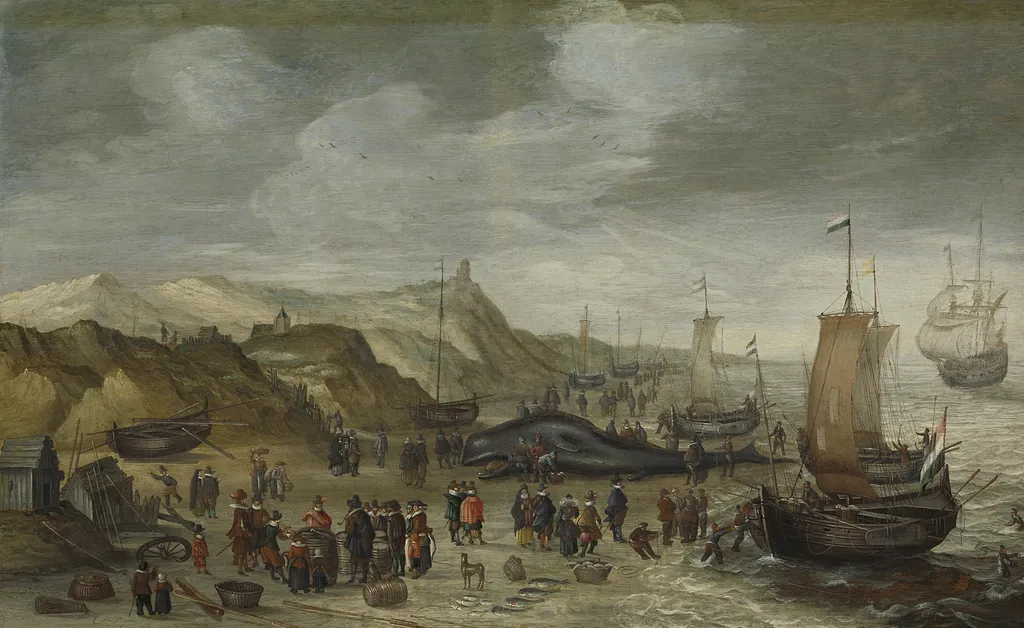
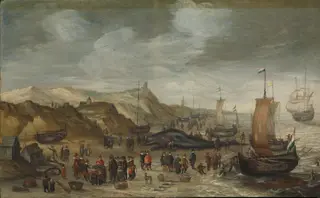
A Sperm Whale Washed up on the Beach at Noordwijk, 28 December 1614 is an oil painting by the Dutch Golden Age artist Hans Savery the Elder. It dates from 1620 and is held in the collection of the Rijksmuseum.
About this work
Subject & Meaning
The painting depicts a massive sperm whale stranded on the sandy beach at Noordwijk on 28 December 1614, an event documented in both visual and written records.
The painting depicts a massive sperm whale stranded on the sandy beach at Noordwijk on 28 December 1614, an event documented in both visual and written records. Hans Savery the Elder renders the carcass with meticulous detail, emphasizing its colossal size relative to the surrounding figures, boats, and dunes. The work falls within the genre of marine art, serving as a topographical record of a rare natural phenomenon rather than an allegorical or mythological scene.
While the painting lacks overt religious or classical symbolism, the whale’s imposing presence may evoke contemporary awe of the natural world’s unpredictability. Its stranding, a spectacle attracting crowds, reflects early modern curiosity about marine life and the fragility of human dominion over nature. The inclusion of small human figures and boats underscores the whale’s scale and the event’s public significance as a moment of scientific and communal fascination.
Technique & Style
Executed in oil paint on panel, the work measures 53 cm in height and 85 cm in width, typical of Northern European marine painting practice in the early seventeenth century.
The composition combines detailed naturalism with a restrained palette dominated by earth tones and muted blues, focusing attention on the whale’s carcass and the surrounding figures. Brushwork remains fluid yet precise, with careful modeling of the whale’s form to convey volume and texture against the flat expanse of the beach.
Formal qualities emphasize the dramatic encounter between human scale and the monumental carcass, framed by the low horizon and a subdued sky. The scene is rendered without visible underdrawing, relying on wet-in-wet transitions to define contours and light effects.
History & Provenance
The painting is held in the collection of the Rijksmuseum in Amsterdam, as recorded in its catalogue and Wikidata entry. It is catalogued as an oil-on-panel marine work by Hans Savery the Elder, dated 1620, with dimensions of 53 × 85 cm. No specific inventory or accession number is provided in the available sources, and no exhibition history is documented beyond its presence in the museum's holdings.
Overview
Hans Savery the Elder’s oil painting, titled A Sperm Whale Washed up on the Beach at Noordwijk, 28 December 1614, was executed around 1620. The work records a striking coastal tableau: a massive sperm whale lies on the sand, surrounded by onlookers and a small fleet of boats under a cloud‑filled sky. The composition is held in the collection of the Rijksmuseum in Amsterdam.
Context
In the early 17th century, the Netherlands’ maritime economy made sea‑related subjects popular among artists. Savery’s depiction aligns with contemporary works that recorded extraordinary natural occurrences, such as whale strandings, while also illustrating daily life on the coast. The painting thus serves both as a historical record of a specific incident at Noordwijk and as a broader commentary on the nation’s seafaring culture.
Own this work as a print
Artist & collection