Artwork
Winter landscape with skaters
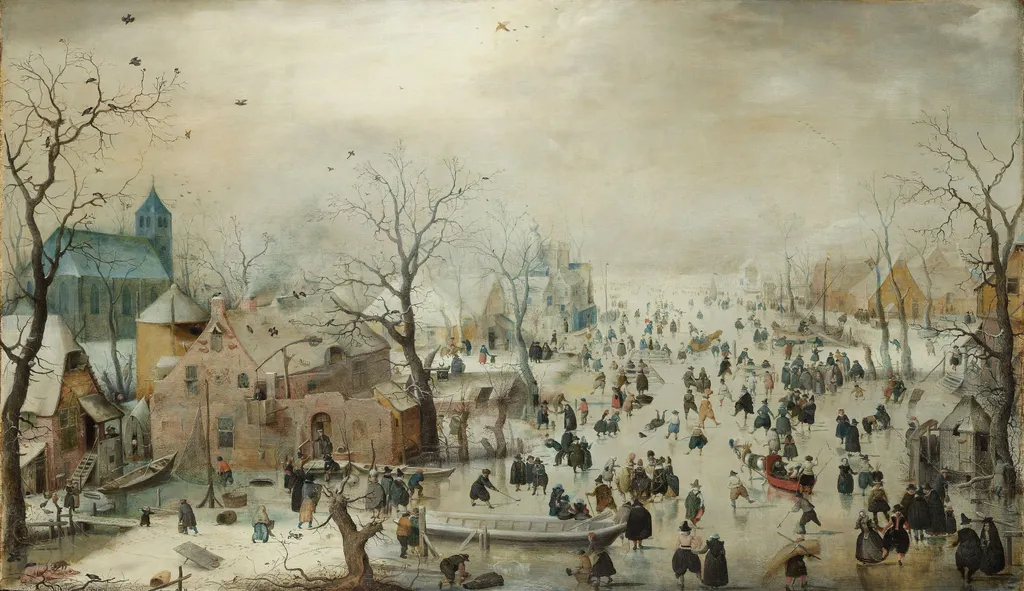
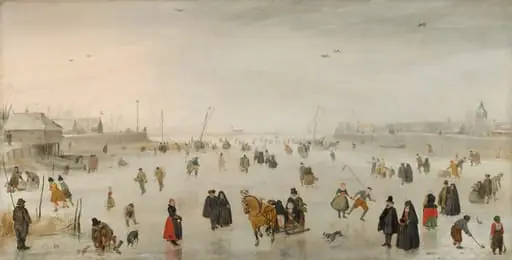
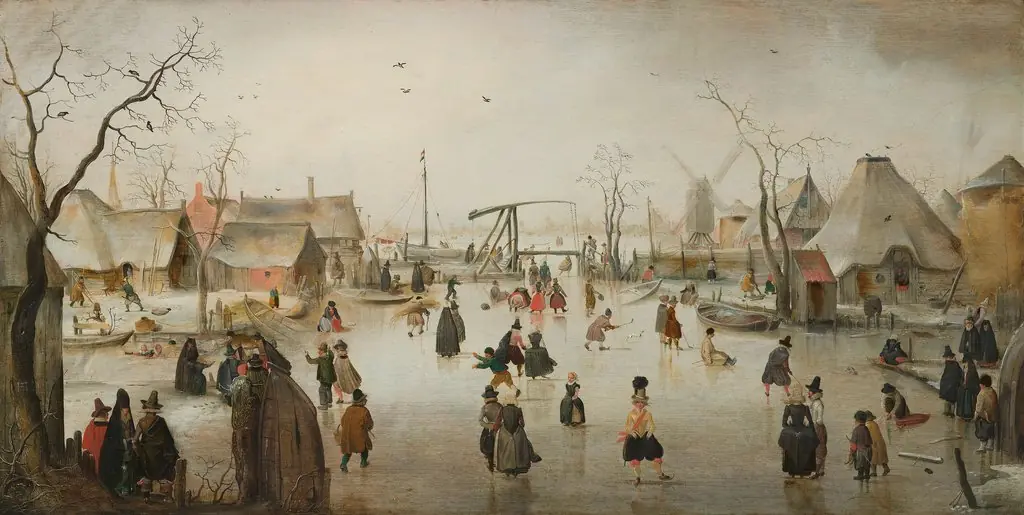
Winter landscape with skaters is an oil painting by Hendrick Avercamp. It dates from 1608 and is held in the collection of the Rijksmuseum.
About this work
Subject & Meaning
A church tower dominates the left side, signaling communal life and possibly a moralizing context.
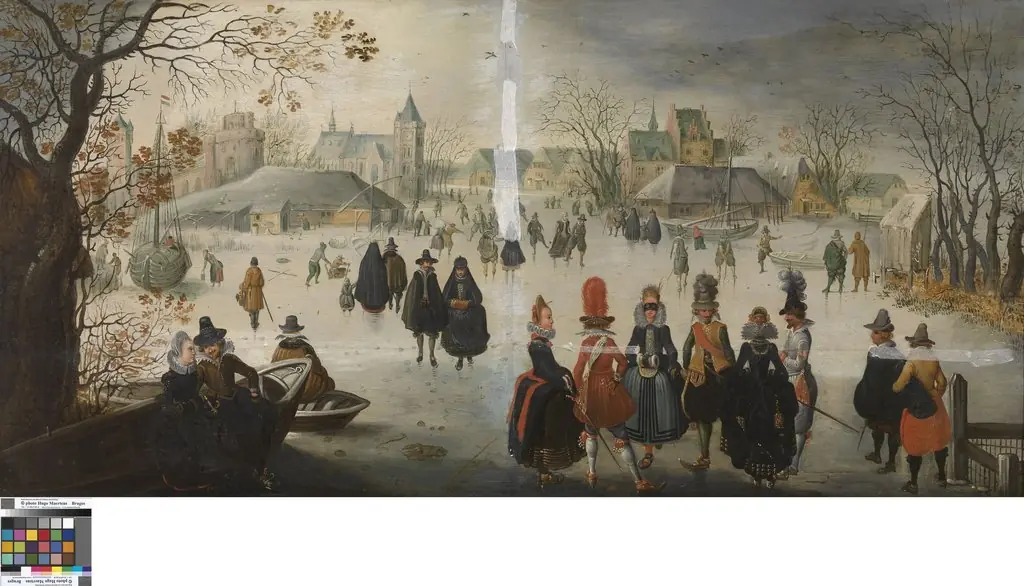
The painting depicts a lively winter scene on a frozen river where people of varied social ranks engage in skating and sledding alongside villagers performing daily chores. A church tower dominates the left side, signaling communal life and possibly a moralizing context. The composition includes humorous and anecdotal details such as a couple courting, a man urinating, and dogs scavenging a frozen horse carcass, reflecting the era’s taste for witty, narrative detail.
The subject was shaped by the Little Ice Age, particularly the harsh winter of 1607–08, which made ice skating a widespread activity and inspired Avercamp’s specialization in winter landscapes. The work’s panoramic format and high horizon, recalling Pieter Bruegel the Elder’s Winter Landscape with Skaters (1565), emphasize communal activity and human resilience amid cold, framing winter as both a social stage and a natural phenomenon.
Technique & Style
Winter Landscape with Skaters is executed in oil paint on an oak panel, measuring approximately 77.3 × 131.9 cm. The work is rendered in a panoramic format with a relatively high horizon, an approach that allowed Avercamp to accommodate a large cast of figures and narrative vignettes across the frozen surface. He employed atmospheric perspective, with tonal shifts toward cooler hues in the distance, alongside repoussoir devices such as foreground boats and trees to establish depth. The viewpoint is conspicuously elevated for a Low Countries painter, granting a sweeping vista of the ice.
Stylistically, the painting remains closely tied to the Flemish tradition of Pieter Bruegel the Elder, evident in the elevated horizon, the densely populated scene, and motifs such as the bird trap. The handling is highly detailed and anecdotal, with finely observed incidents, skaters tying their blades, a frozen carcass being gnawed, a privy in use, distributed evenly across the composition. The signature "HAenricus Av" is inscribed on a fisherman's hut door at the lower right.
History & Provenance
Hendrick Avercamp painted Winter Landscape with Skaters in 1608, dating it to the exceptionally cold winter of 1607–08 during the Little Ice Age. The oil-on-panel work is signed on a fisherman's hut in the lower right. The painting was formerly owned by Gijsbert de Clercq and later Cornelis Sebille Roos before the Rijksmuseum acquired it in 1897 with assistance from the Vereniging Rembrandt.
It has remained a collection highlight since and is currently housed in hall 2.6 of the Rijksmuseum, Amsterdam.
Winter Landscape with Skaters is held by the Rijksmuseum in Amsterdam, where it is installed in hall 2.6 and catalogued under inventory number SK-A-1718. The painting was acquired by the museum in 1897 (some sources date the purchase to 1898) with financial assistance from the Vereniging Rembrandt. Earlier provenance traces the work to the collections of Gijsbert de Clercq and Cornelis Sebille Roos before it entered the Rijksmuseum.
Since its acquisition, the painting has been featured as a collection highlight in successive museum catalogues. It is referenced in Judikje Kiers and Fieke Tissink's volume Der Glanz des Goldenen Jahrhunderts (2000) and in Patrick de Rynck's Cómo leer la pintura (2005), and the Rijksmuseum has made it accessible through its online collection page.
Context
Scholars identify this 1608 panel as one of Hendrick Avercamp's earliest works, marking his specialization in winter scenes, a genre he pioneered in Dutch painting. The composition reflects the environmental conditions of the Little Ice Age, particularly the severe winter of 1607–08. Art historically, the work is situated within the Flemish tradition, displaying a strong stylistic debt to Pieter Bruegel the Elder's 1565 winter landscapes.
Specific motifs, such as the bird trap and the high horizon line accommodating numerous anecdotal figures, are direct borrowings from Bruegel. However, Avercamp distinguishes this piece through its panoramic scope and detailed narrative elements, including humorous vignettes of daily life. This synthesis of Flemish influence with a distinct Dutch focus on realistic landscape and genre activity established Avercamp's reputation, leading to the popular moniker "Wintertjes" for his subsequent productions.
Legacy
Winter Landscape with Skaters has been regarded as one of Hendrick Avercamp's earliest and most accomplished winter scenes, distinguished among his comparable works by its panoramic scope, richness of detail, and refined execution. Its stylistic debt to Pieter Bruegel the Elder's 1565 Winter Landscape with Ice skaters and Bird trap, visible in motifs such as the bird trap, established a template that Avercamp would revisit throughout his career, and his humorous, anecdotal approach made such scenes extraordinarily popular in his own era. Avercamp went on to produce more than a hundred winter paintings and numerous drawings, a body of work later known colloquially as "Wintertjes," of which this panel is considered an originating example.
Acquired by the Rijksmuseum in 1897 with support from the Vereniging Rembrandt, the painting has remained a collection highlight, appearing in museum catalogues ever since and continuing to anchor Avercamp's reputation as the first Dutch painter to specialize in snow scenes.
Overview
Hendrick Avercamp's "Winter Landscape with Skaters," painted around 1608, is an oil-on-oak panel housed in the Rijksmuseum, Amsterdam. This early work by the Dutch artist captures a bustling scene on a frozen waterway, depicting numerous figures engaged in various activities. The painting exemplifies Avercamp's pioneering focus on winter scenes, a genre he helped establish within Dutch art.
Artist & collection

Artist
Hendrick Avercamp (January 27, 1585 (bapt.) – May 15, 1634 (buried)) was a Dutch painter during the Dutch Golden Age of painting.