Artwork
Christ, St. Paul, and the Twelve Apostles
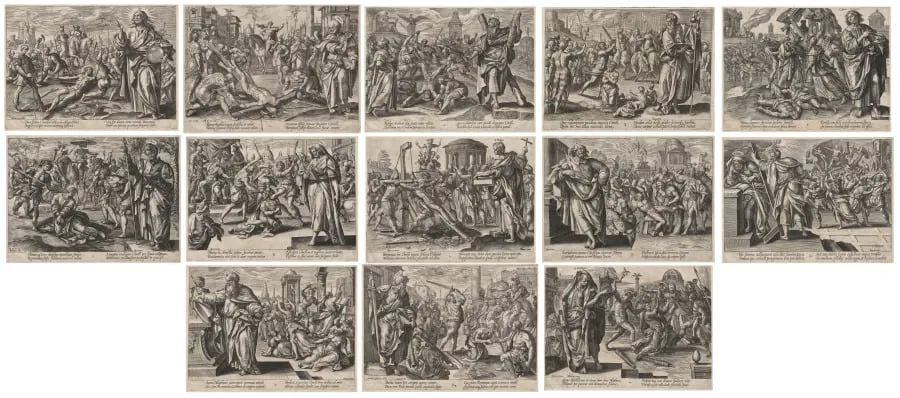
Christ, St. Paul, and the Twelve Apostles is a print by the Renaissance artist Hendrick Goltzius. It dates from 1578 and is held in the collection of the Cleveland Museum of Art.
- Accession no.
- 2019.180
About this work
Overview
Behind them, a secondary scene illustrates their violent death, creating a dual narrative within one frame.
Thirteen engravings depict Christ and the Twelve Apostles, each presenting a single figure in the foreground against a landscape suggesting the region of their missionary work. Behind them, a secondary scene illustrates their violent death, creating a dual narrative within one frame. The prints were produced in the late 16th century, during a period of intense religious conflict over the veneration of saints, and reflect Catholic efforts to reinforce saintly devotion through visual storytelling.
Subject & Meaning
Each apostle is shown alive in the foreground, symbolizing their earthly mission, while their martyrdom unfolds in the background, often involving rulers, idols, or demonic figures as agents of death. This juxtaposition links their preaching with their sacrifice, reinforcing the Catholic doctrine that martyrdom sanctifies. The inclusion of Christ among the apostles elevates the group as a unified witness to the faith, emphasizing continuity between divine authority and human testimony.
Technique & Style
The engravings employ fine, precise lines and controlled chiaroscuro to distinguish between foreground figures and complex background scenes. Light and shadow guide the viewer’s eye across crowded compositions, clarifying spatial depth and emotional intensity. The artist uses scale and placement to compress two temporal moments, life and death, into a single image, creating a visual rhythm that invites sequential reading without formal panels.
History & Provenance
Created around 1590 by Hendrick Goltzius, the series was commissioned during the Counter-Reformation, when the Catholic Church sought to reassert its authority through devotional imagery. The prints circulated widely among educated Catholics, serving both as religious instruction and as a statement against Protestant rejection of saint veneration. Their production coincided with the Council of Trent’s directives on sacred art, emphasizing emotional engagement and doctrinal clarity.
Context
These prints emerged amid fierce theological disputes over the legitimacy of saints and their relics. While Protestants dismissed saintly intercession, Catholics used art to cultivate personal devotion through vivid depictions of martyrdom. The series aligns with broader trends in Netherlandish printmaking that fused narrative complexity with technical precision, responding to both spiritual needs and the growing market for portable religious imagery.
Legacy
The series influenced later generations of printmakers by demonstrating how complex narratives could be compressed into single compositions. Its integration of geography, martyrdom, and theological symbolism became a model for devotional prints in Catholic Europe. Though less widely known today, the engravings remain a significant example of how art served as a tool of doctrinal reinforcement during a period of religious upheaval.
Artist & collection
Artist
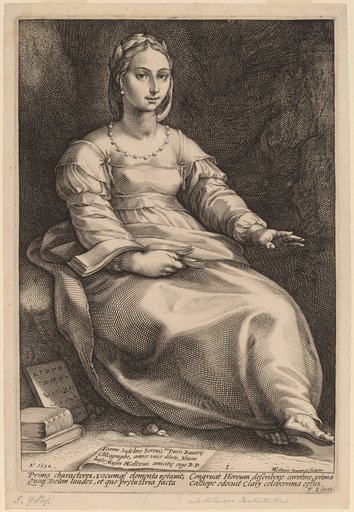
Hendrick Goltzius (German: , Dutch: ; né Goltz; January or February 1558 – 1 January 1617) was a German-born Dutch printmaker, draftsman, and painter.





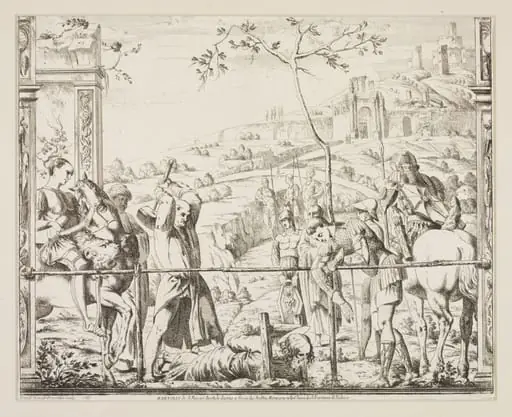 The Martyrdom of St. James and St. Christopher
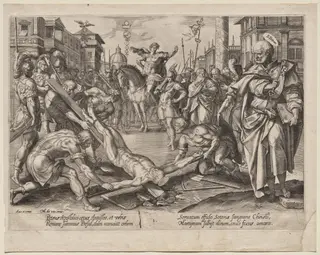 St. Peter
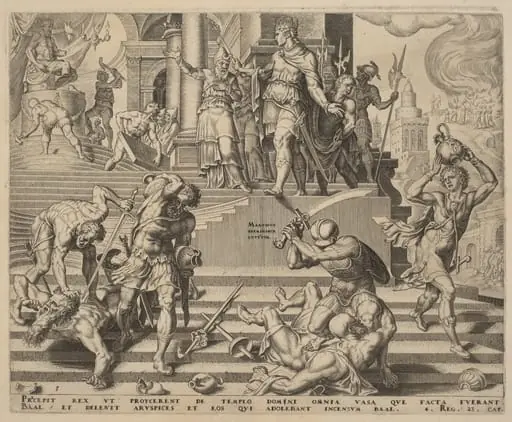 The Destruction of the Temple of Baal and the Slaughter of His Priests
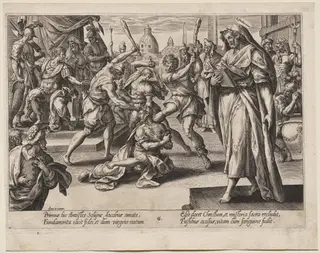 St. James the Less
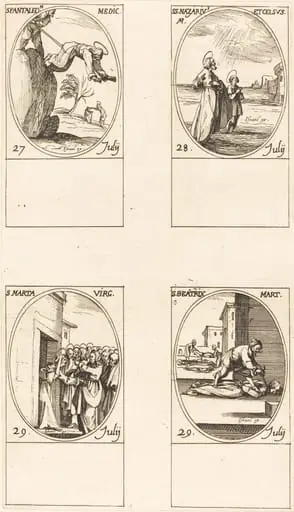 St. Pantaleon; Sts. Nazarius and Celsus; St. Martha; St. Beatrice
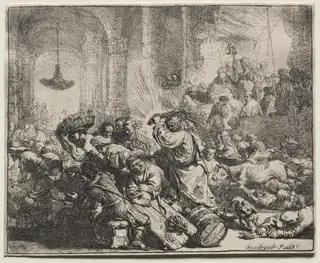 Christ Driving the Money Changers from the Temple
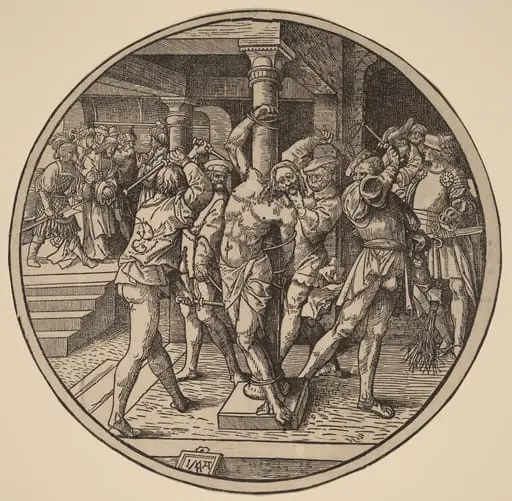 The Flagellation of Christ and Christ Before Pilate
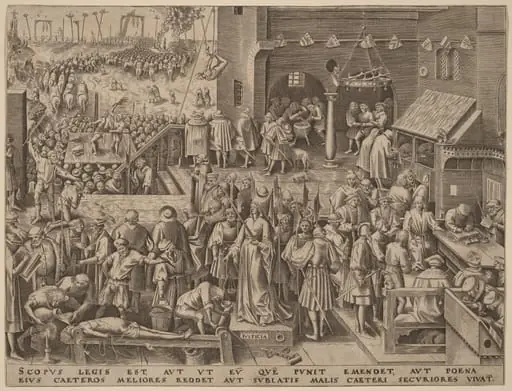 Justice
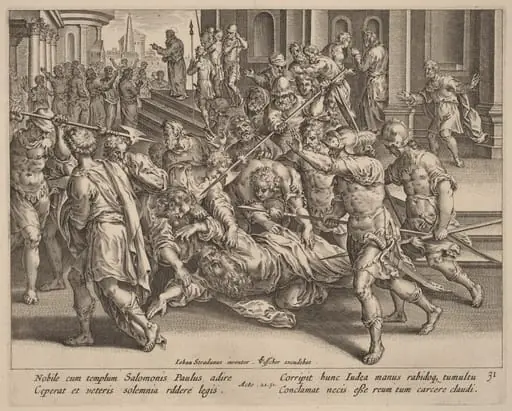 The Arrest of Saint Paul
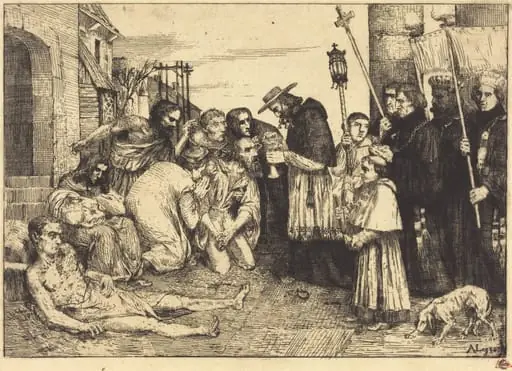 Plague Victims of Rome (Les pestiferes de Rome)
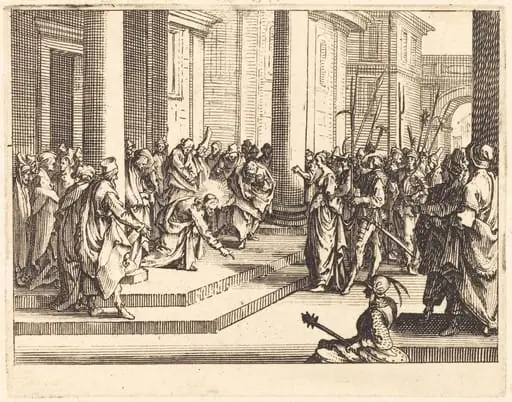 Christ and the Woman Taken in Adultery
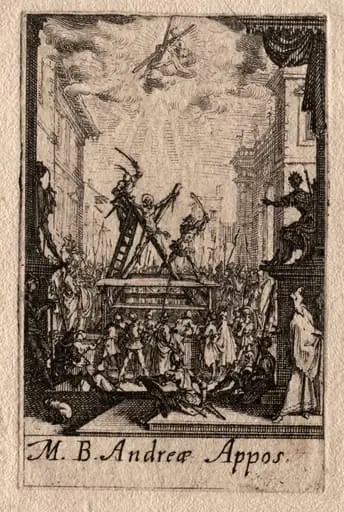
- The Martyrdom of the Apostles: St. Andrew