Artwork
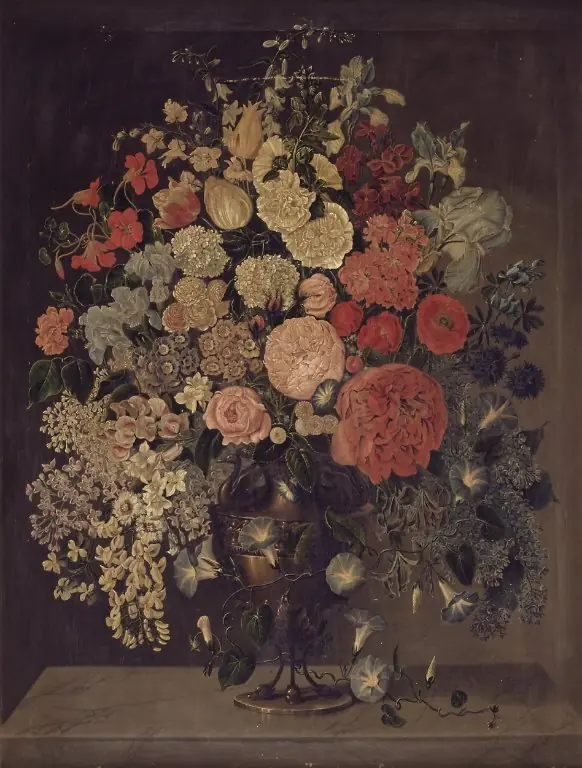
Blomsterbuket med snerle og efeu
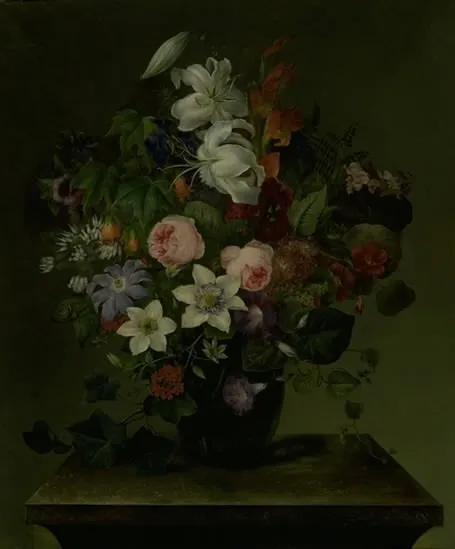
Blomsterbuket med snerle og efeu is an oil painting by the Biedermeier artist Hermania Neergaard. It dates from 1843 and is held in the collection of the Statens Museum for Kunst.
About this work
Overview
Blomsterbuket med snerle og efeu (Flower Bouquet with Morning Glory and Ivy) is an 1843 oil-on-canvas still life by the Danish painter Hermania Neergaard.
Blomsterbuket med snerle og efeu (Flower Bouquet with Morning Glory and Ivy) is an 1843 oil-on-canvas still life by the Danish painter Hermania Neergaard. Measuring 800 by 670 millimetres, the work is held in the collection of the Statens Museum for Kunst (National Gallery of Denmark) in Copenhagen, where it is accessioned as KMS454. Signed and dated "H. Neergaard 1843" in the lower left, the painting represents a significant example of mid-nineteenth-century Danish floral still life and offers insight into the professional practice of a woman artist working within the constraints of the Romantic era.
Subject & Meaning
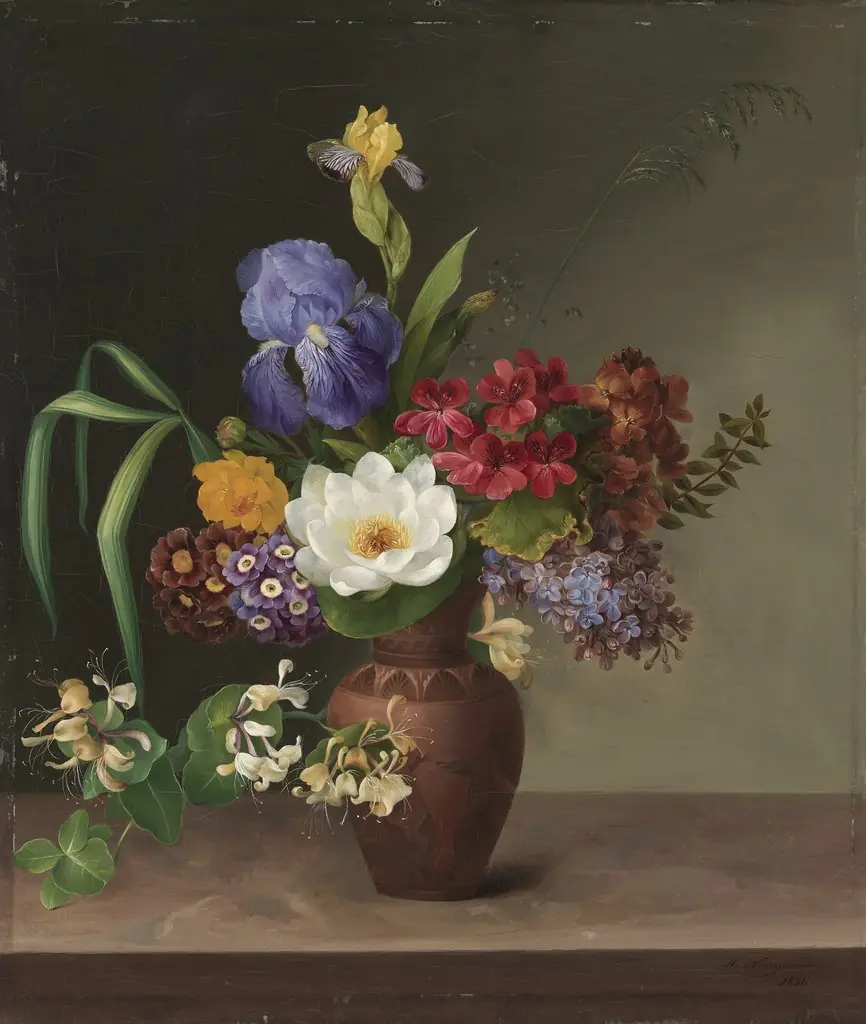
The painting presents a densely arranged bouquet of flowers in a dark vase, set upon a wooden table or ledge against a muted, dark olive-green background. White lilies rise prominently at the top, surrounded by pink roses, pale blue and white clematis, orange and red smaller blooms, and various green leaves. Ivy and other trailing foliage spill downward and outward, with some blossoms appearing fresh while others show slight wilting. The title identifies two plants of particular symbolic resonance: morning glory (snerle), whose blooms are notably ephemeral, and ivy (efeu), which clings with tenacious resilience. This pairing has been interpreted as an articulation of lasting attachment amidst transience, a theme consistent with Romantic-era fascination with nature's emotional impact. The contained, almost secretive quality of the arrangement, with its vibrant yet muted colours, suggests a whispered narrative rather than overt declaration.
Technique & Style
Neergaard executed the work in oil on canvas, employing a smooth and highly finished technique. The brushwork demonstrates careful attention to Petal textures and leaf veining, with light falling from the upper left to illuminate the flowers and create soft shadows on the table surface and within the bouquet. The artist avoids stark outlines, relying instead on delicate gradations of tone to suggest depth and separation between forms. This handling produces a sense of volume and tactility, particularly in the central cascade of lilies and roses. The overall palette balances bright flower colours against deep greens and browns, with the background deepening toward the edges to enhance the sense of enclosure. The wooden table shows subtle grain and a hint of carved or curved leg at the lower left, grounding the floral display in a tangible domestic space.
History & Provenance
The painting was created in 1843, a date confirmed by the artist's inscription in the lower left corner. Its subsequent provenance before acquisition by the Statens Museum for Kunst remains undocumented in available sources. The work is now held by the Statens Museum for Kunst, the National Gallery of Denmark, under accession number KMS454. It was provided to Wikimedia Commons by the museum in May 2024 as part of a collaboration with Wikimedia Denmark, indicating its active place in the museum's public engagement programme. No exhibition history is recorded in the available sources.
Context
Hermania Neergaard worked during the Romantic period, an era in which women artists were frequently confined to genres such as still life, deemed appropriately domestic. The thirteen paintings by Neergaard in the Statens Museum for Kunst collection suggest a sustained professional relationship with Denmark's premier national institution, indicating recognition of her abilities within her lifetime. Critical discussion of this work has centred on how Neergaard directed visual attention artfully while working within these constraints, using the still-life format to convey emotional complexity. The stifled, enclosed lighting of the composition has been read as potentially reflecting the limitations placed upon women artists of her station, even as the work demonstrates undeniable technical mastery.
Legacy
Blomsterbuket med snerle og efeu continues to serve as a significant document of Hermania Neergaard's practice and of the possibilities available to women artists working within restricted professional circumstances in nineteenth-century Denmark. Its presence in the Statens Museum for Kunst, and its dissemination through digital platforms including Wikimedia Commons, ensures ongoing public and scholarly access. The painting has become a focal point for discussions about how women artists of the Romantic era employed genre conventions to express emotional depth and technical sophistication. Its reputation rests on the precision of its execution and the layered symbolism of its floral content, offering contemporary viewers a means to consider both the aesthetic achievements and the social conditions of Neergaard's career.
Artist & collection
Artist
Hermania Sigvardine Neergaard (1799–1875) was a Danish flower and still-life painter. A student of Frederik Christian Camradt (1762–1844), she exhibited her paintings in Charlottenborg where several were bought by the royal family.