Artwork
Xavier: Pools of the Holy Family
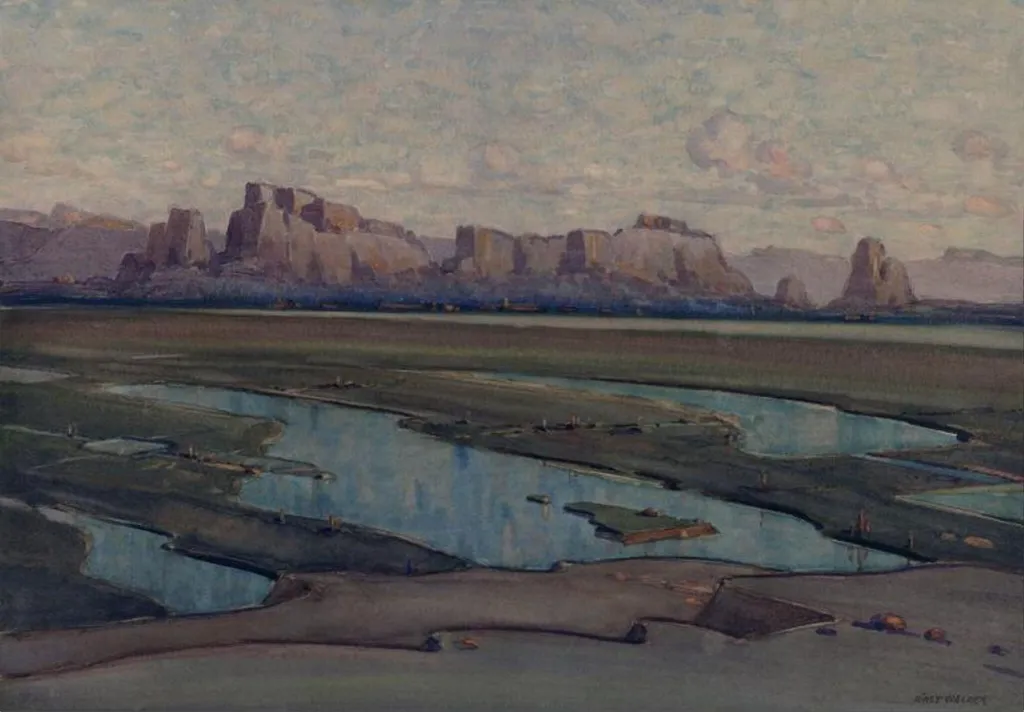
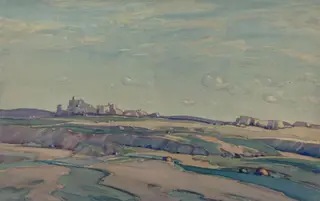
Xavier: Pools of the Holy Family is a watercolor work on paper by Hirst Walker. It dates from 1950 and is held in the collection of the Victoria and Albert Museum.
About this work
Overview
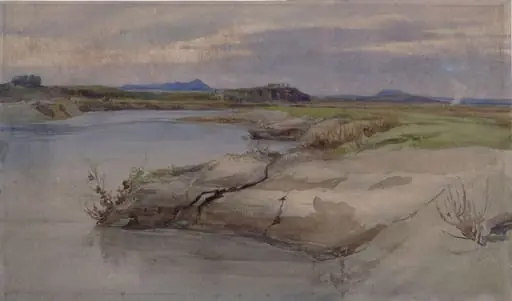
Created in 1950 by Hirst Walker, this watercolour depicts a tranquil, waterlogged landscape. The work is signed by the artist and executed in delicate, translucent washes. Its composition centers on still pools that mirror the sky, surrounded by uneven, muddy terrain and sparse, weathered objects. The overall tone is subdued, with an emphasis on atmosphere rather than narrative detail.
Subject & Meaning
Though titled Xavier: Pools of the Holy Family, the image contains no figures or explicit religious symbols. The title may suggest a spiritual or contemplative mood, but the scene remains abstracted, a quiet, post-rain environment where water and earth merge. The absence of human presence invites reflection on solitude and nature’s quiet persistence.
Technique & Style
Walker employed loose, fluid brushwork and diluted pigments to achieve a hazy, ethereal quality. The watercolour layers are applied thinly, allowing the paper’s texture to show through and enhancing the sense of moisture in the air. Horizontal bands of pale blue and white dominate the sky and its reflections, while the ground is rendered with muted earth tones and irregular strokes.
History & Provenance
The work was completed in 1950 and bears the artist’s signature, confirming its origin. No public record of early ownership or exhibition history is widely documented. Its current location and acquisition path remain unverified in accessible archives, though it is held in private or institutional collections with limited public access.
Context
Emerging in post-war Britain, the piece aligns with a broader interest in lyrical landscape painting that favored mood over realism. Walker’s approach echoes contemporaries who explored watercolour for its capacity to evoke transience and stillness, often distancing themselves from overt political or social themes in favor of quiet, personal observation.
Legacy
Hirst Walker’s watercolours, including this work, are not widely represented in major public collections. Their quiet aesthetic has not attracted sustained scholarly attention, though they remain of interest to specialists in mid-20th-century British watercolour. The piece endures as a modest example of an understated, introspective tradition in British art.
Artist & collection