Artwork
The Judgment of Midas
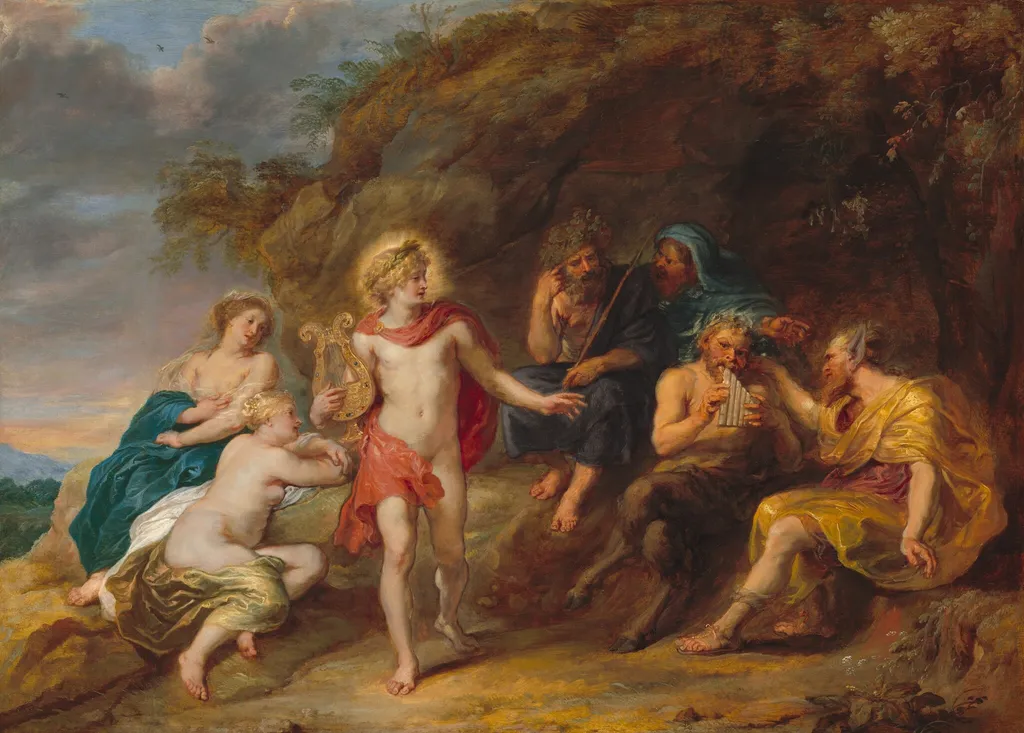
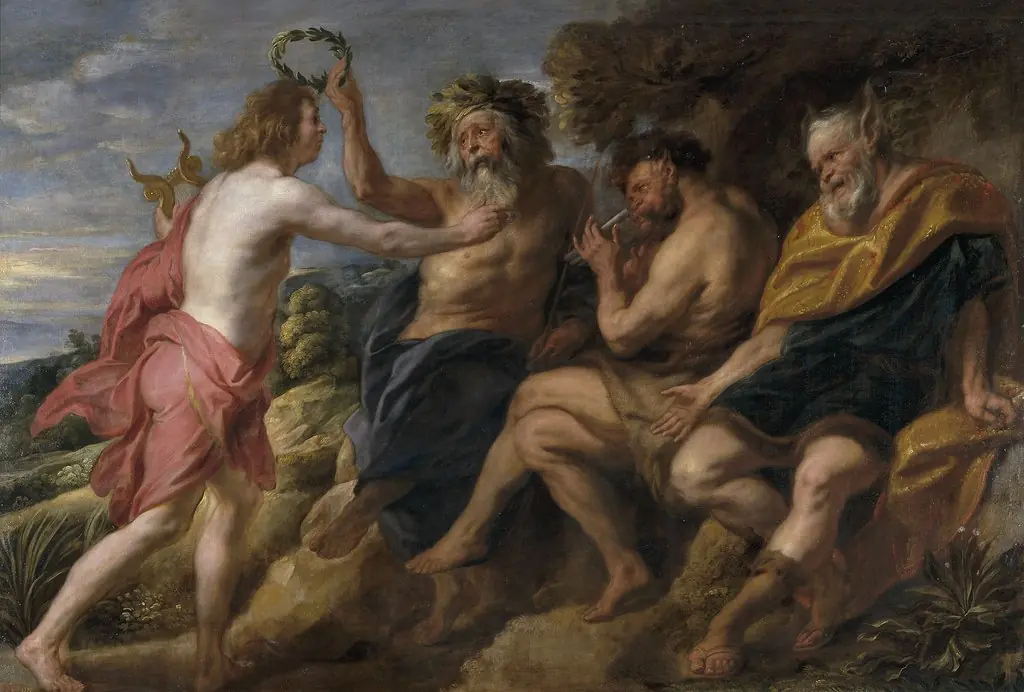
The Judgment of Midas is an oil painting by the Baroque artist Jan van den Hoecke. It dates from 1640 and is held in the collection of the National Gallery of Art.
About this work
Subject & Meaning
The painting depicts the musical contest between Pan and Apollo judged by King Midas, a scene drawn from Ovid's _Metamorphoses_.
The painting depicts the musical contest between Pan and Apollo judged by King Midas, a scene drawn from Ovid's _Metamorphoses_. Apollo, crowned with laurel and holding a lyre, embodies artistic perfection and divine order, while Pan, accompanied by his flute, represents rustic simplicity. Midas, identifiable by his Phrygian cap, is shown on the right, his gesture indicating the award of victory to Pan.
The judgment's outcome symbolizes the tension between cultivated harmony and unrefined expression. The lyre's golden radiance and Apollo's serene authority contrast with Pan's earthy tones and animated posture, underscoring the moral that true artistry resides in divine, not mortal, discernment.
Technique & Style
The Judgment of Midas is executed in oil on a wooden panel support, a common medium for Flemish painting of the seventeenth century. The handling is characterized by a smooth, refined application of paint, typical of Jan van den Hoecke's training, with carefully modeled figures and subtle transitions in tone to articulate volume and space. Stylistically, the composition adheres to Baroque conventions, employing diagonal arrangements and dynamic contrapposto to heighten narrative tension.
The figures are rendered with precise anatomical detail and draped in rich, textured fabrics, while the background unfolds in atmospheric recession, balancing dramatic action with classical clarity. The palette favors warm earth tones enlivened by accents of crimson and gold, reinforcing the mythological gravitas of the scene.
History & Provenance
Jan van den Hoecke executed this oil-on-panel mythological scene in 1640. The early ownership history is reconstructed primarily from the 1872 Péreire sale catalogue, which lists the first known proprietor as "lord," a figure scholars identify as Sir John Rushout, 2nd Baron Northwick. The painting subsequently entered the collection of Otto Mündler, who retained it until 1863.
It was then acquired by the brothers Emile and Isaac Péreire in Paris. Following their estate sale in March 1872, where it appeared as Apollo et Midas, the piece passed through the dealers Edwards and C.G. Candano. In 1899, the American industrialist William A. Clark purchased the work, eventually bequeathing it to the Corcoran Gallery of Art in 1926.
The National Gallery of Art in Washington, D.C., acquired the painting in 2015 when the Corcoran's holdings were transferred, and it is now held there. No exhibition history is documented in the provided sources.
Legacy
The Judgment of Midas passed through a distinguished sequence of collectors after its creation, from possible ownership by Sir John Rushout and Otto Mündler to the Parisian brothers Emile and Isaac Péreire, and later to William A. Clark, who bequeathed it to the Corcoran Gallery of Art in 1926. The painting joined the National Gallery of Art's holdings when the Corcoran collection was transferred in 2015. Its early twentieth-century scholarly presence is noted in Edward Dillon's 1909 study of Rubens, where it is cited as Apollo and Midas.
Overview
The Judgment of Midas is an oil painting rendered on a wooden panel, depicting a significant episode from classical mythology. The artwork presents a crowded composition, centered on the dramatic confrontation between divine and mortal figures. It captures a specific moment of consequence following a musical contest, with the central characters arranged to convey the narrative's tension.

Own this work as a print
Artist & collection

Artist
Jan van den Hoecke (baptised on 4 August 1611 – 1651) was a Flemish painter, draughtsman and designer of wall tapestries.