Artwork
Weir, near Hurley
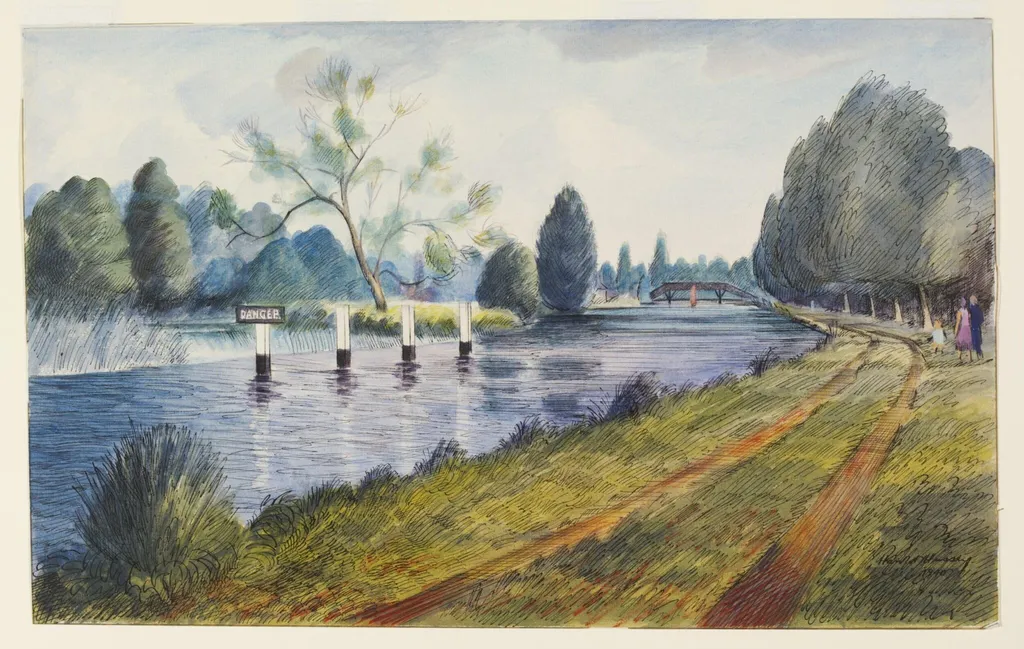
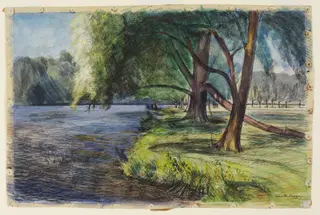
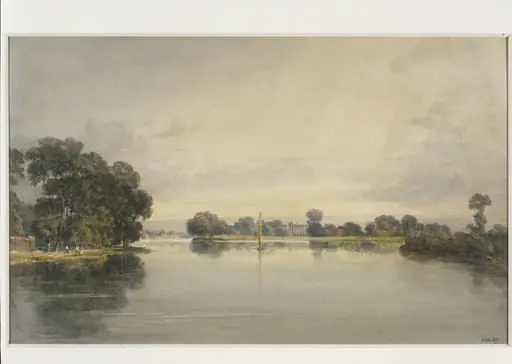
Weir, near Hurley is a watercolor work on paper by Hussey. It is held in the collection of the Victoria and Albert Museum.
About this work
Overview
This 1940 watercolour by Hussey captures a serene scene of a weir on the River Thames near Hurley, incorporating a distant bridge, riverbank figures, and surrounding landscape.
Subject & Meaning
The painting portrays everyday life and natural beauty in a wartime Britain, subtly referencing potential threats (evidenced by a 'DANGER' sign) amidst tranquility.
Technique & Style
Hussey employed loose, expressive brushstrokes to convey light and water movement, using a muted colour palette with a notable glow on the wet grass near the foreground.
History & Provenance
Created for the 'Recording Britain' initiative, a WWII project led by Sir Kenneth Clark and commissioned by the Ministry of Labour and National Service, to document Britain's at-risk landscapes and cultural heritage.
Context
Part of a collection of over 1,500 works, mostly watercolours, focusing on England with limited Welsh inclusion, aiming to preserve a sense of national identity during wartime.
Own this work as a print
Artist & collection
Artist
Philip Hussey (1713–1783), was an Irish portrait-painter. Hussey was born at Cloyne, in the county of Cork and his career began as a sailor. He was shipwrecked three times. He drew the figureheads and stern ornaments of…