Artwork
Playing Cards
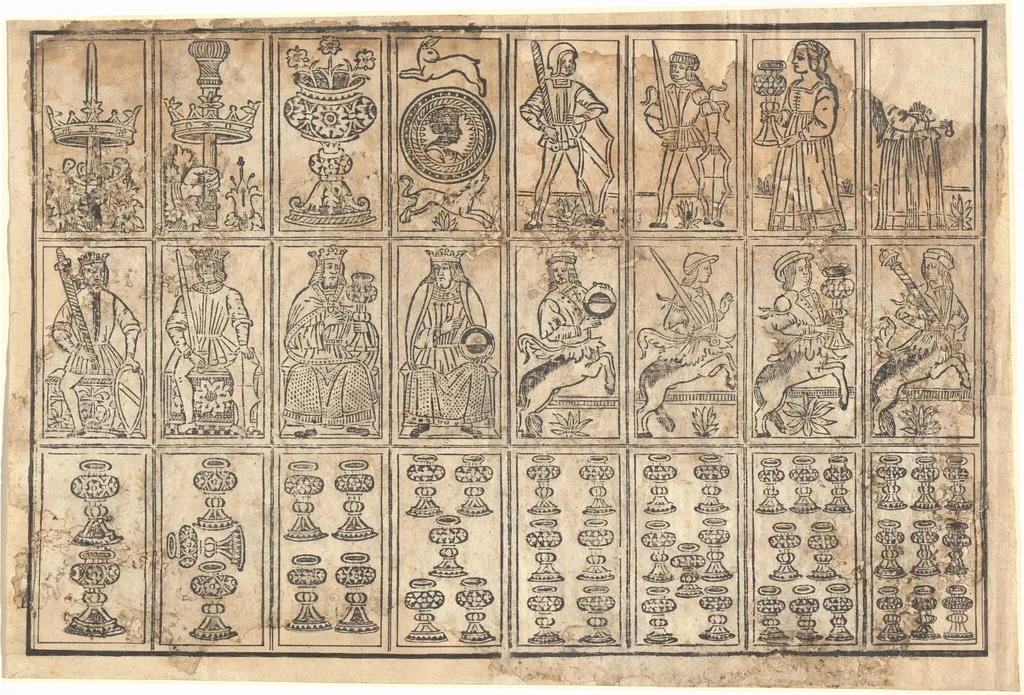
Playing Cards is an ink print by the Renaissance artist Italian 15th Century. It dates from 1401 and is held in the collection of the National Gallery of Art.
About this work
Overview
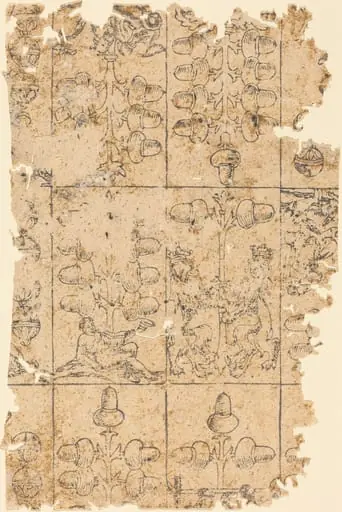
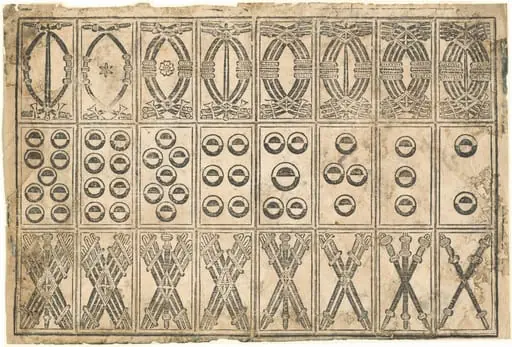
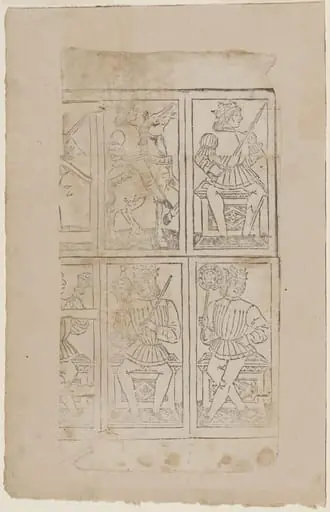
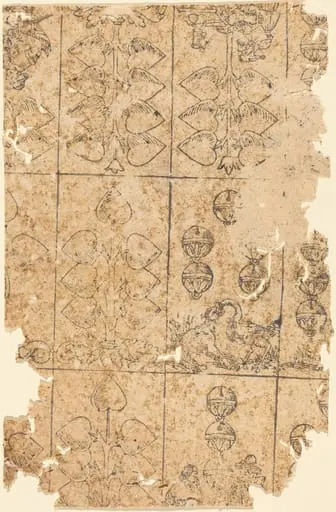
Playing Cards is a woodcut print executed on laid paper, composed of thirty‑six individual squares arranged in a four‑by‑nine grid. Each square functions as a separate image, rendered with the crisp, linear quality typical of woodcut technique. The work presents a systematic visual catalogue rather than a single narrative scene.
Subject & Meaning
The upper half of the grid juxtaposes figures in elaborate dress, crowned heads, animals and assorted objects such as thrones and musical instruments, suggesting a hierarchy of status or roles. The lower half consists solely of varied vase and urn forms, whose decorative motifs may allude to wealth, collection, or the material culture associated with games of chance.
Technique & Style
Carved from a single wood block or a series of blocks, the image relies on strong, clean lines and high contrast between inked and uninked areas, a hallmark of the woodcut process. The use of laid paper provides a subtle texture that interacts with the printed lines, enhancing the sense of precision in each miniature composition.
History & Provenance
The work is identified as a print, but specific details about its date, creator, or original ownership are not recorded in the supplied information. Its format, multiple small prints assembled into a larger panel, reflects a tradition of illustrative series used for educational or decorative purposes.
Context
Woodcut printing was a common method for reproducing images in the pre‑photographic era, allowing for relatively inexpensive distribution of visual material. The inclusion of regal and domestic motifs aligns the piece with broader European iconography that linked games, such as card playing, with social rank and leisure.
Legacy
While the piece itself is not linked to a particular collection, its systematic arrangement and subject matter provide insight into how visual symbols of status were catalogued and disseminated through print media, informing later decorative arts and the visual language of gaming paraphernalia.
Artist & collection

Artist
An anonymous Italian engraver from the 1490s carved images that could be peeled apart like paper dolls.




![The Destruction of the Egyptian Idols [verso], by Italian 15th Century](https://artifactworldgallery.com/img/italian-15th-century--the-destruction-of-the-egyptian-idols-verso--646d3c2b8098cfee-w320.webp)
![The Flight into Egypt [recto], by Italian 15th Century](https://artifactworldgallery.com/img/italian-15th-century--the-flight-into-egypt-recto--8f4d5275d7f90f98-w320.webp)