Artwork
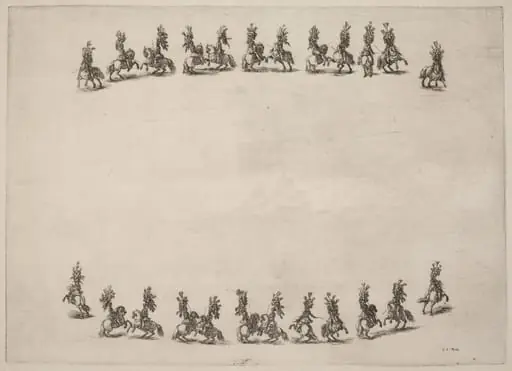
La Calvacatura con le sue Cerimonie [The Procession for the 'Possesso' of a new Pope at the Lateran]
![La Calvacatura con le sue Cerimonie [The Procession for the 'Possesso' of a new Pope at the Lateran], by Italian 16th Century, ink, 1575](https://artifactworldgallery.com/img/italian-16th-century--la-calvacatura-con-le-sue-cerimonie-the-procession-for-the-p--4ba5b8acc96f4bb0-w1024.webp)
La Calvacatura con le sue Cerimonie [The Procession for the 'Possesso' of a new Pope at the Lateran] is an ink print by the Renaissance artist Italian 16th Century. It dates from 1575 and is held in the collection of the National Gallery of Art.
- Inscription
- Inscribed:Lettered lower right: "Ant. Temp. inv. Romae." Lettered along lower margin: "La cavalcatura con le sue cerminonie dun pontefice nuovo q..ando piglia il possesso a Santo Giovanni Laterano" Lettered upper margin: "Cerimoniae equitatus...." "De uyt rydinghe..." "La cavalcade avec le ceremonies..."
About this work
This painting shows a big procession with many people and horses. The artist made this scene very detailed, with lots of things happening at once. It's interesting because it depicts a specific event, the "Possesso" of a new Pope, which was an important ceremony.
You can learn more about this type of art by looking at the work of the artist: Italian 16th Century.
Overview
This 16th-century Italian engraving by Antonio Tempesta captures the ceremonial procession marking the formal installation of a new pope at the Basilica of St.
This 16th-century Italian engraving by Antonio Tempesta captures the ceremonial procession marking the formal installation of a new pope at the Basilica of St. John Lateran. Created as a detailed print, it measures 40.1 by 52 centimeters and belongs to The Ahmanson Foundation’s collection. The work belongs to a tradition of documenting papal rituals through graphic media, combining topographical precision with narrative richness.
Subject & Meaning
The scene illustrates the 'Possesso,' a ritual in which a newly elected pope traveled from the Vatican to the Lateran to assume his role as bishop of Rome. The procession included clergy, nobility, guards, and civic officials, each assigned specific roles. Tempesta’s depiction emphasizes the ceremonial hierarchy and public spectacle, reinforcing the pope’s dual spiritual and temporal authority through visual order and scale.
Technique & Style
Tempesta employed fine-line engraving to render intricate details across a crowded composition. Figures, horses, architecture, and banners are rendered with meticulous precision, creating a sense of movement within a static medium. The dense arrangement of elements reflects a Northern European influence on Italian printmaking, balancing realism with symbolic structure to convey the ceremony’s solemnity.
History & Provenance
The engraving was produced during a period when papal ceremonies were increasingly recorded in print for wider dissemination. Tempesta, known for his historical and military scenes, likely drew from eyewitness accounts or preparatory sketches. The work entered The Ahmanson Foundation’s collection in the 20th century, preserving its historical record as part of a broader archive of early modern papal iconography.
Context
In the late 1500s, printed images of papal rituals served both documentary and propagandistic functions, reinforcing the Church’s authority amid religious upheaval. Tempesta’s print aligns with other contemporary engravings that visualized state ceremonies, catering to educated audiences across Europe who sought to understand Rome’s ceremonial life without direct access to the city.
Legacy
Tempesta’s engraving remains a key visual source for historians studying papal ceremonies of the Counter-Reformation era. Its detailed composition has informed reconstructions of the procession route and attire, while its technical execution influenced later printmakers documenting public rituals. The work endures not as art for art’s sake, but as a calibrated record of institutional performance.
Artist & collection

Artist
An anonymous 16th-century Italian sculptor left a handful of small bronzes in dark brown and gilt.

- Twenty-Four Cavorting Cavaliers
![Fragments from Ancient Cameos in the Grimani Collection [Plate I], by Enea Vico](https://artifactworldgallery.com/img/enea-vico--fragments-from-ancient-cameos-in-the-grimani-collection-plat--1f564c058ab46ade-w320.webp) Fragments from Ancient Cameos in the Grimani Collection [Plate I]
Fragments from Ancient Cameos in the Grimani Collection [Plate I] Cavaliers Fighting with Swords
 H Beard Print Collection
 Untitled
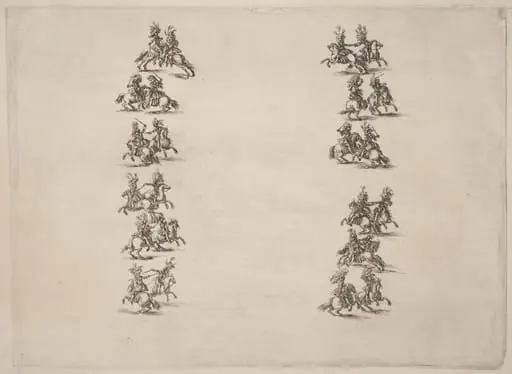 Cavaliers Fighting in Two Columns
![Fragments from Ancient Cameos in the Grimani Collection [Plate III], by Enea Vico](https://artifactworldgallery.com/img/enea-vico--fragments-from-ancient-cameos-in-the-grimani-collection-plat--bf2c0f15852500f8-w320.webp) Fragments from Ancient Cameos in the Grimani Collection [Plate III]
Fragments from Ancient Cameos in the Grimani Collection [Plate III]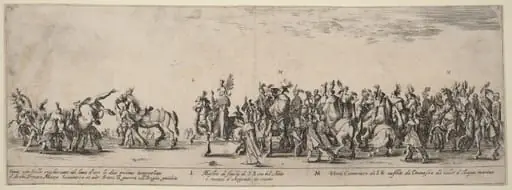 Master of His Excellency's Stables and Twenty Servants
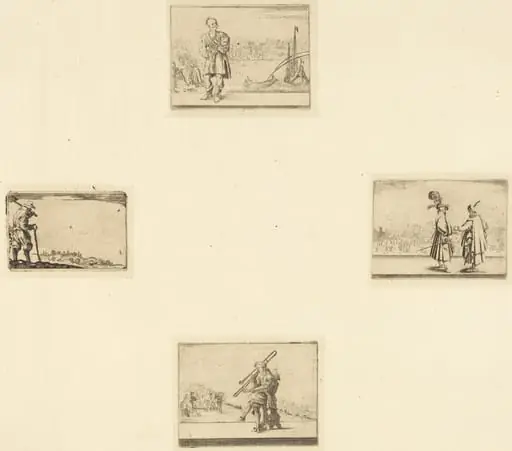 Sheet of Etchings
![The Triumph of Julius Caesar [no.1 and 2 plus 2 columns], by Andrea Andreani](https://artifactworldgallery.com/img/andrea-andreani--the-triumph-of-julius-caesar-no-1-and-2-plus-2-columns--72fc49376c9f9633-w320.webp) The Triumph of Julius Caesar [no.1 and 2 plus 2 columns]
The Triumph of Julius Caesar [no.1 and 2 plus 2 columns]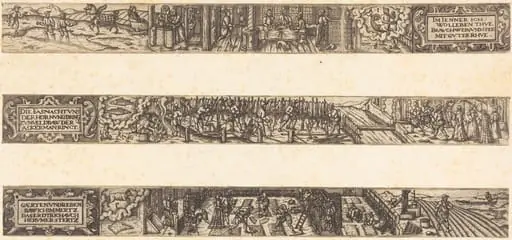 Three Months
 H Beard Print Collection