Artwork
Venus Blindfolding Cupid
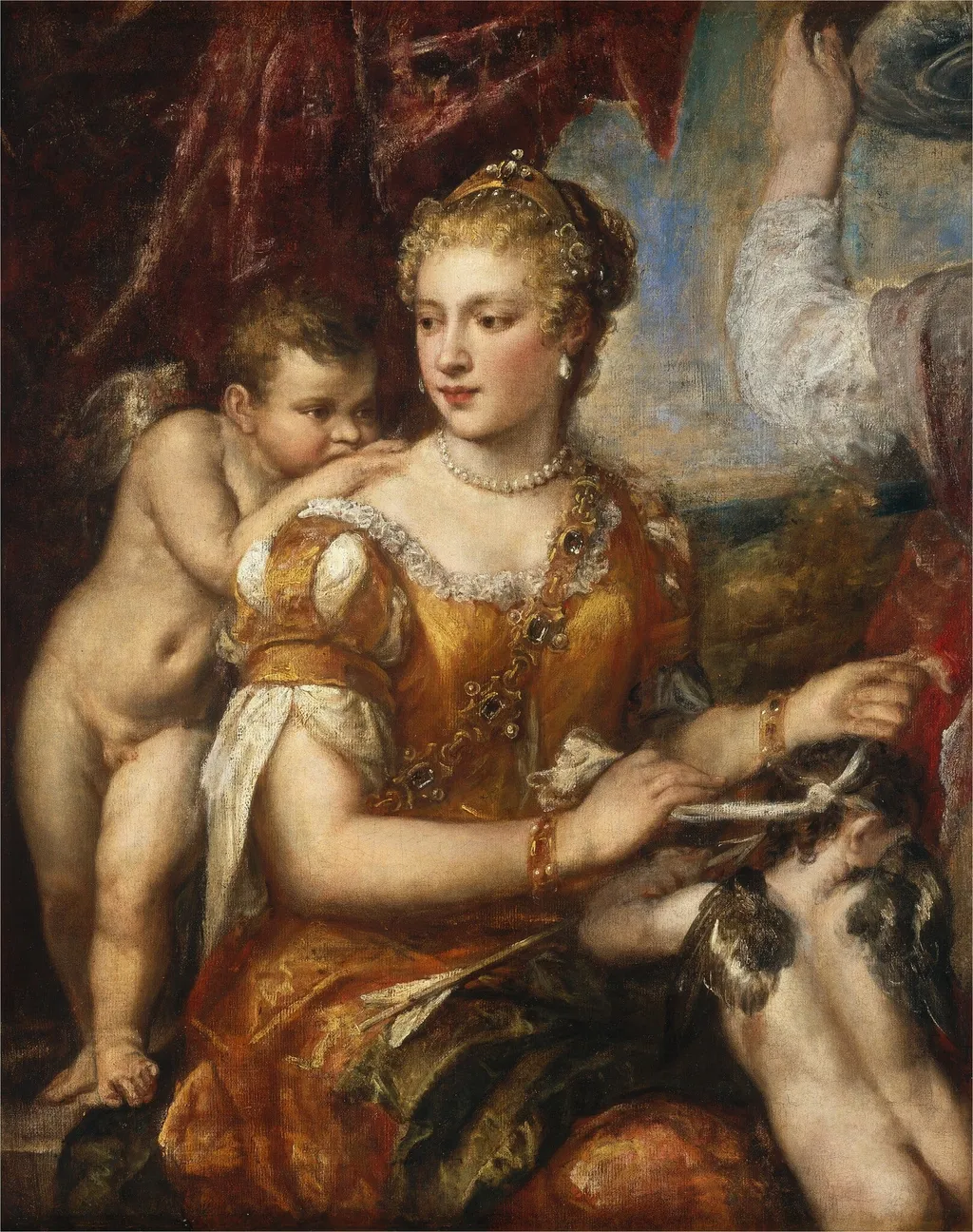
Venus Blindfolding Cupid is an oil painting. It dates from 1568 and is held in the collection of the National Gallery of Art.
About this work
Venus winds a ribbon around Cupid's eyes while a second Cupid looks over her shoulder and a partial attendant lifts a basket behind them. The scene is a cropped variant of Titian's Borghese original, keeping a figure the master had later painted out. Part of the Samuel H. Kress Collection since 1952, the panel once hung at Stowe House among the Buckingham dukes' collection.
Technique & Style
The painting is executed in oil on canvas, a typical medium for 16th-century Italian works, and dates to 1568. The canvas support measures 122.4 × 97.3 cm. The work is attributed to an anonymous Italian artist working after Titian, reflecting the compositional and stylistic influence of the Venetian master. No specific handling or condition details are recorded in the available sources.
History & Provenance
Subsequent owners included the 2nd and 3rd dukes of Buckingham and Chandos; it was sold in 1848 and again in 1921, but apparently bought in.
The painting was created around 1568 by an anonymous Italian artist working after Titian. Its earliest recorded owner was the painter Charles Jervas (d. 1739), in whose 1739 estate sale (lot 543) it was described as by Titian and purchased by Richard Temple, 1st Viscount Cobham. It then passed through inheritance within the Temple-Grenville family, residing at Stowe House, Buckinghamshire.
Subsequent owners included the 2nd and 3rd dukes of Buckingham and Chandos; it was sold in 1848 and again in 1921, but apparently bought in. The painting eventually entered the Samuel H. Kress Collection and is now in the National Gallery of Art, Washington, D.C.
Overview
This oil on canvas, titled Venus Blindfolding Cupid, is attributed to an anonymous Venetian workshop or follower from the late sixteenth century, likely dating between 1566 and 1580. It adapts a celebrated composition by Titian, specifically reproducing the left portion of his work. The painting depicts Venus in the act of blindfolding Cupid, with a second Cupid observing from behind her shoulder.
Subject & Meaning
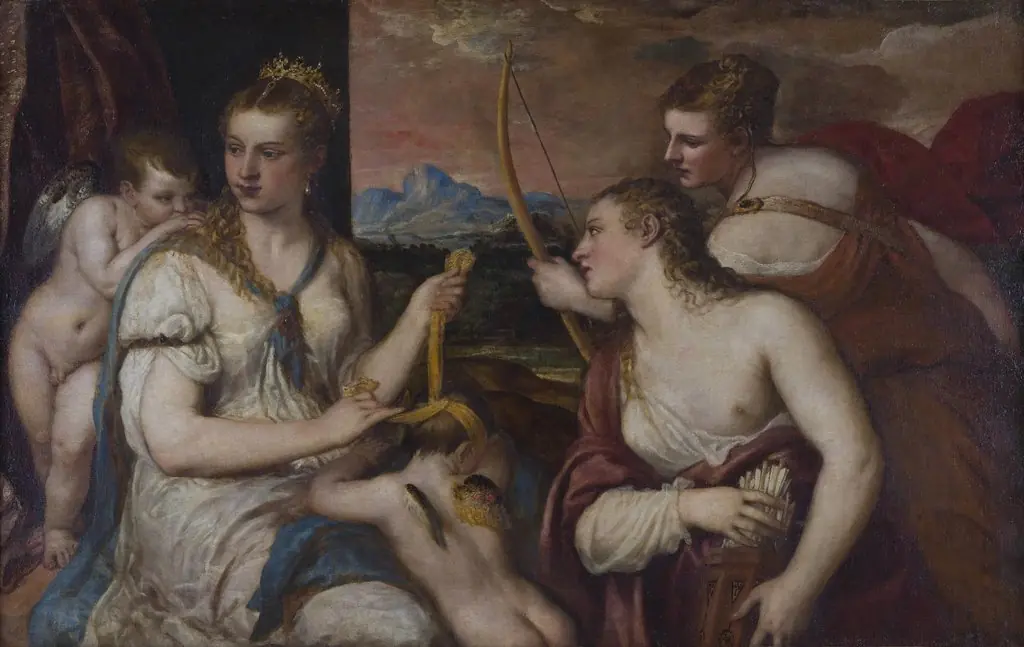
The painting presents a focused view of Venus and Cupid, a common theme in Renaissance art. Notably, it includes a partially visible female figure on the right, shown lifting a basket. This detail is significant because X-radiographs of Titian's original composition reveal that the master initially included this figure but later removed her.
Thus, the Washington canvas offers a unique glimpse into an earlier stage of Titian's creative process, preserving an element he ultimately chose to omit.
Context
This painting serves as a testament to Titian's enduring influence and the practice of artistic adaptation within Venetian workshops. Its inclusion of the basket-lifting figure, later painted out by Titian in his own version, positions it as a valuable document for understanding the master's compositional evolution. Scholars such as Fern Rusk Shapley and Harold Wethey have examined the work, consistently identifying it as a product of Titian's followers rather than his own hand, contributing to its scholarly discourse.
Artist & collection