Artwork
Seashore
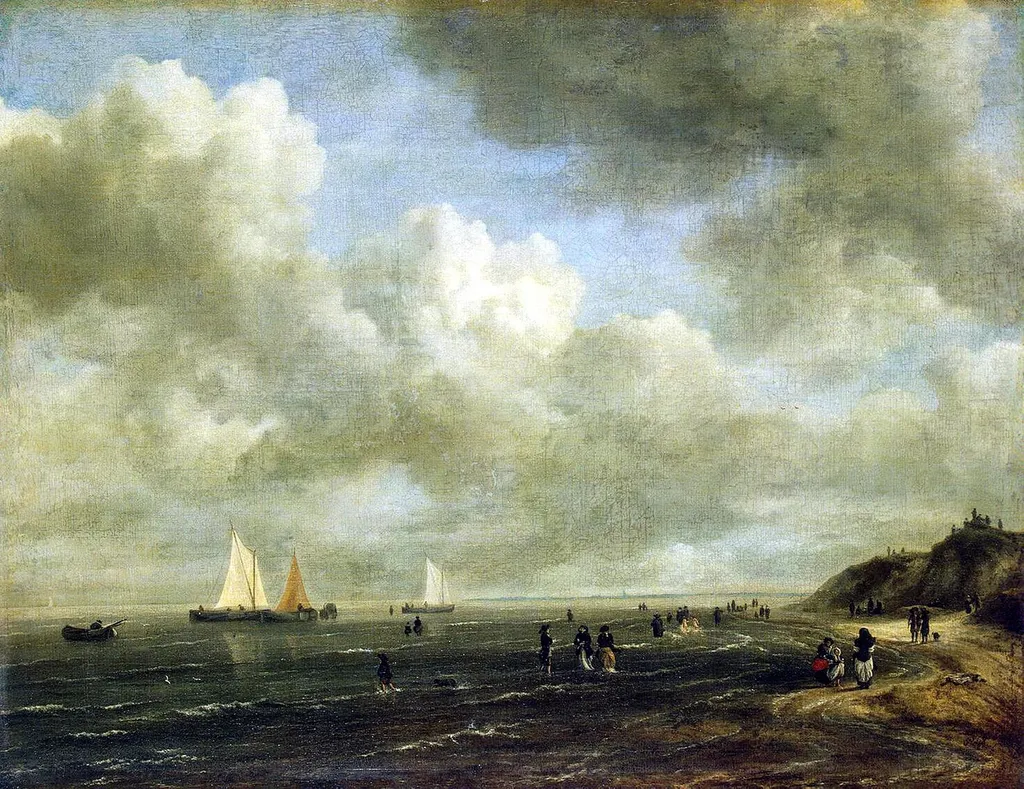
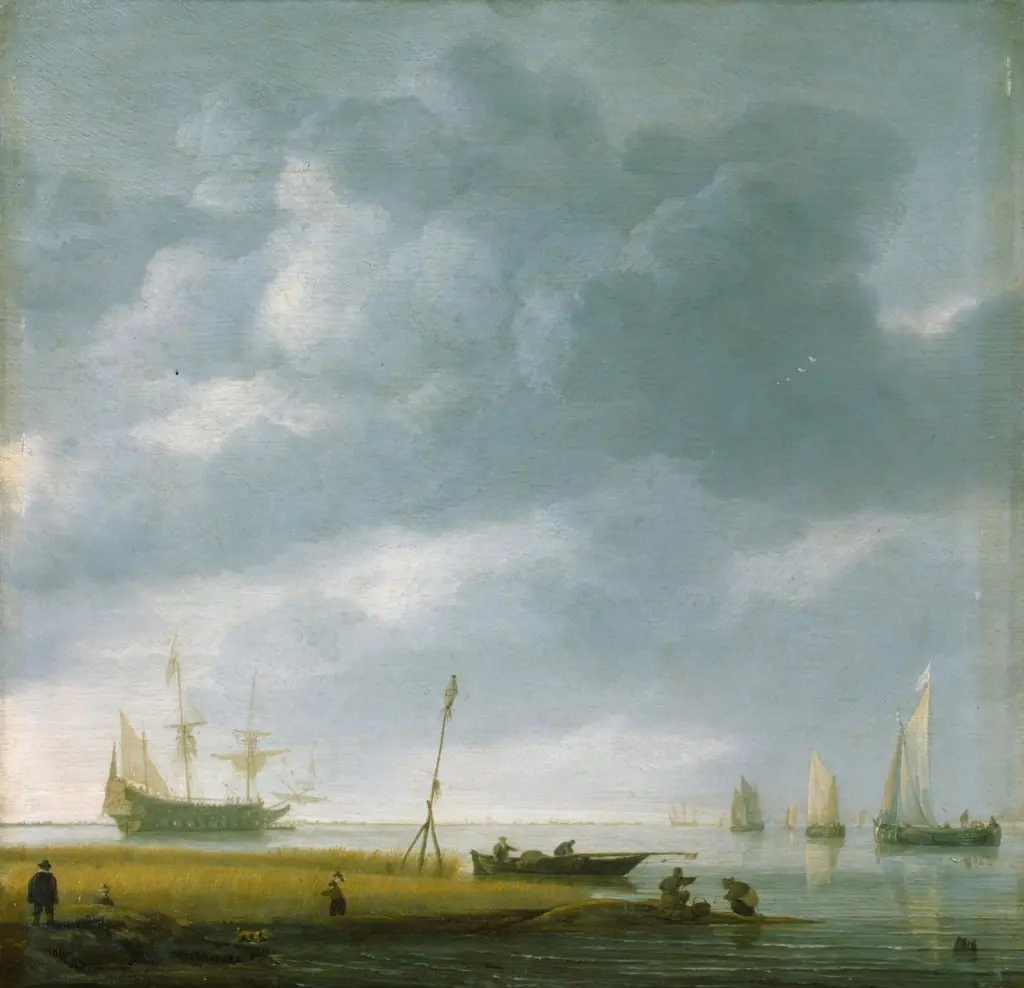
Seashore is an oil painting by the Dutch Golden Age artist Jacob van Ruisdael. It is held in the collection of the Hermitage Museum.
About this work
Subject & Meaning
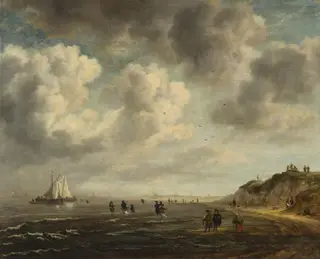
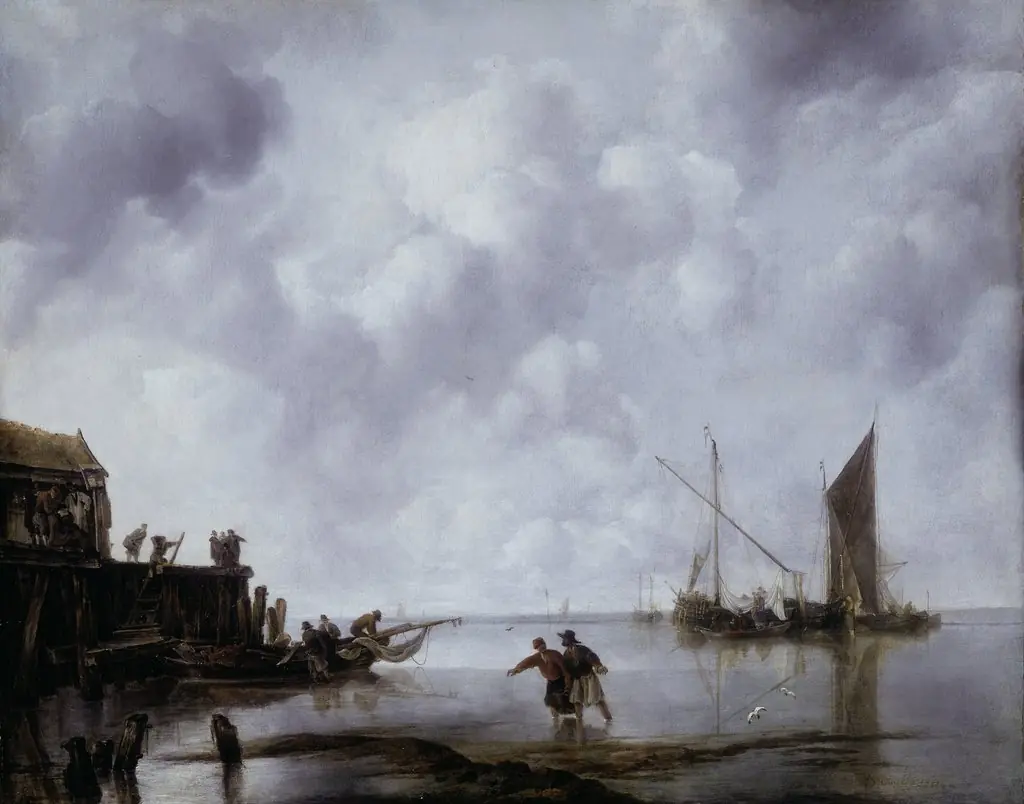
Figures stroll across the sand and atop the dunes, while at the center and left, women, men, and children wade barefoot in the shallows.
The painting presents a summer beach scene, identified by some experts as the shore near Scheveningen, set beneath a cloudy sky. A muted palette of yellows, dark greys, blacks, and whites dominates the composition, interrupted only by a small red accent, the skirt of a Black woman at the water's edge. Figures stroll across the sand and atop the dunes, while at the center and left, women, men, and children wade barefoot in the shallows.
In the distance, other figures wade toward small fishing sailboats, most wearing dark cloaks over their summer clothing. The sea stretches across the left side of the canvas, balanced by rising dunes on the right.
According to some scholars, the figures were largely executed by Adriaen van de Velde, as Ruisdael, in his later years and in declining health, focused primarily on the natural elements of the landscape.
Technique & Style
Created in 1676, Seashore is an oil painting executed on a canvas support measuring 52 by 68 cm. The artist signed the work in the lower right corner. Stylistically, the composition is dominated by yellow and dark gray tones, punctuated by touches of black and white, with a singular small red accent provided by the skirt of a figure at the water's edge. The horizon line is positioned to the left, opening onto the sea, while dunes rise on the right side of the canvas.
The handling of the human figures has been attributed by some experts to Adriaen van de Velde, suggesting a division of labor where Ruisdael focused on the natural landscape elements while the figures were added by the other hand.
History & Provenance
The Seashore (also known as Scène de plage) is an oil-on‑canvas landscape dated to 1676 and signed lower right. Painted in the Netherlands, the work is thought to have been executed primarily by Jacob van Ruisdael, with the figures possibly contributed by Adriaen van de Velde due to Ruisdael’s illness. Its provenance begins with a description by Gustav Friedrich Waagen in 1864 after viewing it at Pavlovsk Palace; the painting then entered the collection of Grand Duke Constantin, who displayed it in the Marble Palace.
After the 1919 Bolshevik confiscation, it became part of the Dutch collection of the Hermitage Museum in Saint‑Petersburg, where it remains.
The painting is held in the collection of the Hermitage Museum in Saint Petersburg. It bears the inventory number that is not specified in the sources. The work was first described by Waagen in 1864 after he saw it at Pavlovsk Palace, and it entered the Grand Duke Konstantin's collection before being installed in the Marble Palace.
In 1919 the canvas was confiscated by the Bolsheviks and has remained in the Hermitage's Dutch collection ever since.
The painting was exhibited in the Marble Palace following its acquisition by the Grand Duke, and it was later included in the Hermitage's displays after the 1919 nationalization. Its presence in the museum's Dutch section is documented in Hermitage exhibition records.
The artwork is cataloged in scholarly publications such as Seymour Slive's 2001 catalogue, which lists it as number 633, and it is also referenced in the 1864 inventory of the Imperial Hermitage.
The Hermitage Museum website provides an online description of the piece, confirming its location and accession status.
Context
Jacob van Ruisdael painted Seashore in 1676, an oil on canvas work now housed in the Hermitage Museum in Saint Petersburg. The painting depicts a summer beach scene with dunes, figures on the shore, and distant sailboats, characterized by dominant yellow, dark gray, and black tones with a single red accent. Scholars have noted that figures in the composition may be attributed to Adriaen van de Velde while Ruisdael, then ill, focused on natural elements.
The work entered the Hermitage collection after being confiscated by Bolsheviks in 1919 following its display in the Palace of Marble, having previously been described by Waagen in 1864 after a visit to Pavlovsk.
Seashore is part of the Dutch Golden Age tradition of marine landscapes and reflects Ruisdael's mastery of atmospheric effects and compositional depth. It is cataloged in major scholarly references, including Seymour Slive’s 2001 catalogue raisonné, which documents it as no. 633.
Overview
Jacob van Ruisdael’s oil painting titled Seashore, executed in 1688, presents a coastal scene that balances human activity with expansive natural elements. The composition is anchored by a sandy beach and a low dune, while distant vessels navigate a tranquil sea under a sky dominated by voluminous clouds pierced by shafts of light. The work is part of the collection of the State Hermitage Museum.
Own this work as a print
Artist & collection
Artist
Jacob Isaackszoon van Ruisdael was a Dutch painter, draughtsman, and etcher. He is generally considered the pre-eminent landscape painter of the Dutch Golden Age, a period of great wealth and cultural achievement when…