Artwork
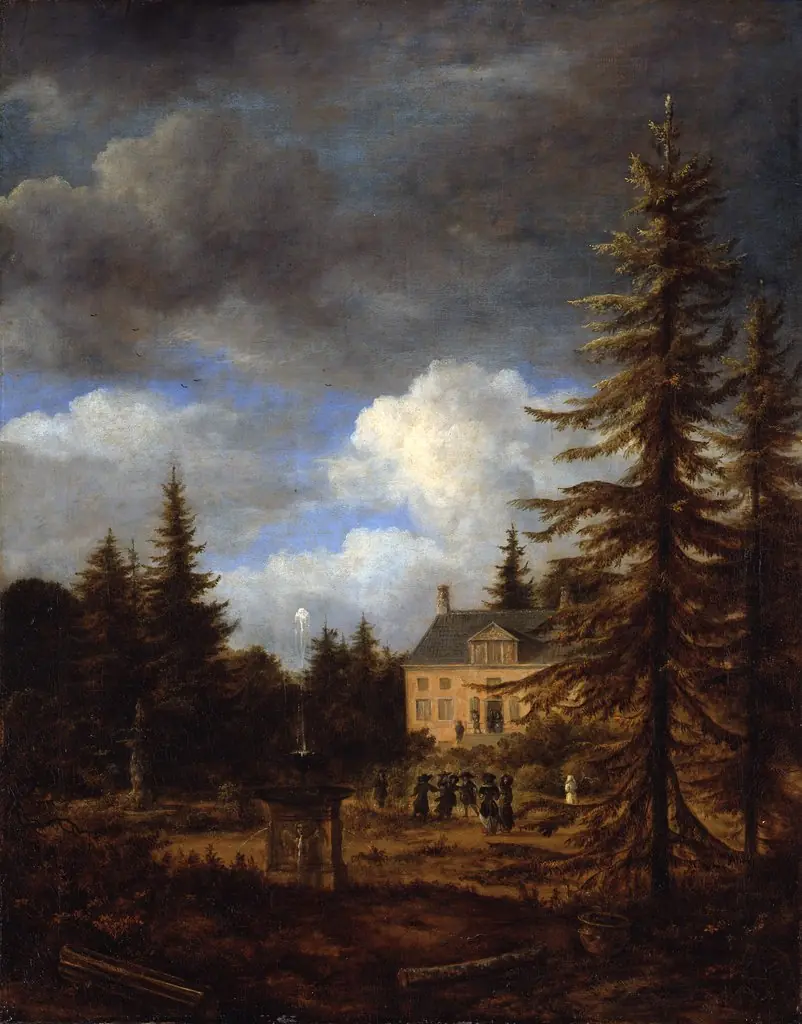
Country House in a Park
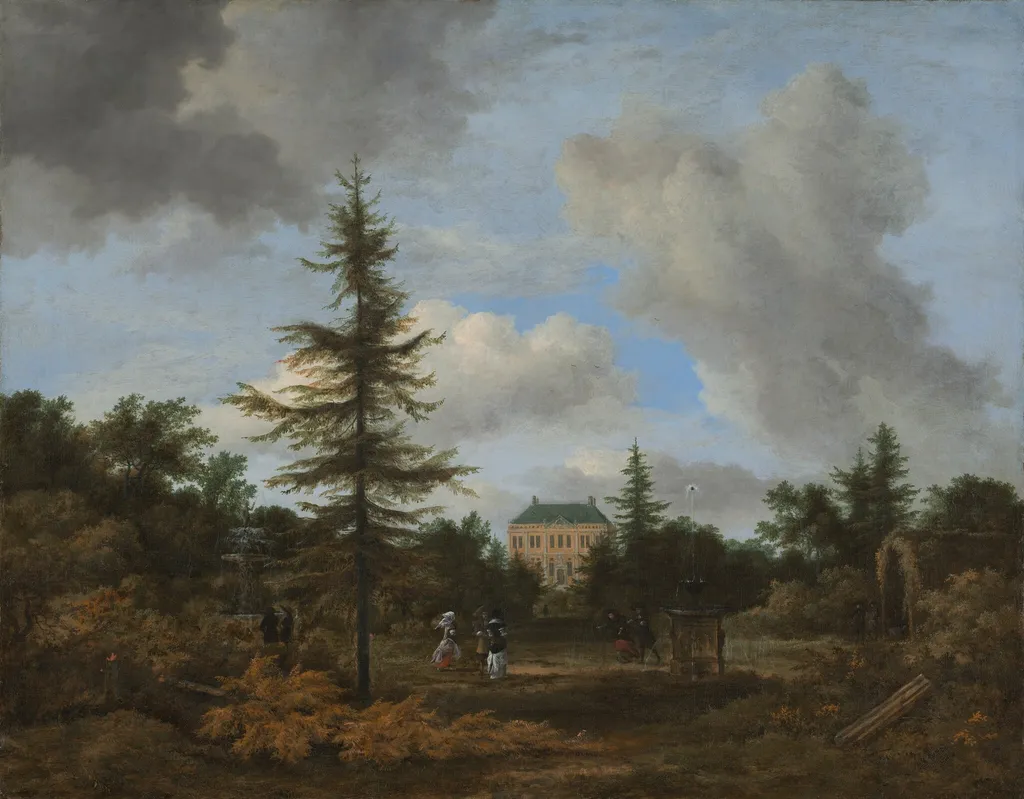
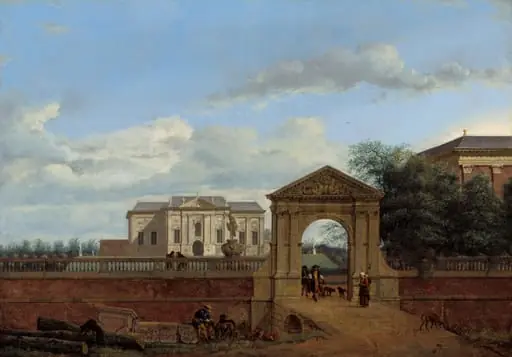
Country House in a Park is an oil painting by the Baroque artist Jacob van Ruisdael. It dates from 1675 and is held in the collection of the National Gallery of Art.
- Inscription
- Inscribed:lower left: J v Ruisdael (JvR in ligature)
About this work
A trick fountain startles two figures in the wild garden of an imaginary Dutch estate, spruces towering over a classical villa in the distance. Jacob van Ruisdael signed it at the lower left, and pentimenti show he once raised the roofline and moved a fountain. Bequeathed by Rupert L. Joseph in 1960, it entered the National Gallery of Art; a 1993 restoration redated it to the mid-1670s.
History & Provenance
The painting later passed to the latter's son, George Halifax Lumley-Savile, 3rd Baron Savile (1919–2008).
Dated to 1675, Country House in a Park was painted by Jacob van Ruisdael. Its early provenance is linked to the Savile family of Rufford Abbey, Nottinghamshire, possibly owned by Sir John Savile, 1st Baron Savile (1818–1896), or his nephew John Savile Savile-Lumley, 2nd Baron Savile (1853–1931). The painting later passed to the latter's son, George Halifax Lumley-Savile, 3rd Baron Savile (1919–2008).
It was sold at Christie, Manson & Woods, London, on 18 November 1938 (lot no. 123). Subsequently owned by Rupert L. Joseph of New York (d. 1959), the work was bequeathed to the National Gallery of Art, Washington, D.C., in 1960.
The painting is in the collection of the National Gallery of Art, Washington, D.C. It entered the museum in 1960 as a bequest from Rupert L. Joseph. Previously, it was owned by the Savile family and sold in 1938. During Joseph’s ownership, the painting was exhibited on loan at the Joslyn Art Museum, Omaha, in 1942 and at the Museum of Fine Arts, Springfield, Massachusetts, from 1948 until at least 1955.
Overview
Jacob van Ruisdael's Country House in a Park presents an idealized vision of a Dutch estate, rather than a specific location. The painting emphasizes a sprawling wilderness garden, where towering Norwegian spruces frame a distant classical villa. Figures explore the grounds, with a trick fountain surprising two individuals at the center.
Ruisdael incorporated symbolic elements in the foreground, contrasting the garden's fleeting pleasures with the inevitability of time's passage.
Subject & Meaning
This painting reflects the 17th-century Dutch trend of depicting elegant country estates, a popular subject as wealthy merchants built grand residences. Ruisdael, however, conceived an imaginary villa, its classical façade echoing designs like Pieter Post's Vredenburgh. The expansive, informal garden, featuring imported Norwegian spruces, dominates the composition.
Amidst leisurely figures and elaborate fountains, including a playful "manneken pis" and a trick fountain, the artist subtly introduces vanitas symbols like a broken tree and architectural debris, suggesting the transient nature of earthly delights.
Technique & Style
Ruisdael's characteristic approach to landscape is evident in this work, despite the unusual subject matter for him. The artist's hand is revealed through pentimenti, showing initial compositional changes such as a higher roofline for the villa and an altered fountain placement. While earlier scholarship attributed a restrained brushwork to the artist's later years, subsequent restoration efforts have led to a revised understanding of its execution, placing it earlier in his career.
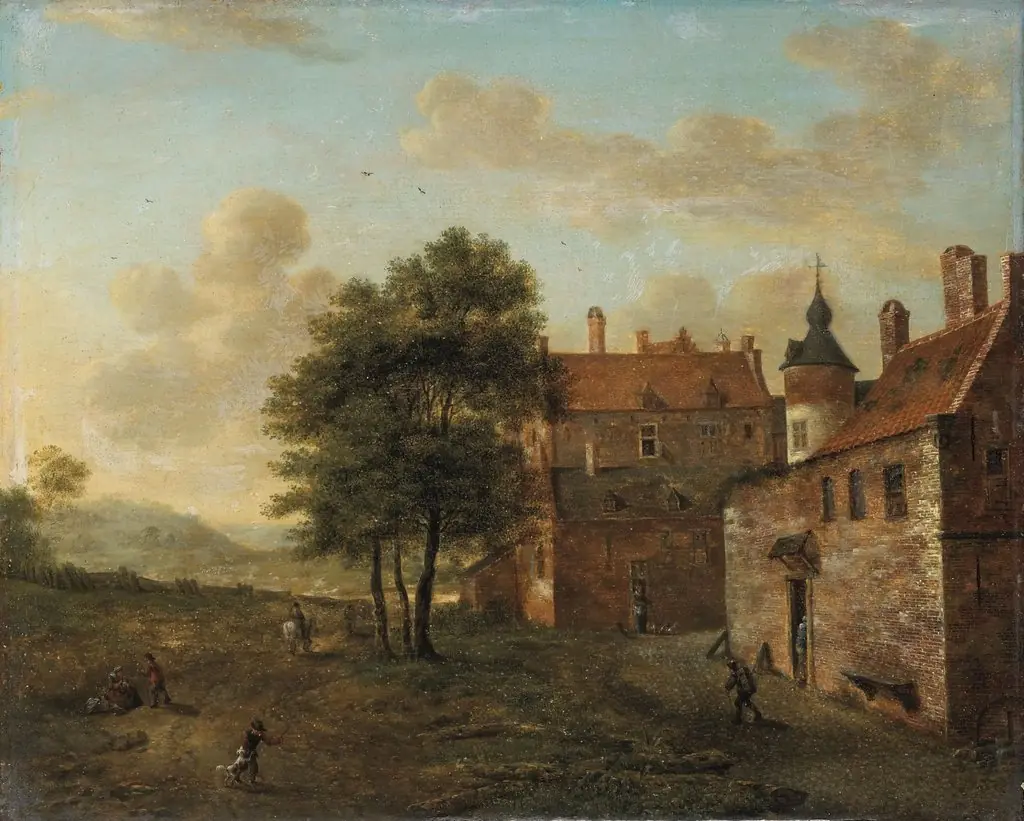
Own this work as a print
Artist & collection
Artist
Jacob Isaackszoon van Ruisdael was a Dutch painter, draughtsman, and etcher. He is generally considered the pre-eminent landscape painter of the Dutch Golden Age, a period of great wealth and cultural achievement when…