Artwork
Skeletons fighting over a Hanged Man
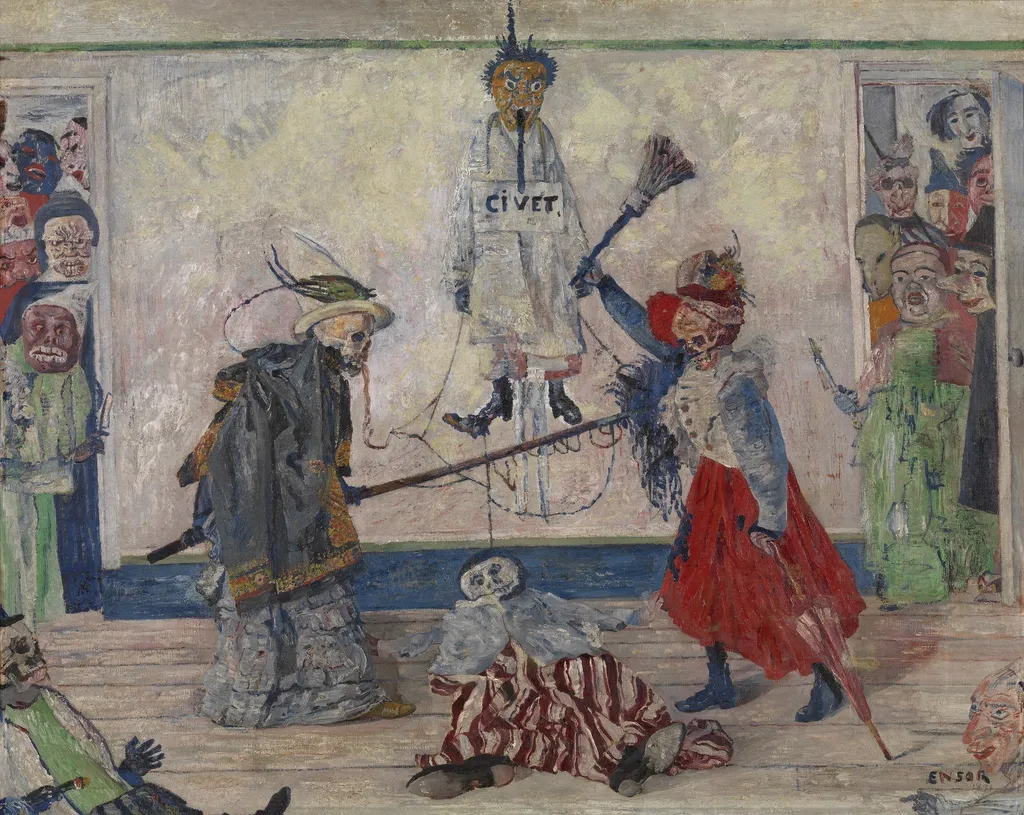
Skeletons fighting over a Hanged Man is an oil painting by the Post-Impressionist artist James Ensor. It dates from 1896 and is held in the collection of the Royal Museum of Fine Arts Antwerp.
About this work
Subject & Meaning
A placard around the corpse's neck labels it "civet," the French term for a hare stew, reducing the prize to a piece of meat to be fought over.
Ensor's painting stages a macabre allegorical drama in which two skeletons, dressed in women's clothing and masks, fight with brooms and umbrellas over a hanged corpse suspended behind them. A loose web links the dangling body to the combatants, while masked extras carrying knives observe the quarrel from both wings of the stage. A placard around the corpse's neck labels it "civet," the French term for a hare stew, reducing the prize to a piece of meat to be fought over. The work operates as a satirical allegory of human condition and contemporary society. One reading casts the two quarrelers as Ensor's wife and mistress, with the artist himself as the helpless body they contest. A more androgynous interpretation sees them as a bitter caricature of his critics, depicted as haggling fishwives, with the painter again as the powerless prize and the masked onlookers standing in for a divided public. The Spanish-language analysis adds a class dimension: the left figure wears upper-class dress with a stuffed bird on her hat, the right figure lower-class attire, framing the scene as a critique in which the wealthy seize the poor's meager possessions while politicians, the hanged man, submit to their will.
Technique & Style
The painting is executed in oil on canvas, measuring 59 cm in height and 74 cm in width, and belongs to the genre of fantastic art. It depicts two masked skeletons, dressed in women's attire, engaged in a theatrical confrontation using brooms and umbrellas, with a hanging corpse described as 'civet' linked to them by a loose web; extras in grotesque masks and carrying knives observe the scene. Formal qualities include the stark contrast between the skeletal figures and the fleshy, lifelike corpse, the use of symbolic objects such as the hare stew reference, and the compositional tension created by the web and the surrounding watchers. Stylistically, the work combines symbolist imagery with grotesque elements, reflecting Ensor's satirical critique of social and artistic criticism.
History & Provenance
Created in 1891, *Skeletons Fighting over a Hanged Man* is an oil painting on canvas by the Belgian Symbolist James Ensor. The work is currently held in the collection of the Royal Museum of Fine Arts Antwerp. While the source material confirms the creation date and the artist's identity, it does not provide specific details regarding the original commission, the precise circumstances of its creation, or a detailed chain of previous ownership prior to its arrival at the museum. The painting measures 59 cm in height and 74 cm in width.
James Ensor's 1891 oil painting *Skeletons Fighting over a Hanged Man* is held in the collection of the Royal Museum of Fine Arts Antwerp. The work is located within the museum in Antwerp, Belgium. While the sources confirm the painting's presence in this institution and its creation date, they do not provide a specific inventory or accession number for the piece. Additionally, the available documentation does not list any exhibition history for the work, focusing instead on its attribution, physical dimensions, and iconographic analysis.
Context
James Ensor's 1891 painting Skeletons fighting over a Hanged Man depicts a theatrical scene with two skeletons in women's clothing engaged in combat, wielding items such as brooms and umbrellas, while a corpse hangs nearby. Behind them, masked figures observe the struggle, and a loose rope connects the body to the combatants. The work is interpreted as an allegory reflecting Ensor's views on criticism and social dynamics, with some scholars suggesting the skeletons represent his wife and mistress contesting his affections, while others see them as symbols of his embittered stance toward critics, with the hanging figure acting as an arbiter. The painting is part of the collection at the Royal Museum of Fine Arts Antwerp and exemplifies Ensor's symbolic, satirical approach to human condition and society.
The analysis draws on scholarly interpretations of the work's symbolic elements, including its satirical commentary on class and gender, as well as its place within Ensor's broader Symbolist practice and his engagement with contemporary social tensions.
Own this work as a print
Artist & collection
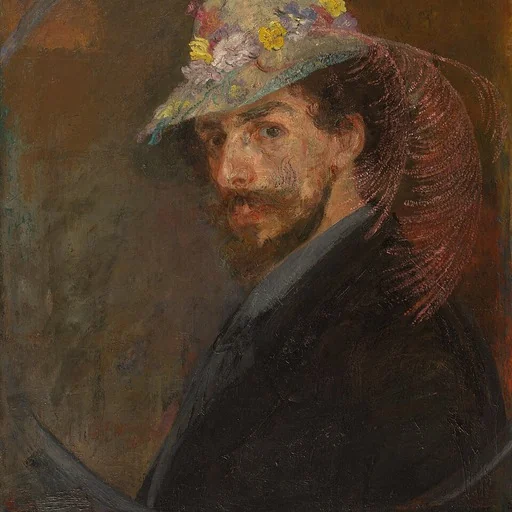
Artist
James Sidney Edouard, Baron Ensor (13 April 1860 – 19 November 1949) was a Belgian painter and printmaker, an important influence on expressionism and surrealism who lived in Ostend for most of his life.