Artwork
The Paalhuis and the Nieuwe Brug, Amsterdam, in the winter
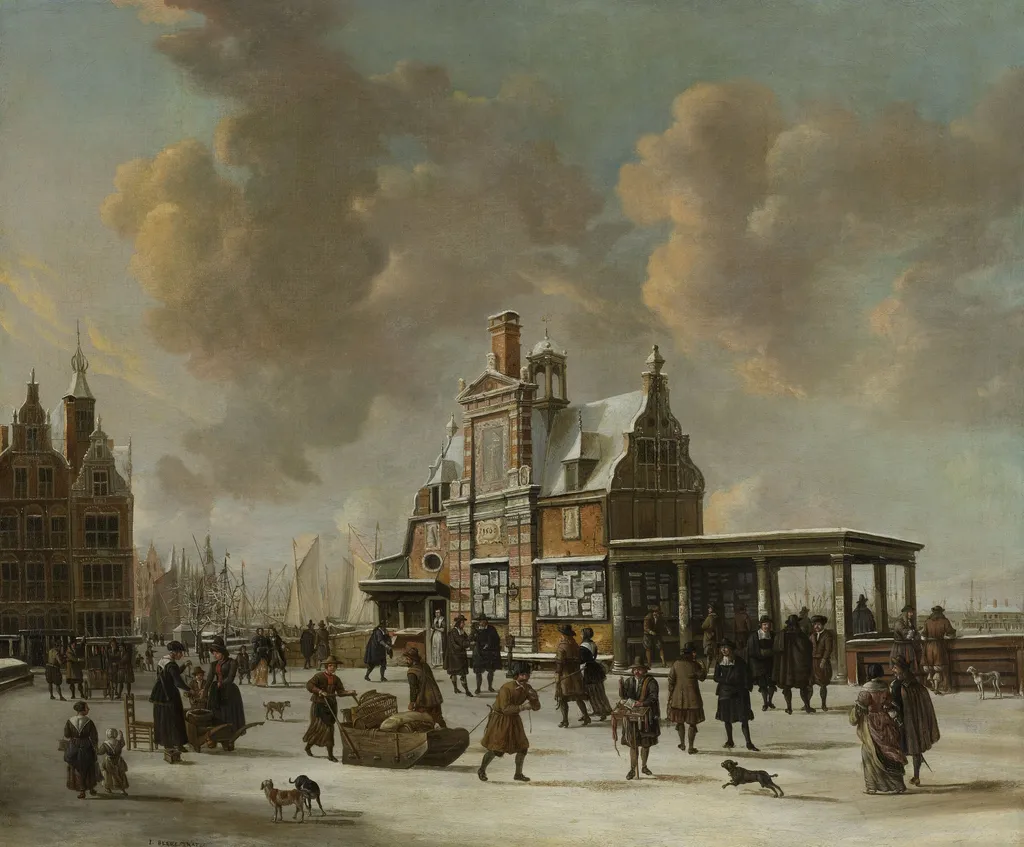
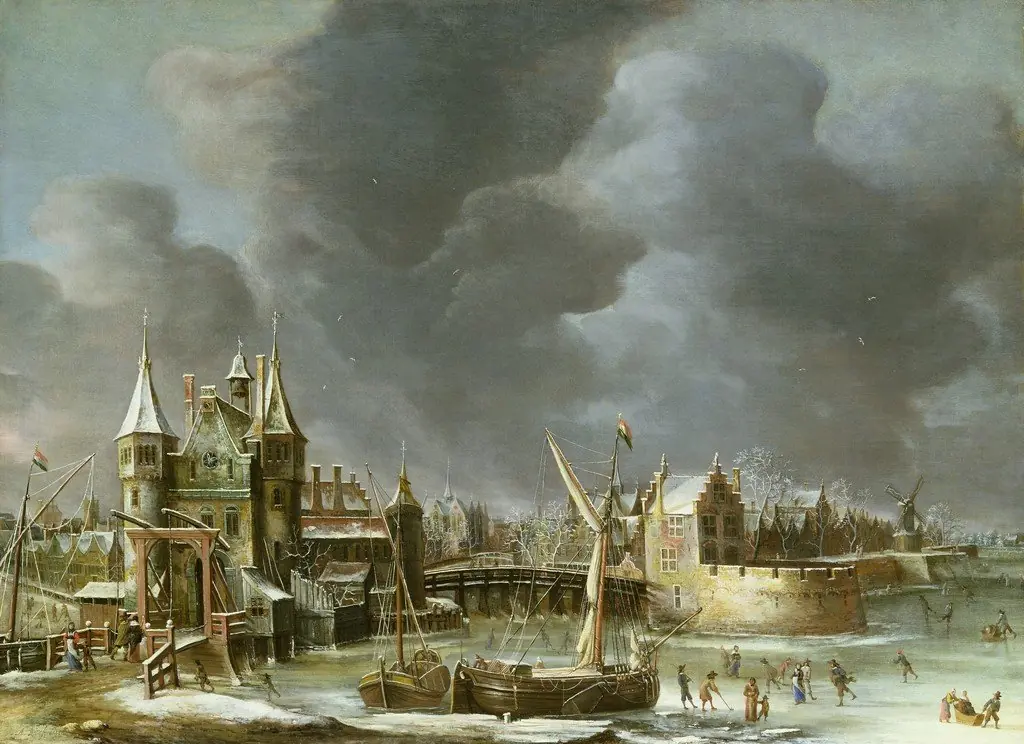
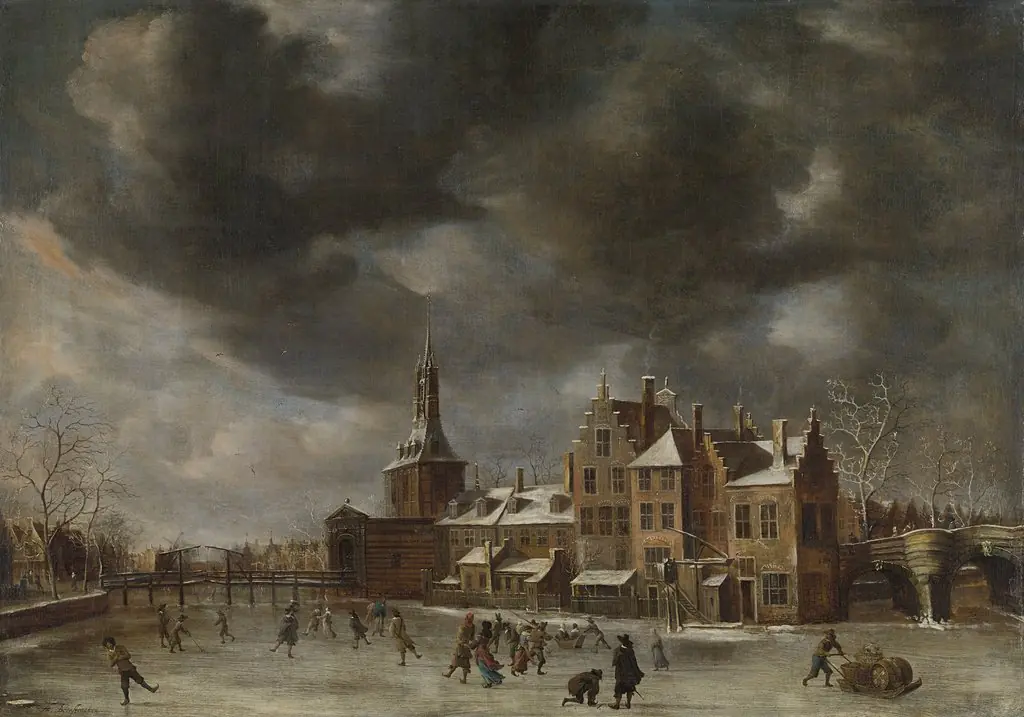
The Paalhuis and the Nieuwe Brug, Amsterdam, in the winter is an oil painting by the Dutch Golden Age artist Jan Abrahamsz Beerstraaten. It dates from 1653 and is held in the collection of the Rijksmuseum.
About this work
Subject & Meaning
The scene is animated by foreground figures, including street vendors and a couple pulling a sled, which enlivens the topographical record.
The painting depicts a winter cityscape of Amsterdam viewed from the Nieuwe Brug, centering on the Paalhuis situated along the IJ. To the far left, the House with the Little Tower stands at the corner of the Damrak and Texelse Kade, while the Haringpakkerstoren appears in the background and the Nieuwe Stadsherberg is visible on piles to the right. The scene is animated by foreground figures, including street vendors and a couple pulling a sled, which enlivens the topographical record.
Historically, the Paalhuis functioned as a toll collection point for harbor dues and served as a post office for ships starting in 1598 to ensure mail reached literate recipients. Posted schedules for local packet boats on the building's columns and gallery pillars further document the area's commercial activity before the structure's mid-17th-century demolition.
Technique & Style
The work is an oil painting on canvas, executed in 1653 by Jan Abrahamsz Beerstraaten. Its handling emphasizes topographical precision and atmospheric winter effects, with crisply rendered architectural details and a subdued palette of grays, whites, and earth tones to convey cold, overcast conditions.
Formal qualities include a low horizon that anchors the composition in the frozen river and foreground activity, while layered architectural forms, from the Paalhuis to distant towers, establish a receding spatial order. The figures, including street vendors and a sleigh-pulling couple, animate the scene without disrupting its measured, documentary character.
History & Provenance
The painting was created in 1653 by Jan Abrahamsz Beerstraaten, who signed it in the lower left corner as 'I.BEERESTRAT[EN]'. It entered the collection of Rotterdam-based patron Gerrit van der Pot, who owned it until its purchase by the Rijksmuseum on 6 June 1808 from his estate sale in Rotterdam. The work was subsequently placed on long-term loan to the Amsterdam Museum in 2001.
The painting was acquired by the Rijksmuseum on 6 June 1808 at the estate auction of the Rotterdam collector Gerrit van der Pot, heer van Groeneveld. It is also recorded as having been owned by the Rijksmuseum and by Gerrit van der Pot, and is held in the collections of both the Rijksmuseum and the Amsterdam Museum. In 2001 the Rijksmuseum transferred the work on long-term loan to the Amsterdam Museum, where it is currently located.
No exhibition history beyond its acquisition and subsequent loan is documented in the available sources.
Context
The painting belongs to the tradition of Amsterdam topographical painting, a practice in which Jan Abrahamsz. Beerstraaten and his family were prominent. According to Dutch-language scholarship, Beerstraaten came from a family of Amsterdam topographical painters, and in this work he combines his skills as a winter landscape and figure painter with a recognizable urban location.
The scene depicts the Paalhuis on the IJ, the Nieuwe Brug, and surrounding landmarks including the Haringpakkerstoren and the Nieuwe Stadsherberg, with street vendors and figures pulling a sleigh animating the foreground. The work is signed 'I.BEERESTRAT[EN]' at the lower left and is held in the Amsterdam Museum, on long-term loan from the Rijksmuseum since 2001. Its provenance traces to the Rotterdam collector Gerrit van der Pot, heer van Groeneveld, from whose estate sale the Rijksmuseum acquired the painting on 6 June 1808.
Overview
In 1653 Jan Abrahamsz Beerstraaten painted a winter view of Amsterdam that captures the bustling activity around the Paalhuis and the Nieuwe Brug. Executed in oil on canvas, the composition presents a snow‑covered square filled with pedestrians, carts, and distant ships, all framed by the distinctive brick building with its steep roof.
Own this work as a print
Artist & collection
Artist
Jan Abrahamsz Beerstraaten or Johannes (Beerstrat or Bierstraten) (bapt. 1 March 1622 in Amsterdam – buried 1 July 1666) was a Dutch painter of marine art, particularly of events of the First Anglo-Dutch War and…