Artwork
Adam and Eve in Paradise
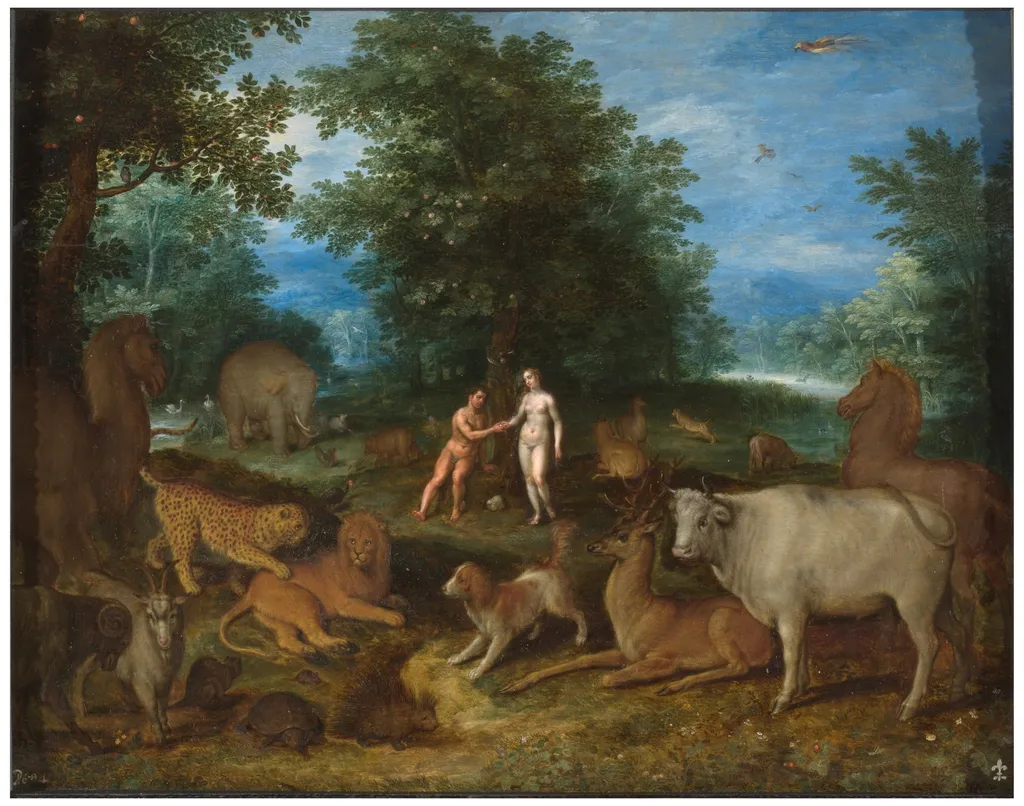
Adam and Eve in Paradise is an oil painting by the Flemish Baroque painting artist Jan Brueghel the Younger. It dates from 1618 and is held in the collection of the Museo del Prado. Created in 1618, this oil painting presents a verdant garden where the first humans stand beside a central tree.
About this work
Subject & Meaning
The imagery aligns with traditional Christian iconography concerning the first humans, emphasizing their central role in theological accounts of human origins.
Jan Brueghel the Younger's 1618 oil painting on panel depicts the biblical figures Adam and Eve within the setting of Paradise. As a work of religious art, the composition focuses on the two protagonists of the Genesis creation narrative, illustrating the moment before the Fall of Man. The presence of these specific figures in a garden environment serves as a visual representation of the state of original innocence and the divine order prior to the introduction of sin.
The imagery aligns with traditional Christian iconography concerning the first humans, emphasizing their central role in theological accounts of human origins.
Technique & Style
The painting is executed in oil on wooden panel, a technique characteristic of early 17th‑century Flemish religious works. Brueghel renders the figures of Adam and Eve with fine brushwork that emphasizes delicate flesh tones and intricate foliage, creating a luminous surface that blends narrative clarity with decorative detail. The composition balances naturalistic anatomy with a richly patterned ornamental border, reflecting the artist’s signature blend of realism and ornamental flourish.
These formal qualities are heightened by the smooth handling of the paint, which yields a polished finish typical of courtly patronage in the Spanish royal collection.
History & Provenance
Adam and Eve in Paradise was painted by Jan Brueghel the Younger in 1618, executed in oil on panel. The ownership chain can be traced through several Spanish monarchs, beginning with Philip V of Spain and subsequently passing to Elisabeth Farnese. The work later entered the collection of Charles III of Spain and was subsequently held by Ferdinand VII of Spain.
The painting is now part of the collection of the Museo del Prado, with associated locations recorded at the Royal Palace of Aranjuez and the Royal Palace of La Granja de San Ildefonso.
The painting Adam and Eve in Paradise by Jan Brueghel the Younger is held in the collection of the Museo del Prado, where it is recorded under inventory number P00866. It entered the royal collections of Spain through the ownership of Ferdinand VII, Charles III, Elisabeth Farnese, and Philip V, and has been displayed in exhibitions focused on Flemish and Spanish Baroque art at the museum.
The work measures 40 cm in height and 50 cm in width, was completed in 1618, and is classified as a religious painting executed in oil on panel.
Overview
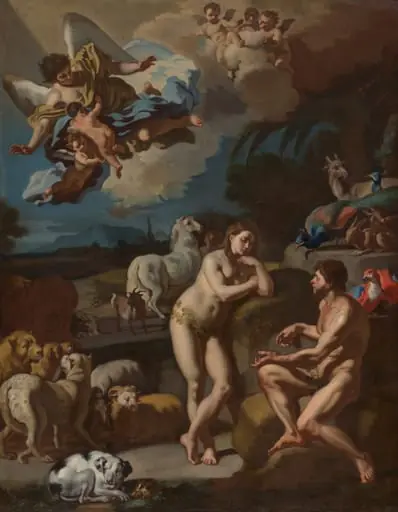
Created in 1618, this oil painting presents a verdant garden where the first humans stand beside a central tree. The composition is populated with a variety of animals, cattle, deer, lions, horses, and a sky of clear blue with scattered clouds. The figures of Adam and Eve appear tranquil, positioned at the heart of an orderly yet bustling natural setting.
Context
Painted during the early 17th‑century flourishing of Flemish Baroque, the piece reflects the period’s interest in combining religious narrative with naturalistic observation. Brueghel the Younger’s inclusion of a wide range of animals mirrors the era’s fascination with cataloguing the natural world, a trend also evident in contemporary scientific and artistic circles.
Own this work as a print
Artist & collection
Artist
Jan Brueghel (also Bruegel or Breughel) the Younger ( BROY-gəl, US also BROO-gəl; Dutch:; 13 September 1601 – 1 September 1678) was a Flemish Baroque painter.