Artwork
Winter Pleasures on the Ice
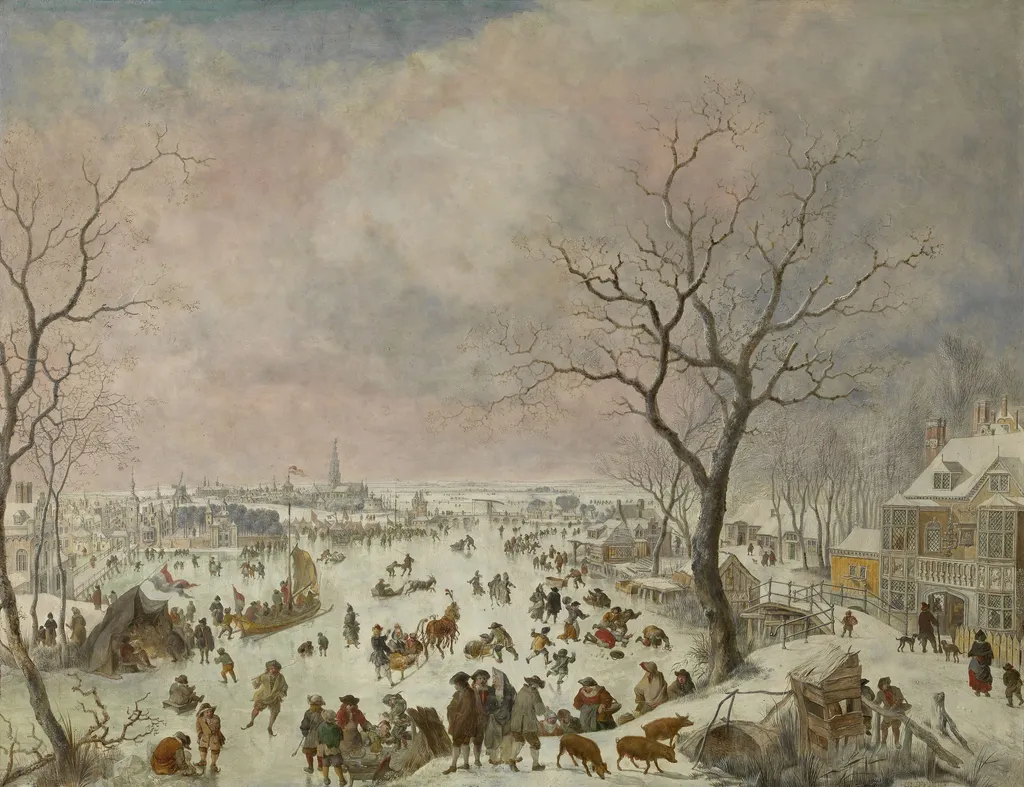
Winter Pleasures on the Ice is an oil painting by the Rococo painting artist Jan Griffier. It dates from 1710 and is held in the collection of the Royal Museum of Fine Arts Antwerp.
About this work
Subject & Meaning
Its creation around 1710–1719 on a copper support preserves its original luminous surface, distinguishing it from typical oil-on-canvas works of the period.
Winter Pleasures on the Ice depicts a festive winter scene on a frozen river, showing people of various social classes engaging in ice skating, sledding, and leisurely travel. The composition includes symbolic elements such as a falling woman illustrating the hazards of ice and the moral caution against reckless behavior, while a kolf stick references the year-round popularity of the game. The work reflects the cultural significance of winter pastimes in early 18th-century Flanders and offers insight into the era's climatic conditions known as the Little Ice Age.
The painting is housed in the Royal Museum of Fine Arts Antwerp, where it has been part of the collection since 1908, acquired from the English-born Dutch dealer John St. Hensé. Its creation around 1710–1719 on a copper support preserves its original luminous surface, distinguishing it from typical oil-on-canvas works of the period.
Technique & Style
Winter Pleasures on the Ice is an oil painting executed on a copper support measuring 49.6 cm in height by 64 cm in width, created circa 1710–1719 by Jan Griffier I. The work depicts a winter scene on a frozen river, showing figures skating, sledding, and ice-boating, with detailed anecdotal elements such as a richly decorated carriage and a figure falling on the ice, possibly symbolizing moral warnings about recklessness. Griffier employed the distinctive technique of painting in oil on copper, which contributed to the painting’s preserved smooth surface and lack of craquelure, differentiating it from canvas works of the period. The composition reflects influences from earlier Dutch winter landscapes, particularly those of Hendrick Avercamp, while incorporating narrative and moral themes characteristic of 17th-century visual allegory.
History & Provenance
Winter Pleasures on the Ice was painted by Jan Griffier I, presumably around 1710, and bears his signature at the lower right. Executed in oil on a copper plate measuring 49.6 by 64 cm, the work depicts a frozen waterway populated by skaters, sledges and an ice boat.
The painting entered the Royal Museum of Fine Arts Antwerp in 1908, when the institution purchased it in London from John St. Hensé, a Dutch artist who had become a naturalized British citizen. Hensé also did business with Henry Clay Frick of The Frick Collection in New York and with the dealers Léonce and Paul Rosenberg.
The 1,000-franc acquisition was funded by the Antwerp connoisseur Oscar Nottebohm (1865–1935), a German-born collector who had amassed his fortune in overseas wholesale trade. Nottebohm was a major patron of Antwerp institutions, bequeathing more than 2,000 books to the museum and donating numerous works of art.
Winter Pleasures on the Ice is held in the collection of the Royal Museum of Fine Arts Antwerp (Koninklijk Museum voor Schone Kunsten Antwerpen). The museum acquired the painting in 1908, purchasing it in London from the English artist John St. Hensé with funds provided by the benefactor Oscar Nottebohm. The acquisition price was recorded as 1,000 francs.
The work is part of the museum's permanent holdings and is not associated with a specific public exhibition history in the provided sources, though its provenance traces back to Nottebohm's legacy of supporting Antwerp institutions.
Overview
Created in 1710, Winter Pleasures on the Ice is a copper painting by Jan Griffier, a Dutch-born artist who spent his career in England. The work presents a bustling winter landscape where figures skate, play, and travel across a frozen river, while a modest settlement and distant city rise along the banks.
Context
The painting reflects the popularity of winter genre scenes in the early 1700s, when frozen waterways became venues for public recreation in northern Europe. Griffier’s depiction aligns with contemporary interests in portraying everyday life, while the Rococo influence signals a shift toward lighter, more decorative visual narratives within the broader Dutch Golden Age tradition.
Own this work as a print
Artist & collection
Artist
Jan Griffier (c. 1652 – 1718) was a Dutch Golden Age painter who was active in England, where he was admitted to the London Company of Painter-Stainers in 1677.