Artwork
The Expulsion from Paradise
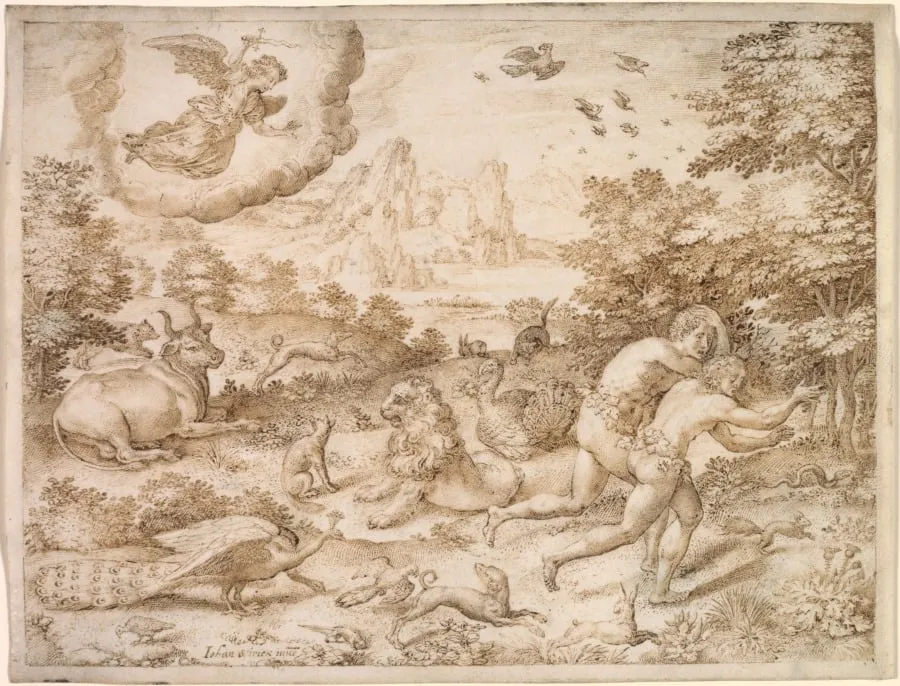
The Expulsion from Paradise is a drawing by the Baroque artist Jan Wierix. It dates from 1606 and is held in the collection of the Cleveland Museum of Art.
- Accession no.
- 1994.16
- Credit line
- Dudley P. Allen Fund
About this work
Overview
This delicate pen-and-ink drawing on vellum is one of twenty-one small-scale illustrations by Jan Wierix depicting scenes from Genesis.
This delicate pen-and-ink drawing on vellum is one of twenty-one small-scale illustrations by Jan Wierix depicting scenes from Genesis. Created in the late 16th century, it captures the moment Adam and Eve are expelled from Eden by a winged angel. The work was designed as part of a devotional album, valued for its intricate detail and intimate scale, meant to be held and examined closely rather than displayed as a large public image.
Subject & Meaning
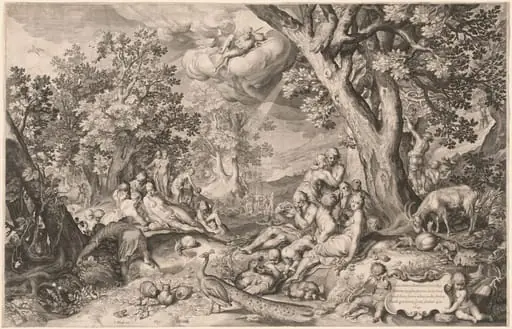
The scene portrays the biblical fall from grace, with Adam and Eve driven from a lush, enclosed garden by an angel. Surrounding animals, birds, deer, and small mammals, observe silently, their calm presence contrasting with the disruption of human sin. The garden, rich with symbolic life, becomes a microcosm of innocence lost, its tranquility shattered by divine judgment and the irreversible consequence of disobedience.
Technique & Style
Wierix employed fine, precise pen strokes to render every feather, leaf, and fur texture with extraordinary clarity. The ink, applied with controlled pressure, creates subtle gradations without washes, relying on line density for depth. The vellum surface enhances the luminosity of the ink, allowing the drawing to retain a luminous, almost luminous quality, akin to miniature painting in its attention to minute naturalistic detail.
History & Provenance
The drawing was part of a commissioned series illustrating Genesis, likely produced for a private collector or religious patron in Antwerp. Such albums of biblical miniatures were popular among Northern European elites in the late Renaissance. Though the full set is now dispersed, this sheet remains among the best-preserved examples, reflecting the high esteem for such works as objects of contemplation and connoisseurship.
Context
In the decades following the Reformation, visual narratives of Genesis gained renewed interest among both Catholic and Protestant patrons seeking morally instructive imagery. Wierix’s drawings, rooted in the tradition of Netherlandish illumination, adapted the precision of manuscript art for the emerging market of collectible drawings, bridging devotional function with aesthetic refinement.
Legacy
Wierix’s technique influenced later generations of draftsmen who sought to capture natural detail with minimal means. While not widely known today, his work exemplifies the Renaissance ideal of the artist as observer, transforming biblical narrative into a quiet, intimate world where every element, from a single leaf to a bird’s wing, carries symbolic weight and emotional resonance.
Artist & collection
Artist
Johannes Wierix (1549 – c. 1620) was a Flemish engraver, draughtsman and publisher. He was a very accomplished engraver who made prints after his own designs as well as designs by local and foreign artists. He further…