Artwork
The Battle of Smolensk, 17th August 1812
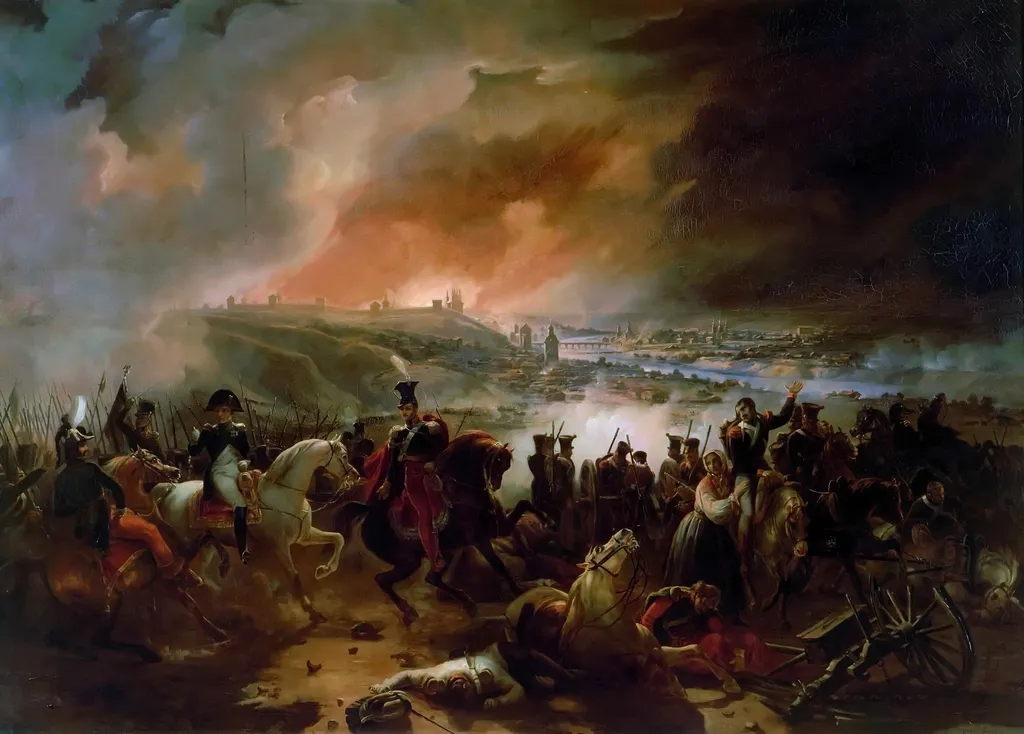
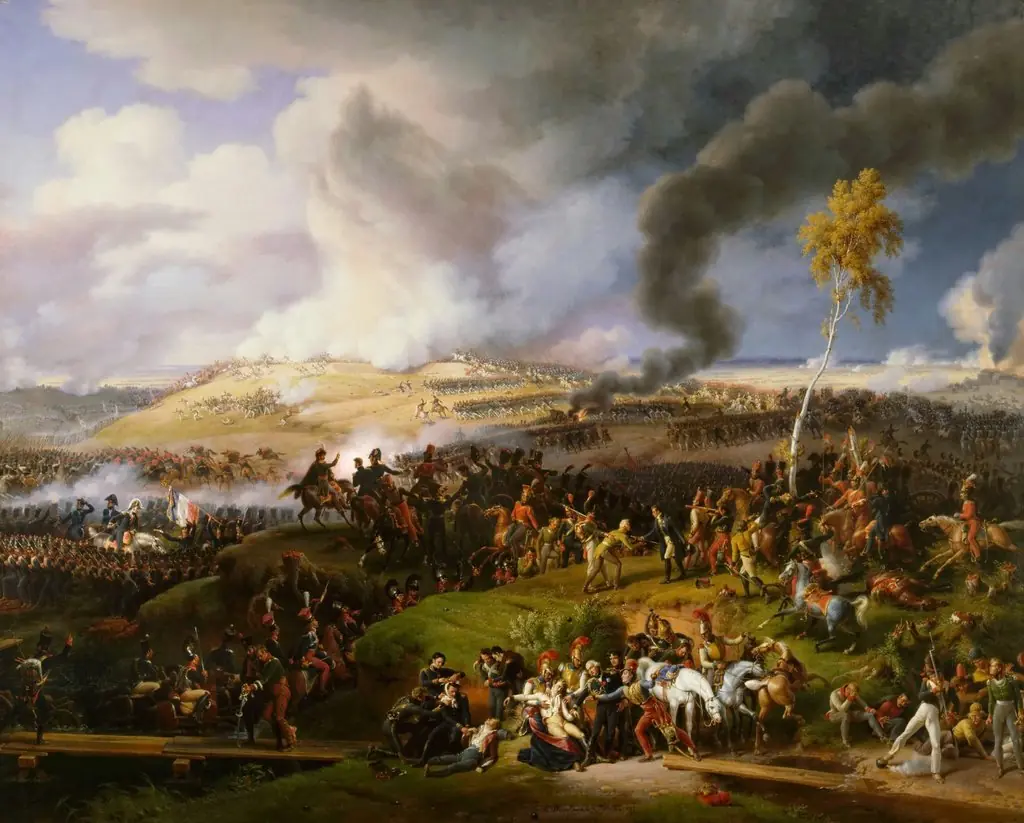
The Battle of Smolensk, 17th August 1812 is an oil painting by Jean-Charles Langlois. It dates from 1839 and is held in the collection of the Palace of Versailles.
About this work
Subject & Meaning
Symbolically the work links military triumph with national devastation, reflecting the era’s narrative of heroic conquest amid destruction.
The Battle of Smolensk, 17th August 1812 portrays the 1812 clash between French and Russian forces as a French victory, emphasizing Napoleon’s command and the Polish commander Józef Poniatowski. The canvas shows the ruined city of Smolensk engulfed in flames, the Dnieper River, and shattered fortifications, while cavalry, infantry, a cart and fleeing peasants illustrate the chaos of war. Symbolically the work links military triumph with national devastation, reflecting the era’s narrative of heroic conquest amid destruction.
Commissioned for the Galerie des Batailles, the painting was exhibited at the 1839 Salon and now hangs in the Palace of Versailles.
Technique & Style
Executed in oil on canvas, The Battle of Smolensk measures 184 cm in height and 259 cm in width. The composition is structured around a panoramic view of the battle, with the burning city of Smolensk straddling the Dnieper in the background. In the foreground, Napoleon and Polish commander Józef Poniatowski are depicted among cavalry and infantry units, underscoring the scene’s historical specificity.
Langlois’s handling emphasizes dramatic contrasts of light and shadow, particularly in the depiction of conflagrations that illuminate the sky and reflect on the river. The painting’s formal qualities align with the grand-manner history tradition, combining topographical accuracy with dynamic movement to convey the scale and intensity of the engagement.
History & Provenance
Jean-Charles Langlois executed this history painting in 1839, depicting the 1812 conflict between French and Russian forces. The work was specifically commissioned by King Louis Philippe I for installation in the Galerie des Batailles at the Palace of Versailles, part of the monarch's broader project to refurbish the royal residence. Upon completion, the canvas was presented to the public at the Salon of 1839, held at the Louvre in Paris.
The painting has remained within the French national collections since its creation. It is currently housed at the Museum of the History of France within the Palace of Versailles, where it continues to be displayed. Museum records list the object under inventory numbers MV 1760, INV 5626, and LP 3712.
The painting is held by the Museum of the History of France at the Palace of Versailles, specifically within the national museums of the châteaux of Versailles and Trianon. Its inventory records include the accession numbers MV 1760, INV 5626, and LP 3712, alongside the Joconde reference 000PE005090. Commissioned by Louis Philippe I for the Galerie des Batailles, the work was first exhibited at the Salon of 1839 in Paris. It remains on permanent display at its original location within the Palace of Versailles.
Context
The Battle of Smolensk, 17th August 1812, painted by Jean‑Charles Langlois in 1839, exemplifies the rise of historicising battle art in the early Third Republic. Executed in oil on canvas, the work was commissioned by Louis‑Philippe I for the Galerie des Batailles and first shown at the 1839 Salon, where it received contemporary acclaim for its dramatic depiction of Napoleonic warfare. Its inclusion in the Palace of Versailles underscores the state’s effort to legitimize recent military narratives through grand public display.
Scholarship notes that the painting belongs to a series of battle scenes by Langlois, reflecting the broader 19th‑century fascination with martial spectacle and the institutionalization of national history. Today it remains on view at the Musée national de Versailles.
Legacy
The Battle of Smolensk, 17th August 1812 was commissioned by Louis Philippe I for the Galerie des Batailles at the Palace of Versailles, a space devoted to French military triumphs. After its debut at the Salon of 1839, the canvas entered the national collection and has remained on display at Versailles ever since. Contemporary reviews praised its dramatic depiction of the burning city and the presence of Napoleon and Józef Poniatowski, cementing its reputation as a key example of early‑19th‑century history painting.
As part of a series of battle scenes by Jean‑Charles Langlois, the work contributed to the visual narrative of the 1812 Russian campaign and continues to influence scholarly interpretations of the conflict.
Overview
The oil painting "The Battle of Smolensk, 17th August 1812" was completed by French artist Jean-Charles Langlois in 1839. This historical work commemorates a significant engagement during Napoleon's Russian campaign of 1812, which resulted in a French victory. The canvas captures the dramatic intensity of the conflict, featuring the burning city of Smolensk in the background and prominent military figures in the foreground. It was part of a larger series of battle depictions by Langlois.
Own this work as a print
Artist & collection
Artist
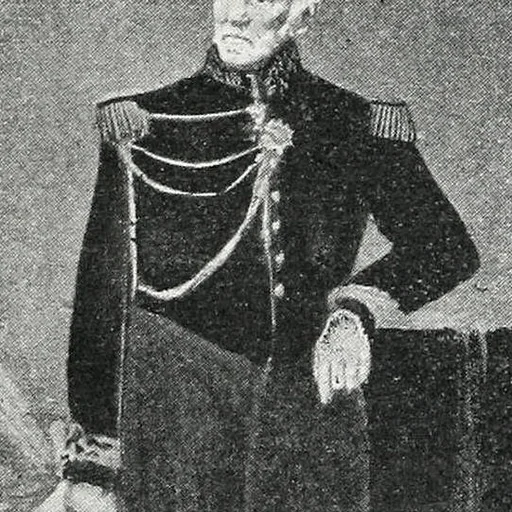
Jean-Charles Langlois (French pronunciation:; 22 July 1789 – 1870), known as The Colonel, was a French soldier, painter and photographer.