Artwork
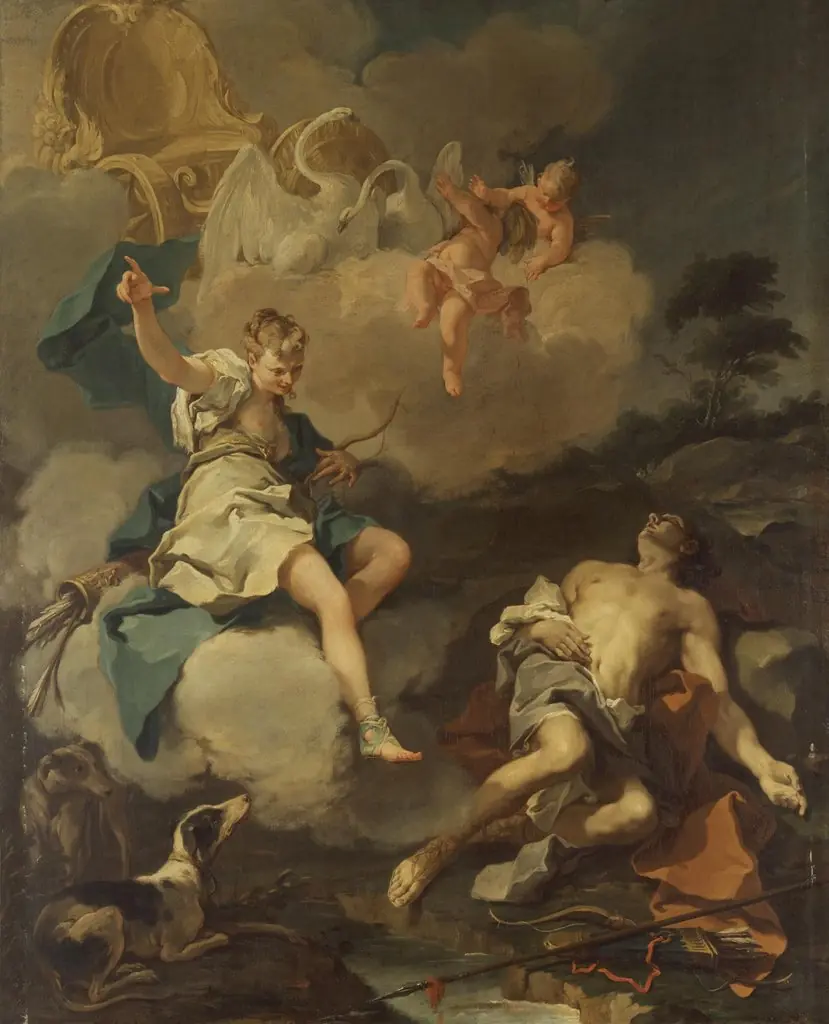
Diana and Endymion
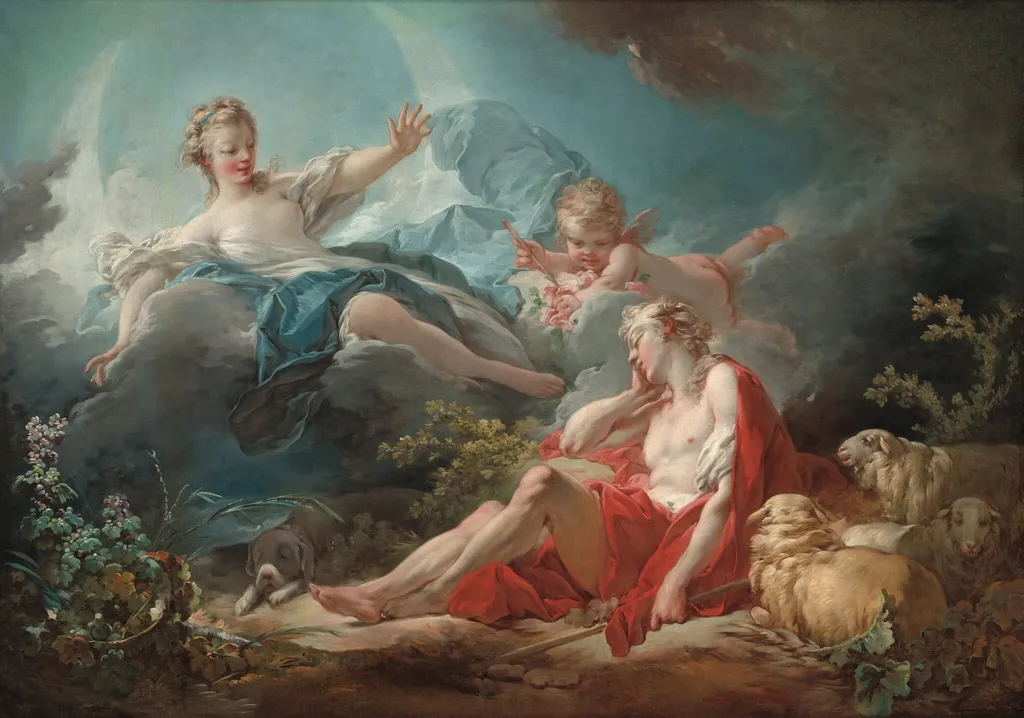
Diana and Endymion is an oil painting by the Rococo painting artist Jean Honoré Fragonard. It dates from 1754 and is held in the collection of the National Gallery of Art.
About this work
Technique & Style
The application of oil paint on a woven canvas support aligns with standard eighteenth-century French academic practices.
Executed in 1753, Jean-Honoré Fragonard's _Diana and Endymion_ is an oil painting on canvas. The work measures 94.9 by 136.8 centimeters, presenting a horizontal format typical for mythological narratives. As a piece classified within the mythological genre, the composition depicts the goddess Diana.
The application of oil paint on a woven canvas support aligns with standard eighteenth-century French academic practices. While specific details regarding the artist's brushwork, surface condition, or varnish layers are not explicitly detailed in the available records, the fundamental material construction remains consistent with Fragonard's early output. The physical object has survived through significant provenance transitions, from the Wallace collection to the National Gallery of Art, retaining its original medium and support structure throughout these ownership changes.
History & Provenance
The painting Diana and Endymion was created by Jean‑Honoré Fragonard in 1753 as an oil on canvas mythological work. Its early ownership began with Sir Richard Wallace, who inherited it and later passed it to his wife Julie‑Amélie‑Charlotte Castelnau and then to their adviser Sir John Murray Scott; it subsequently belonged to Josephine Victoria Sackville‑West before being sold in 1913 to Jacques Seligmann and Co., then to Knoedler in 1914, and in March 1922 to John McCormack, who sold it to William R. Timken in 1924. Timken’s widow Lillian Guyer Timken inherited the piece, which was bequeathed to the National Gallery of Art in 1960. No documentation of a specific commission is recorded.
Jean-Honoré Fragonard's Diana and Endymion (1753) is held in the collection of the National Gallery of Art in Washington, D.C., where it was accessioned in 1960 as a bequest from Lillian Guyer Timken. The painting's provenance traces back to Sir Richard Wallace, who owned it by 1883, before passing through his wife, Lady Wallace, and their secretary, Sir John Murray Scott. It subsequently entered the art market via Jacques Seligmann and Co. and M. Knoedler & Co. before being acquired by John McCormack in 1922 and William R. Timken in 1924.
The work remained in the Timken family until Lillian Guyer Timken's death, at which point it was transferred to the National Gallery. The provided sources detail this ownership history and current location but do not record specific exhibition dates or venues for the work.
Context
Critical scholarship on Fragonard's Diana and Endymion has clarified its provenance and contextual significance, noting early confusion with a Boucher work and tracing its ownership from Sir Richard Wallace through successive dealers to the National Gallery of Art, where it remains on display; the painting exemplifies mid‑18th‑century French mythological painting, reflecting the Rococo fascination with classical themes and the artist’s role in popularizing such subjects, and its inclusion in major collections underscores its recognized artistic and historical value.
Overview
Jean Honoré Fragonard's 'Diana and Endymion' (1754) is an oil on canvas depicting the mythological encounter between the moon goddess Diana and the sleeping shepherd Endymion. Executed early in the artist's career, shortly after his return from the French Academy in Rome, the work demonstrates the influence of his teacher François Boucher and the prevailing Rococo aesthetic. The composition centers on the intimate moment where Diana descends from the sky to gaze upon Endymion, who lies asleep in a pastoral landscape.
Fragonard employs a soft, luminous palette and delicate brushwork to create a dreamlike atmosphere, emphasizing the tenderness of the divine visitation rather than a dramatic narrative. The goddess is portrayed with a gentle demeanor, contrasting with more martial representations of the huntress. This painting reflects Fragonard's mastery of light and his ability to synthesize classical mythology with the sensuous, decorative style characteristic of mid-18th century French art.
It stands as a significant example of his early mythological output before his later, more dynamic and theatrical works.
Subject & Meaning
The painting portrays Diana, the goddess of the hunt and moon, in a tender interaction with Endymion, a mortal youth. While Diana is frequently depicted in art as a powerful and independent figure, Fragonard chose to emphasize a moment of quiet intimacy and vulnerability. This interpretation offers a nuanced perspective on the goddess, highlighting a gentle aspect of her character often overshadowed by her more formidable attributes.
Own this work as a print
Artist & collection

Artist
Jean-Honoré Fragonard was born on 5 April 1732 in Grasse, the son of a glover, and moved with his family to Paris in 1738.