Artwork
A Vignette of Life on the Frontier
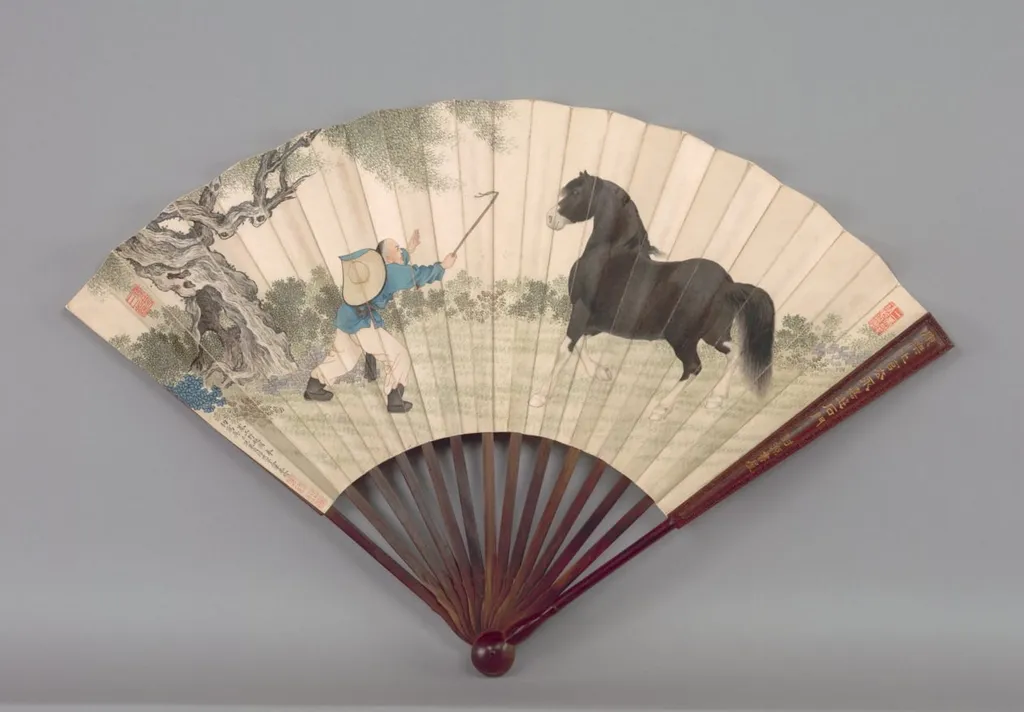
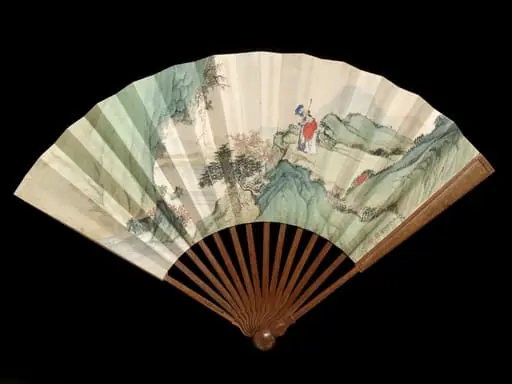
A Vignette of Life on the Frontier is an unspecified painting by the Baroque artist Jiao Bingzhen. It dates from 1720 and is held in the collection of the Cleveland Museum of Art.
- Accession no.
- 1979.18
- Credit line
- Gift of Eleanor and Morris Everett
About this work
To see more work from this time, look up china, qing dynasty (1644-1911), kangxi period (1662-1722).
You see a man in a blue robe leading a white horse past a willow tree on a small fan.
This painting is unusual because two artists worked on it, one Chinese, one Italian. The Chinese artist painted the man and tree; the Italian added the horse later. Both kept their own styles but made it look like one scene.
To see more work from this time, look up china, qing dynasty (1644-1911), kangxi period (1662-1722).
Overview
This fan painting, titled A Vignette of Life on the Frontier, depicts a Manchu horse trainer in a blue robe guiding a white horse past a willow. Executed during the Kangxi reign, the work combines the hand of Chinese court painter Jiao Bingzhen with that of Jesuit artist Giuseppe Castiglione, who contributed the equine figure.
Subject & Meaning
The central figure is a Manchu official, identifiable by his shaved forehead and white temple markings. His posture and gesture follow established Chinese conventions for depicting figures, while the scene offers a documentary glimpse of frontier life, emphasizing the relationship between rider and animal within a natural setting.
Technique & Style
Jiao Bingzhen renders the willow and the trainer with controlled, linear brushwork characteristic of Chinese court painting, emphasizing the twisting trunk and the texture of heavy garments. Castiglione’s horse displays a subtle Western realism, employing modest modeling, perspective, and chiaroscuro to suggest anatomy and movement without overwhelming the composition.
History & Provenance
Created in the early eighteenth century, the fan reflects a collaborative moment when Jesuit missionaries introduced European artistic methods to the Qing court. Both artists adhered to their respective traditions while integrating each other's visual language, a practice that enhanced Castiglione’s reputation as a favored painter to the imperial household.
Context
The work belongs to a period of cultural exchange under the Kangxi Emperor, when the Qing court encouraged the synthesis of Chinese and Western artistic techniques. Such collaborations illustrate the broader diplomatic and artistic interactions between China and European missionaries during the early Qing dynasty.
Artist & collection
Artist
Jiao Bingzhen (simplified Chinese: 焦秉贞; traditional Chinese: 焦秉貞; pinyin: Jiāo Bǐngzhēn; Wade–Giles: Chiao Ping-chen, active 1689–1726) was a native of Jining, Shandong who became a noted painter and astronomer.