Artwork
A Danish Coast. View from Kitnæs on Roskilde Fjord. Zealand
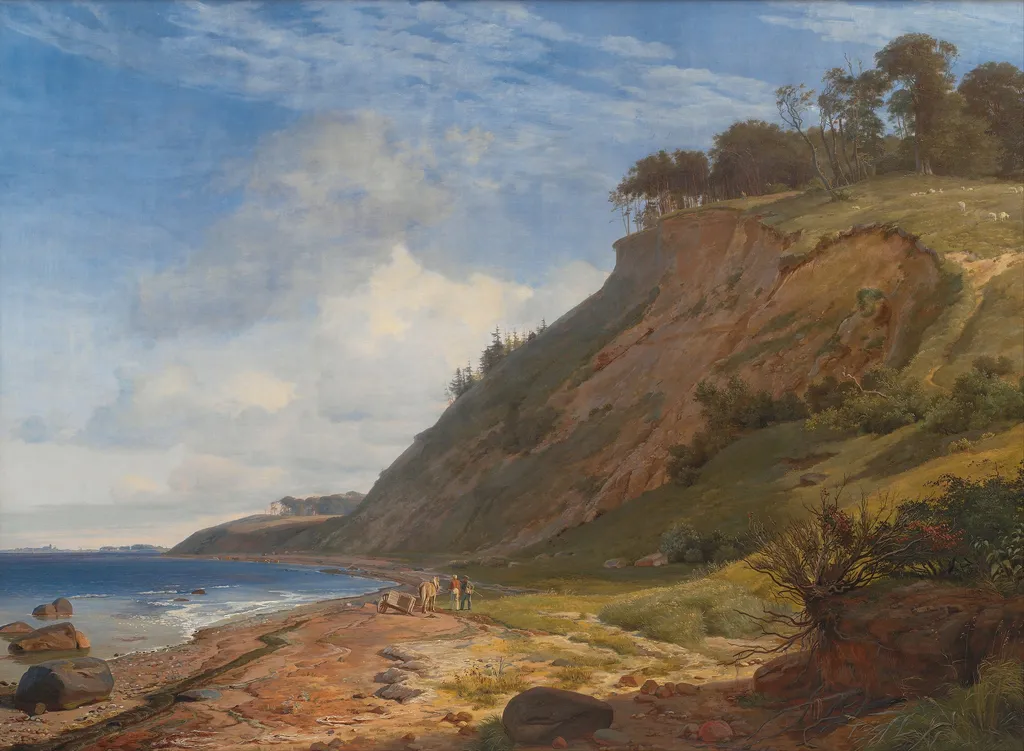
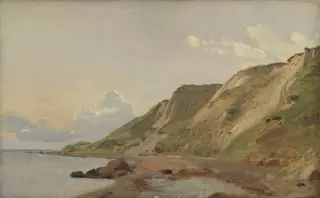
A Danish Coast. View from Kitnæs on Roskilde Fjord. Zealand is an oil painting by Johan Lundbye. It dates from 1843 and is held in the collection of the Statens Museum for Kunst.
About this work
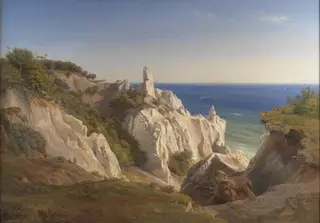
A serene coastal scene: water stretching to the horizon, a rocky shoreline, and a grassy hill topped with a few trees. In the distance, a small group stands on the shore beside a horse-drawn wagon. Johan Lundbye painted it in 1843, using color and light to give the calm scene depth.
Subject & Meaning
In the far distance on the left side of the fjord, the silhouette of a town with church towers and windmills appears as a reference to distant civilization.
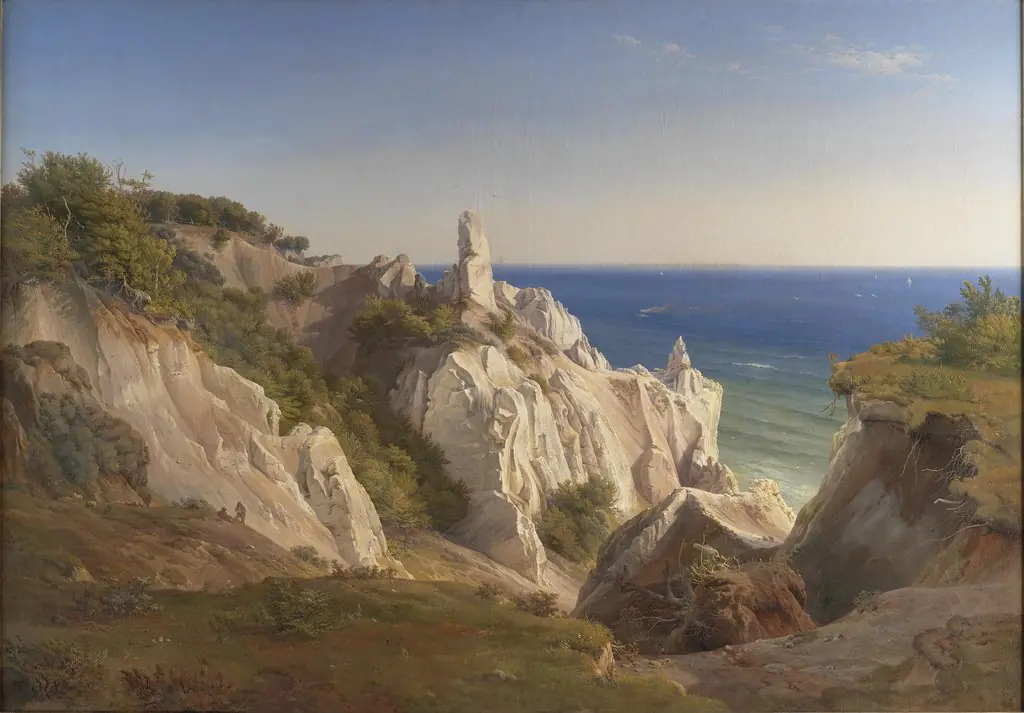
The painting depicts the coastline at Kitnæs on the Roskilde Fjord on the island of Zealand, centered on a massive, steep clay cliff that dominates the right side of the composition. Although the location is based on a real place, Lundbye took considerable artistic license, rendering the cliff considerably higher and more dramatic than it was in reality. Atop the cliff, a herd of sheep grazes in a peaceful meadow, reinforcing the idyllic atmosphere.
At the foot of the cliff, two men and a horse stand beside a horse-drawn wagon with a broken wheel, the figures deliberately small to emphasize the overwhelming scale of nature. In the far distance on the left side of the fjord, the silhouette of a town with church towers and windmills appears as a reference to distant civilization. The broken wagon functions as a veiled autobiographical comment: Lundbye, troubled by artistic doubt during painting, wrote in his diary that he recognized himself in the disabled cart, unable to move forward despite one wheel still turning.
Technique & Style
Executed in oil on canvas, the work measures 203.9 × 271.2 cm. Lundbye rendered the steep clay cliff with thick, layered brushwork that builds up texture and volume, while the sky and distant city silhouette are treated with softer, blended glazes to convey atmospheric recession. The composition balances natural grandeur against human scale: the towering cliff and sweeping fjord dominate the right and center, while small figures, a pair of men and a horse with a broken cartwheel, anchor the lower left, their diminutive scale emphasizing the sublime presence of the landscape. The palette favors earthy ochres and greens for the terrain, contrasted with muted blues and whites in the sky, reinforcing the quiet, reflective mood of Danish National Romanticism.
History & Provenance
Johan Thomas Lundbye created A Danish Coast. View from Kitnæs on Roskilde Fjord. Zealand in 1843, though the canvas bears the signature date 1842.
The artist began preparatory studies during the summer of 1842 near Jægerspris before completing the large-scale oil painting in early 1843. Driven by the nationalist call of art historian Niels Laurits Høyen to document Danish heritage, Lundbye finished the work just before its debut at the spring exhibition at Charlottenborg in March 1843. On May 17, 1843, the painting was acquired by the Royal Picture Collection (Den Kongelige Malerisamling) for 400 rigsdalers.
This transaction marked the first time a work by the then 25-year-old Lundbye entered the national gallery. The painting remains in the collection of the Statens Museum for Kunst in Copenhagen, where it is housed today.
In modern times, the work has been featured in significant surveys including 'Dansk Guldalder - Verdenskunst mellem to katastrofer' and 'The Mirror of Nature: Nordic Landscape Painting 1840-1910'.
Context
Created during a surge of national consciousness encouraged by art historian Niels Laurits Høyen, this 1843 canvas is regarded as a paramount example of Danish National Romanticism and the Danish Golden Age. Although based on a real location at Roskilde Fjord, Johan Lundbye dramatically exaggerated the cliff's height to emphasize nature's overwhelming scale against small human figures. The work contains an autobiographical element where a broken wagon wheel symbolizes the artist's personal creative doubts.
Upon its debut at the Charlottenborg spring exhibition, it became the first piece by the twenty-five-year-old painter acquired for the Royal Painting Collection. Its significance was later underscored by Nobel laureate Johannes Vilhelm Jensen, who declared it the definitive artistic representation of the Danish landscape.
Legacy
A Danish Coast. View from Kitnæs on Roskilde Fjord became a defining example of the Danish Golden Age's national-romantic landscape tradition, influencing later generations of artists who sought to elevate the local environment as a symbol of cultural identity. Its purchase by the Royal Painting Collection in 1843, shortly after its debut at the Charlottenborg Spring Exhibition, cemented its status as a canonical work of the period.
The painting's dramatic composition and thematic emphasis on national heritage were repeatedly cited in art-historical surveys, including Johannes V. Jensen's assertion that it embodied the essence of Danish nature in a single image. Its inclusion in major exhibitions such as 'Dansk Guldalder – Verdenskunst mellem to katastrofer' and 'The Mirror of Nature' (Nordic Landscape Painting 1840–1910) reinforced its legacy as a touchstone for Danish landscape painting. The work remains a cornerstone of the Statens Museum for Kunst's collection, frequently referenced in studies of nineteenth-century Danish art.
Overview
Johan Lundbye's A Danish Coast. View from Kitnæs on Roskilde Fjord. Zealand, painted in oil in 1843, exemplifies the national romantic current in Danish art.
This landscape captures a tranquil moment along Roskilde Fjord, showcasing the natural beauty of the Zealand region. The work reflects a broader artistic trend of the period, emphasizing the distinct character of the Danish homeland through its scenery. It is currently housed at the Statens Museum for Kunst.
Own this work as a print
Artist & collection
Artist
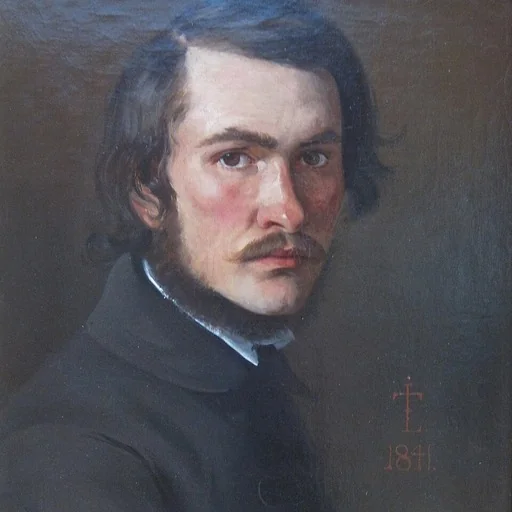
Johan Thomas Lundbye (1 September 1818 – 25 April 1848) was a Danish painter and graphic artist, known for his animal and landscape paintings.