Artwork
The Granite Bowl at the Lustgarten, Berlin
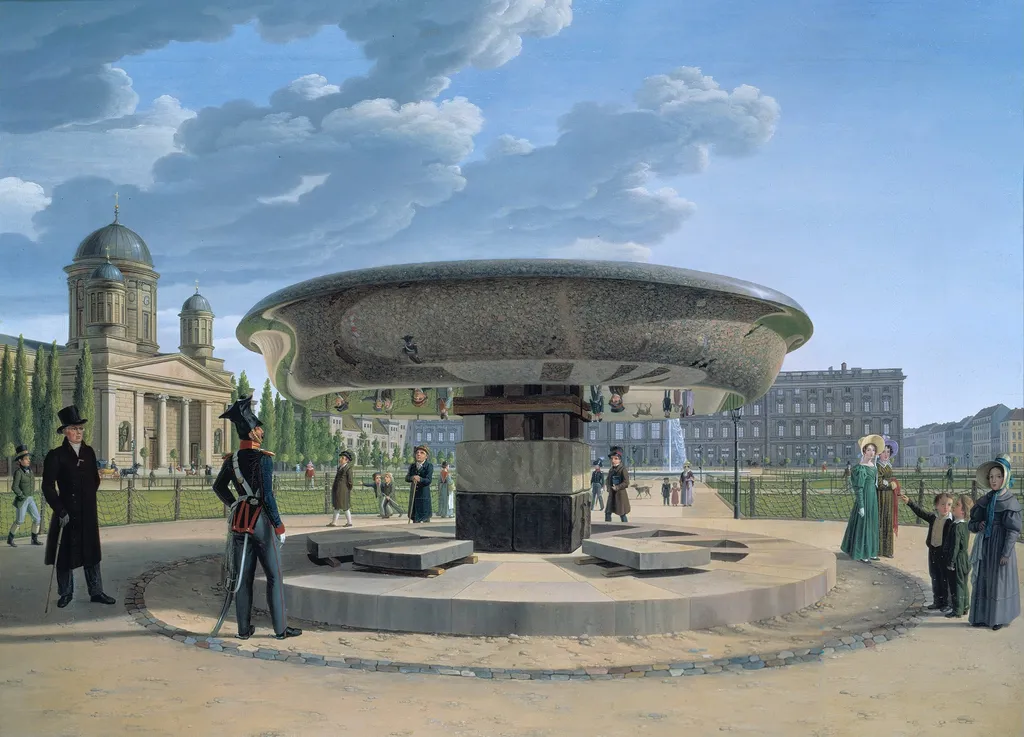
The Granite Bowl at the Lustgarten, Berlin is an oil painting by the Biedermeier artist Johann Erdmann Hummel. It dates from 1831 and is held in the collection of the Alte Nationalgalerie.
About this work
Subject & Meaning
The painting shows the Lustgarten in Berlin, centered on a granite bowl surrounded by recognizable landmarks such as the Berlin Cathedral and the Berlin Palace.
The painting shows the Lustgarten in Berlin, centered on a granite bowl surrounded by recognizable landmarks such as the Berlin Cathedral and the Berlin Palace. Symbolic elements include the Christian Gottlieb Cantian figure, suggesting a contemplative view of the city’s cultural and religious heritage. The work reflects the 19th‑century fascination with urban monuments and the interplay of nature and architecture within the Prussian capital.
Technique & Style
The work is an oil painting executed on canvas, reflecting the conventional materials of early‑19th‑century German academic art. Hummel’s handling of light and atmospheric perspective emphasizes the surrounding Lustgarten setting while the granite bowl anchors the composition in a tangible, almost sculptural presence. Formal analysis notes a restrained palette and precise brushwork that convey both the texture of stone and the softness of foliage, aligning with the neoclassical emphasis on clarity and order. The painting’s condition is stable, with no documented alterations to its original support or surface treatment.
History & Provenance
Created in 1831 by Johann Erdmann Hummel, this oil painting depicts the Granite Bowl at the Lustgarten in Berlin, showing the Berlin Cathedral and Palace. It entered the collection of Richard Bialon and has been exhibited in major institutions including the Alte Nationalgalerie and the National Gallery of Art in Washington, D.C., notably during the 1906 Jahrhundertausstellung deutscher Kunst. The work is part of the holdings of several prominent museums, such as the Cleveland Museum of Art, Yale University Art Gallery, and the Victoria and Albert Museum.
Its dimensions measure 66 cm in height by 89 cm in width, and it was completed in the same year it was painted.
The Granite Bowl at the Lustgarten, Berlin (1831) is an oil paint work by Johann Erdmann Hummel. It is held in the Alte Nationalgalerie as part of its collection. The painting has been exhibited in the Jahrhundertausstellung deutscher Kunst in 1906.
The work is listed in the inventory of the Alte Nationalgalerie and has traveled to several institutions including the Cleveland Museum of Art, Yale University Art Gallery, the Art Institute of Chicago, the Victoria and Albert Museum, the Royal Academy of Arts in Bonn and Düsseldorf, the Germanisches Nationalmuseum, the National Gallery in Berlin, Weimar, and the National Gallery of Art in Washington, D.C.
Its provenance includes ownership by Richard Bialon, and it was featured in the 1906 Jahrhundertausstellung deutscher Kunst exhibition.
Context
Johann Erdmann Hummel's 1831 oil painting The Granite Bowl at the Lustgarten, Berlin, depicts the Berlin park with the Granite Bowl, Berlin Cathedral, and Berlin Palace, reflecting early 19th-century German landscape interests. Its provenance includes ownership by Richard Bialon and exhibition at the 1906 Jahrhundertausstellung deutscher Kunst. The work appears in multiple institutional collections, including the Alte Nationalgalerie and Yale University Art Gallery, and is documented in scholarly sources as part of Hummel's broader oeuvre and the period's artistic output.
Legacy
Hummel's 1831 oil painting The Granite Bowl at the Lustgarten, Berlin influenced 19th-century German landscape traditions through its precise topographical detail and integration of architectural landmarks. The work's depiction of Berlin's Lustgarten served as a reference for contemporary cityscape painters seeking to document urban evolution. Its inclusion in the 1906 Jahrhundertausstellung deutscher Kunst cemented its reputation as a significant example of early German plein air practice, later cited by scholars examining the intersection of civic identity and artistic representation in pre-unification Berlin.
Overview
Johann Erdmann Hummel’s 1831 oil on canvas, titled The Granite Bowl at the Lustgarten, Berlin, presents a cityscape centered on a monumental stone fountain. The work is part of the Art Institute of Chicago’s collection and offers a panoramic view of early‑19th‑century Berlin, highlighting the Lustgarten’s architectural landmarks.
Own this work as a print
Artist & collection


- London: the New Horse Guards from St James's Park
 A View of O'Connell Street, Dublin
 Ireland without the Repeal
 Parti ved Holmens Kirke
 La Chapelle de l'Institut, Paris
 View from the Castle Square towards Krakowskie Przedmieście
 Monte Cavallo, Rome
 Whitehall, with the Banqueting House
 Picturesque Architecture in Paris, Ghent, Antwerp, Rouen: La Chapelle de l'Institut, Paris
 The Prison of Copenhagen
 The Prison of Copenhagen
 Pont Royal seen from Quai Voltaire