Artwork
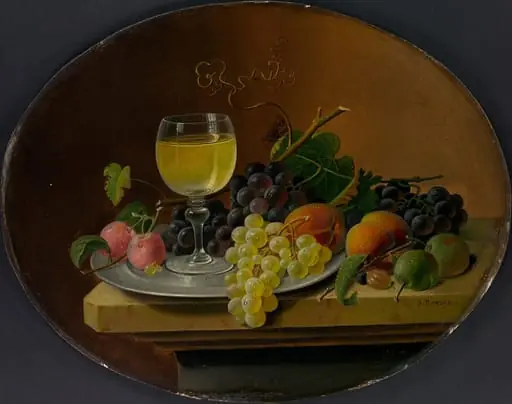
Fruit and a Goblet
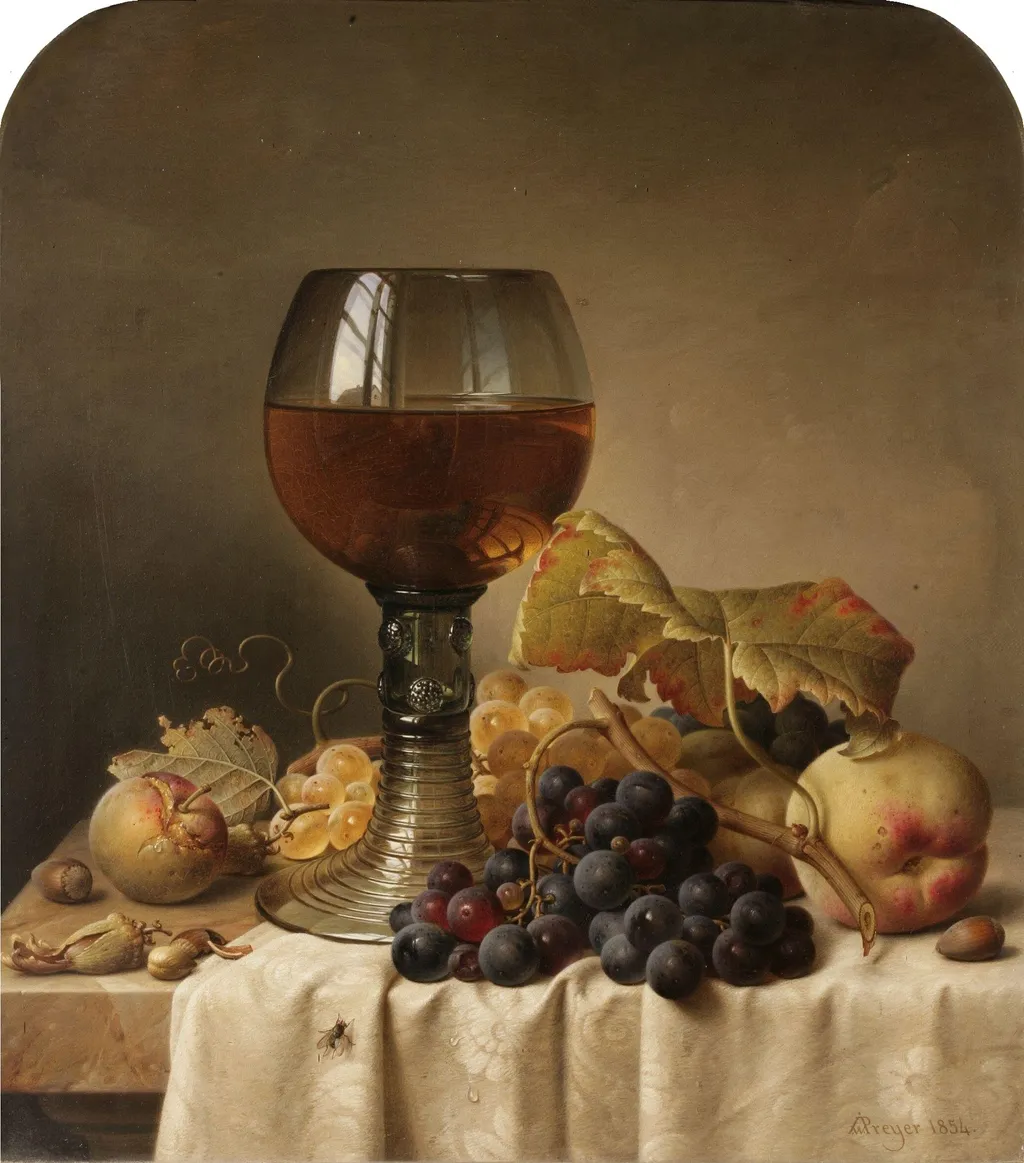
Fruit and a Goblet is an oil painting by the Realist artist Johann Wilhelm Preyer. It dates from 1854 and is held in the collection of the Victoria and Albert Museum.
About this work
Overview
3 centimetres, the work is held in the Victoria and Albert Museum in London, where it entered the collection in 1882 as part of the John Jones bequest.
Fruit and a Goblet is an oil-on-canvas still life painted in 1854 by the German artist Johann Wilhelm Preyer. Measuring 39.4 by 34.3 centimetres, the work is held in the Victoria and Albert Museum in London, where it entered the collection in 1882 as part of the John Jones bequest. The painting exemplifies the small-scale, meticulously rendered fruit still life that brought Preyer international recognition and made him the most important German still-life painter of the nineteenth century. Its combination of jewel-like precision, decorative Biedermeier sensibility, and deliberate homage to seventeenth-century Dutch masters positions it as a defining work of Preyer's mature style.
Subject & Meaning
The composition centres on a tall glass goblet filled with amber liquid, its stem decorated with raised bosses, standing on a stone ledge partially draped with a white cloth bearing embroidered patterns. Clustered around the base are bunches of grapes in green, yellow, and deep purple, two peaches with red blushes and a large veined leaf, and to the left walnuts and hazelnuts. A small fly rests on the cloth, while the background consists of a plain, dark brown wall. Light enters from the left, creating soft shadows and highlighting the reflective surfaces of glass and fruit. Unlike seventeenth-century Flemish still lifes, which typically carried Christian vanitas symbolism or memento mori messages, Preyer's arrangement is purely decorative. The fly, a traditional symbol of transience in Dutch Golden Age painting, here appears stripped of moralising intent, serving instead as a demonstration of the artist's virtuoso ability to render organic texture. The rounded top frame, noted in visual observation, further emphasises the work's decorative function.
Technique & Style
Preyer executed the painting in oil on canvas with a smooth, highly finished technique that displays precise detail in the textures of glass, fabric, and organic forms. The palette is almost monochrome, dominated by ochre pigments that create a restrained, harmonious tonality. His handling of the medium achieves an enamel-like luster, with particular attention to the optical properties of the goblet, the translucency of grape skins, and the matte surfaces of nuts. The artist's miniaturist approach, developed through rigorous draftsmanship, produces what contemporaries described as jewel-like precision directly comparable to seventeenth-century Dutch practice. The signature and date, "JW Preyer 1854," appear in the lower right corner with the initials in monogram. The Victoria and Albert Museum's physical description notes a pleated tablecloth, tall goblet, and neutral greyish background, though the visual record specifies a dark brown wall.
History & Provenance
The painting was created in 1854, during the mature period that Preyer settled into after the mid-1840s, a phase from which he would not substantially depart for the remainder of his career. The work was bequeathed to the Victoria and Albert Museum by John Jones in 1882, entering the collection under accession number 579-1882. It is one of two paintings by Preyer in the museum's holdings. Preyer's compositional formula proved remarkably consistent: several drawings on paper focusing on the same goblet and grape arrangement, executed between 1833 and 1857, survive in the Museum Schloss Rheydt, Mönchengladbach, while a similar painted composition is held in the Nationalgalerie, Museum Preussischer Kulturbesitz, Berlin. No exhibition history is recorded in the available sources.
Context
Johann Wilhelm Preyer was born in Rheydt in the Ruhr region on 19 July 1803 and died in Düsseldorf on 20 February 1889. He studied at the Düsseldorf Kunstakademie from 1822 to 1831, then travelled to The Hague and Amsterdam to study Dutch masters. In 1848 he founded the Malkasten Artist Association in Düsseldorf, where he remained for the rest of his life. Preyer came from an important painting family: his brother Gustav Preyer (1801-1839) was a landscape painter, and his daughter Emilie Preyer (1849-1930) also became a noted still-life painter. The Preyer brothers were both one metre tall, well-proportioned dwarfs. Preyer's still lifes were deeply influenced by seventeenth-century Flemish technique and composition, particularly the monochrome, highly detailed works of Willem Claesz. Heda. However, where Dutch Golden Age still lifes functioned within a culture of mercantile prosperity and religious meditation, Preyer's interpretations served the Biedermeier aesthetic influential among Düsseldorf school artists, an aesthetic that valued domestic refinement, technical virtuosity, and decorative appeal over moral or narrative content.
Legacy
Preyer's achievement was to ensure unprecedented success for the still-life genre in nineteenth-century Germany. His revival of Dutch seventeenth-century imagery responded to a broader European renewed interest in nature and the naturalistic tradition. By stripping the still life of its traditional Christian symbolism while preserving its technical brilliance, he created a formula that proved commercially and critically durable. The Victoria and Albert Museum's acquisition of Fruit and a Goblet through the John Jones bequest testifies to the international esteem in which Preyer was held by the 1880s. His influence persisted through his daughter Emilie, who continued the family specialisation, and through the broader Düsseldorf school, where his enamel-smooth finish and compositional repetitions established a model for academic still-life painting. Today, the work remains a touchstone for understanding how nineteenth-century German artists negotiated the legacy of the Dutch Golden Age within contemporary aesthetic frameworks.
Own this work as a print
Artist & collection
Artist
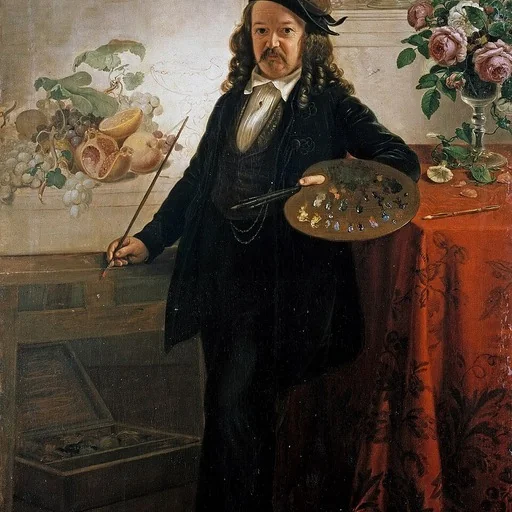
Johann Wilhelm Preyer (July 19, 1803 – February 20, 1889) was a German still life painter of the Düsseldorf school of painting.

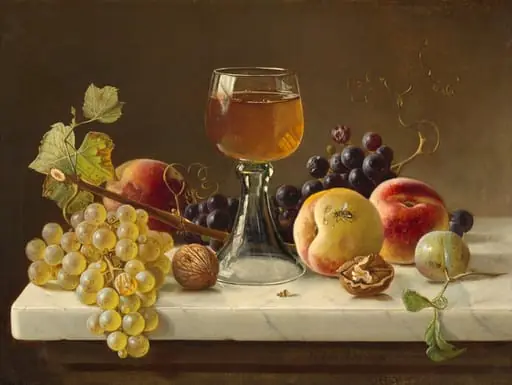 Marble Tabletop with Fruit and Wineglass
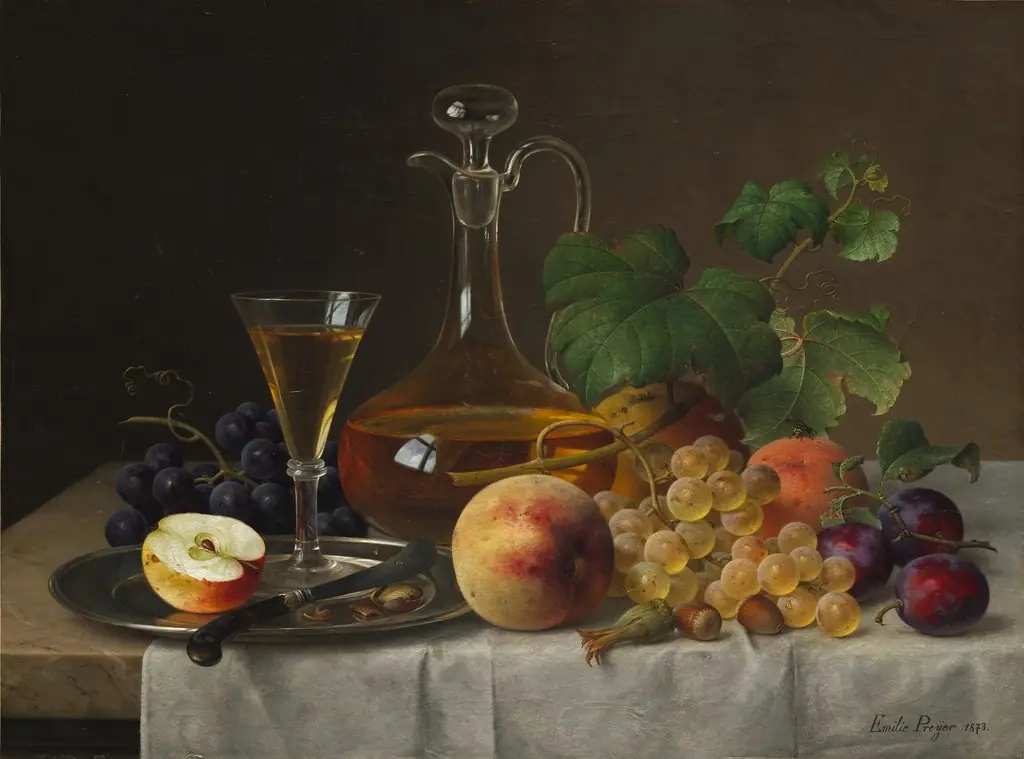 Still Life with Fruit
 Still Life with Fruit
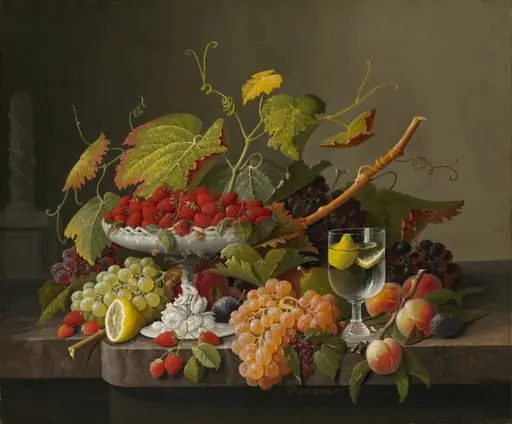 An Abundance of Fruit
 Hedelmäasetelma, kopio Jac. Stockmannin mukaan
 Still Life with Fruit
 Still life with fruit
 Opstilling med vinglas, østers, citron og andre frugter
 Still Life Fruit and Wine Glass
 Still life of flowers and fruits on a marble ledge