Artwork
Maenan Hall, near Llanrwst
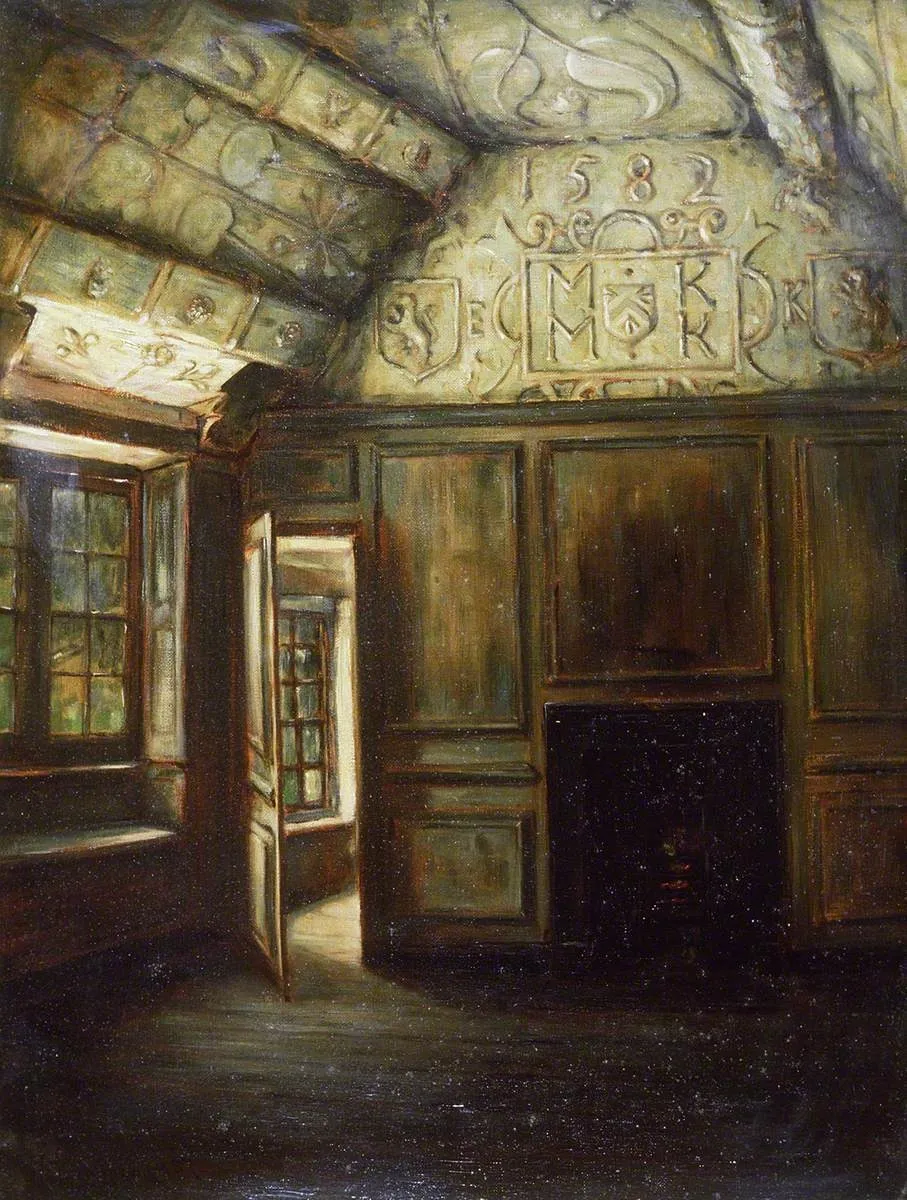
Maenan Hall, near Llanrwst is an oil painting by the Impressionist artist Joseph Thomas Steadman. It dates from 1894 and is held in the collection of the National Library of Wales.
About this work
Sunlight streams through an open door, revealing another room with a window and a fireplace.
This painting shows a dimly lit room with dark wood paneling. Sunlight streams through an open door, revealing another room with a window and a fireplace. The ceiling has faded plasterwork with symbols and the year 1582 carved into it.
The coat of arms above the fireplace looks old and slightly worn, adding a sense of history. The way light and shadow play across the walls makes the room feel cozy yet mysterious.
Want to see more of this kind of detail? Check out plasterwork.
Overview
Maenan Hall, near Llanrwst is an oil painting on canvas by the British artist Joseph Thomas Steadman, dated 1887. Measuring 65 by 50.5 cm, the work depicts an interior view of the historic Maenan Hall in North Wales and is held in the National Library of Wales as part of its Framed works of art collection, accessioned as PZ03828. The painting matters as a careful documentary record of a significant Grade I-listed medieval house, capturing its notable Elizabethan decorative plasterwork and architectural features at a specific moment in the late nineteenth century, before later twentieth-century restoration altered the building.
Subject & Meaning
The painting depicts the interior of a paneled room at Maenan Hall, a late medieval country mansion that was the seat of the Kyffin family. The ceiling dominates the composition, displaying ornate plasterwork with geometric and floral patterns, and prominently features the date 1582 above a central heraldic emblem flanked by the letters M and K, with additional shields. These initials refer to Maurice Kyffin, High Sheriff of Caernarvonshire, who altered and expanded the building in 1582, and his wife. The dark wood paneling of the lower walls, a central fireplace opening to the right, a multi-paned leaded window, and an open door revealing a further room with a second window, all contribute to a sense of architectural depth and historical presence. The absence of human figures directs attention entirely to the fabric of the house itself, treating the interior as a subject worthy of contemplation. The work functions as both a topographical record and a meditation on the persistence of historical domestic spaces, with the heraldic emblems and date serving as tangible connections to the Elizabethan past and the social status of the Kyffin family.
Technique & Style
Steadman executed the work in oil on canvas, employing a smooth brushwork technique that demonstrates careful attention to architectural detail and atmospheric depth. The palette is restrained, consisting of muted browns, greens, and ochres, with darker tones in the shadowed areas. Light enters from the left, illuminating the ceiling plasterwork and creating deliberate contrast with the shadowed floor and fireplace recess. This handling of light models the three-dimensional space effectively, emphasizing the texture of the ornate plasterwork and the grain of the dark wood paneling. The composition is fundamentally descriptive and documentary in character, consistent with late nineteenth-century British interest in recording historic interiors and architectural heritage. The artist maintains a single, stable viewpoint that allows the viewer to read the spatial relationships between the visible windows, doorways, and structural elements, while the atmospheric treatment of the further room, glimpsed through the open door, adds a subtle sense of lived continuity beyond the immediate frame.
History & Provenance
The painting was created in 1887, a period when Maenan Hall was known as Meanan House according to census records of the time, though the artist used the established name Maenan Hall. The work was deposited at the National Library of Wales by Mrs Manning in 1987, entering the collection as accession number PZ03828. The National Library of Wales now holds it within its Framed works of art collection. The painting is available under a Public Domain Mark, permitting unrestricted use with acknowledgment of the collection. No exhibition history is recorded in the available sources.
Context
Joseph Thomas Steadman, also known as J. Thomas Steadman and Joseph T. Steadman, is represented in at least two Welsh collections including the National Library of Wales and Wolverhampton Art Gallery, with Maenan Hall, near Llanrwst identified as his top-ranked work. His practice aligned with a broader Victorian and Edwardian tradition of British artists documenting historic buildings and interiors, a genre that gained urgency as industrialization and modernization threatened older architectural fabric. Maenan Hall itself occupied a significant place in Welsh architectural history as a fine example of a late medieval timber-framed dwelling, later encased in rubble in 1582 by Maurice Kyffin. The Elizabethan plasterwork at Maenan Hall has been noted by architectural historians as comparable to that at Plas Mawr, Conwy and Gwydir Castle, Llanrwst, suggesting the same craftsman worked at all three properties. Steadman's painting thus participates in a larger project of visual preservation, capturing the interior before the extensive restoration of around 1955 by architect S. Colwyn-Ffoulkes and the later additions of conservatories designed by Clough Williams-Ellis and others.
Legacy
The painting's afterlife is closely tied to its documentary value. As a public domain image held by the National Library of Wales, it serves as an accessible visual record of Maenan Hall's interior in the late nineteenth century, before twentieth-century restoration and alteration. For scholars of Welsh architecture and social history, it offers evidence of the hall's condition and appearance during a period when it functioned variously as a private residence and farm. The work's reputation rests on this archival function rather than on any claim to avant-garde artistic innovation. In the broader cultural sphere, Maenan Hall itself has gained public recognition through the National Gardens Scheme, with its gardens opened for charity and its occasional feature in publications such as Country Life and The Field. The painting thus forms part of a cumulative visual and documentary record that has helped sustain interest in the property across generations, even as the building itself has evolved through restoration and continued private ownership by descendants of the Aberconway family.
Artist & collection
Artist
Joseph Steadman painted detailed oil scenes of Welsh buildings in the late 1800s.

- Interieur van het Tsaar Peterhuisje te Zaandam
 Sacristy
 Refectorio de las Cárceles de San Francisco en Asís
 Courtyard of the house of Christoffel Plantin
 Architectural Study (Door of the Francis I Staircase, Oval Court, Fontainebleau)
 Old Antwerp Facade - Klaverbladpoortje
 Interior
 The Corridor, Brewer's Hall, Antwerp
 Staircase
 Staircase of a former Inn, "The Plume of Feathers," Queen Street, Salisbury
 Intrarea în arhondărie (Mănăstirea Viforâta)
 The Entrance Hall of Mortham Tower, Rokeby, Yorkshire
 The Pérussis Altarpiece
 Madonna and Child with the Donor, Pietro de' Lardi, Presented by Saint Nicholas
 The Virgin Mary and Five Standing Saints above Predella Panels
 Portrait of a Woman, possibly Ginevra d'Antonio Lupari Gozzadini
 The Seven Sacraments
 Portrait of a Woman Holding a Book
 An Artist Painting a Heraldic Shield in a Cabinet of Curiosities
 Angel Supporting a Heraldic Shield