Artwork
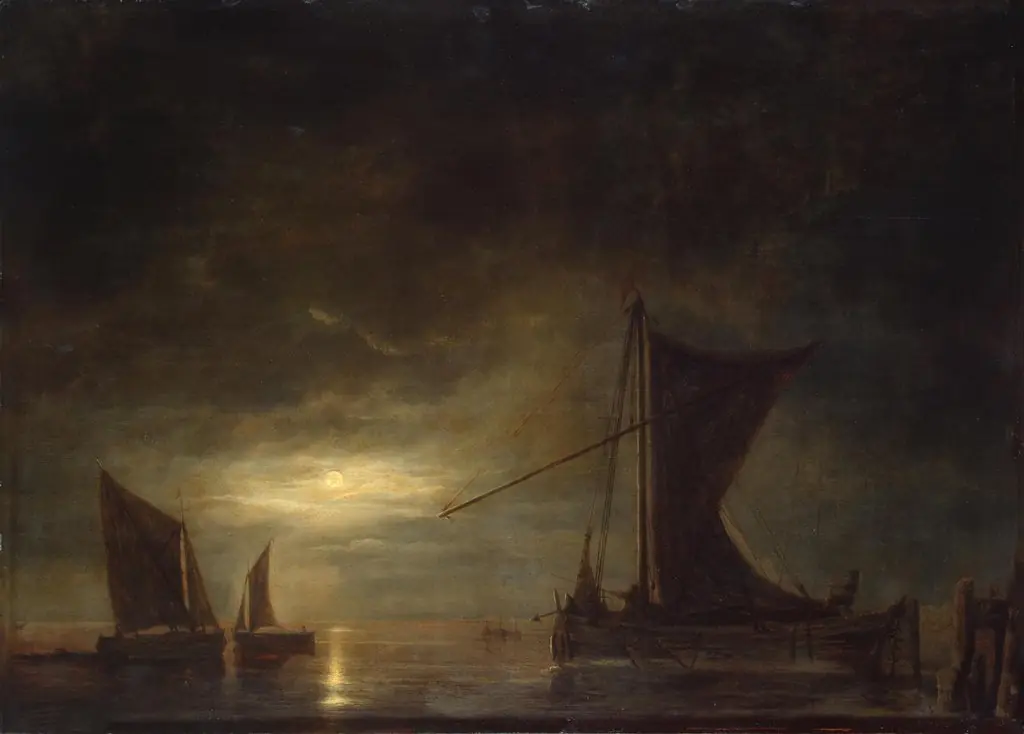
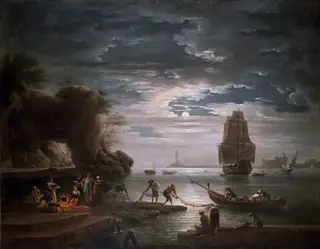
Entrance to the Port of Palermo by Moonlight
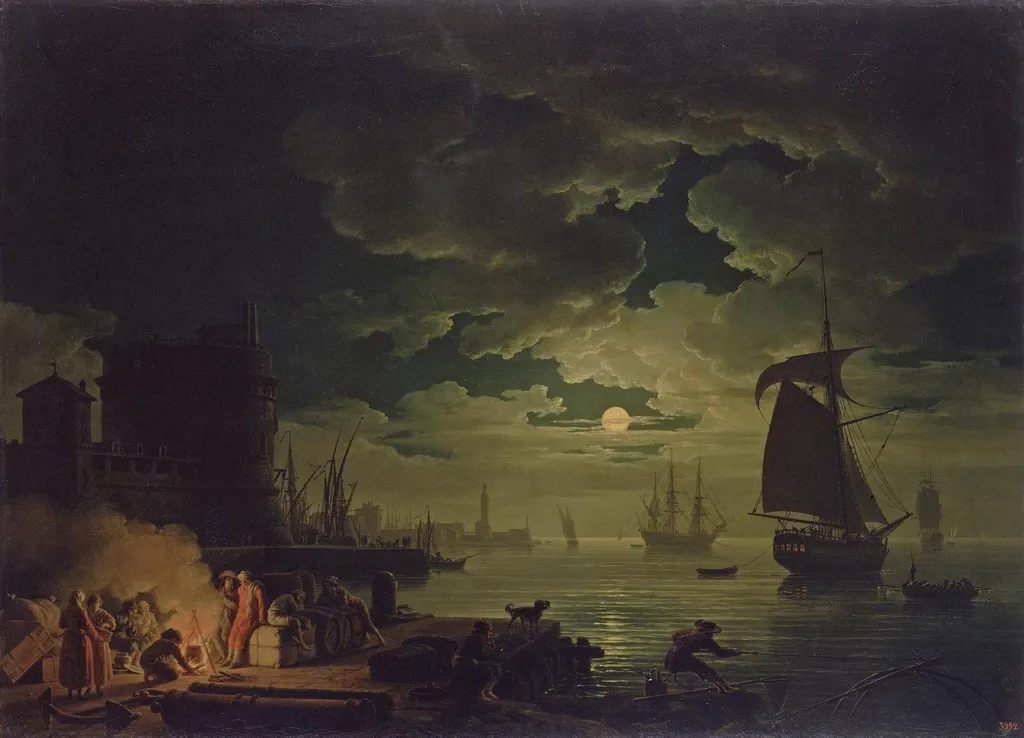
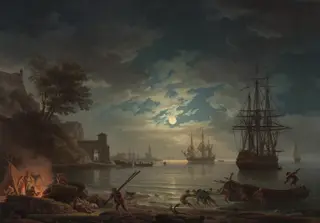
Entrance to the Port of Palermo by Moonlight is an oil painting by the Rococo painting artist Joseph Vernet. It dates from 1769 and is held in the collection of the Hermitage Museum.
About this work
Joseph Vernet painted Entrance to the Port of Palermo by Moonlight in 1769. It’s oil on canvas, showing a harbor scene at night. The artist signed it “J. Vernet f 1769” and displayed it at the Paris Salon that same year.
This painting sits in the State Hermitage Museum in Saint Petersburg now. It’s one of many Vernet seascapes that glow under moonlight.
Look up the State Hermitage Museum next.
Subject & Meaning
The work belongs to the tradition of marine art, combining a topographically identifiable Mediterranean port with a nocturnal, atmospheric treatment.
The painting depicts the entrance to the harbor of Palermo, Sicily, illuminated by moonlight, with the moon positioned near the center of the composition and a partly cloudy sky concentrated on the right side. On the left foreground, a group of figures gathers around a fire to warm themselves, while behind them rises the tower of Palermo's harbor fortress. To the right, the dark silhouettes of sailing ships stand out against the sea, creating a contre-jour effect against the moonlit water.
The work belongs to the tradition of marine art, combining a topographically identifiable Mediterranean port with a nocturnal, atmospheric treatment. The contrast between the warm glow of the foreground fire and the cool, silvery moonlight across the harbor emphasizes the interplay of competing light sources that defines the scene's mood. Painted as a pendant to a View of the Surroundings of Reggio in Calabria, also held at the Hermitage, the canvas pairs Sicilian and Calabrian coastal views within a unified pictorial program.
Technique & Style
Entrance to the Port of Palermo by Moonlight is an oil painting on canvas measuring 99.5 × 138 cm, signed and dated lower left: "J. Vernet f 1769." Vernet's handling displays his characteristic marine expertise: delicate brushwork renders the moonlight's silvery glow, while broader strokes define the ships' silhouettes and the fire-lit figures in the foreground. The composition employs contre-jour lighting, with the moon positioned near the centre, creating a subtle chiaroscuro that models the clouds, sea, and architecture.
Stylistically, the painting blends precise topographical detail with a poetic, atmospheric night scene typical of Vernet's 1760s landscapes.
History & Provenance
Created in 1769, this oil on canvas by Claude-Joseph Vernet bears the signature and date "J. Vernet f 1769" in the lower left corner. The work was originally exhibited at the Salon of 1769 held at the Louvre in Paris. Its early ownership began in the Longvilliers collection in Montreuil-sur-Seine, before transferring to the Boyer de Fonscolombe collection in Aix-en-Provence until 1791.
In 1803, Tsar Alexander I of Russia acquired the painting in Saint Petersburg through the Dresden-based firm Pirling et Compagnie. It has since been held in the Hermitage Museum, where it serves as a companion piece to Vernet's View of the Surroundings of Reggio in Calabria.
Legacy
The painting entered the Hermitage collection after its acquisition by Alexander I in 1803 and has remained there, becoming a reference point for Vernet's nocturnal marine scenes. It was shown abroad in the late twentieth century, appearing in exhibitions at Göteborg's Konstmuseum in 1968, a touring show across Shizuoka, Tochigi, Okayama and Kumamoto in 1995, Niigata and Osaka in 1996, and the University of Michigan Museum of Art in 2003. Scholarly catalogues such as the 1990 Cinq siècles de peinture française and the revised Diderot Salons of 1767–1769 cite the work, underscoring its continued art-historical relevance.
Overview
Entrance to the Port of Palermo by Moonlight is an oil painting created by the French artist Claude-Joseph Vernet in 1769. This work depicts a nocturnal harbor scene, characteristic of Vernet's specialization in marine subjects. The painting exemplifies his skill in rendering atmospheric effects, particularly the subtle illumination of a port under moonlight. It is a notable example of 18th-century landscape painting, showcasing the artist's enduring interest in maritime themes.
Own this work as a print
Artist & collection

Artist
Claude-Joseph Vernet (French pronunciation: ; 14 August 1714 – 3 December 1789) was a French painter. His son Carle Vernet and daughter Marguerite Émilie Chalgrin were also painters.