Artwork
The Shipwreck
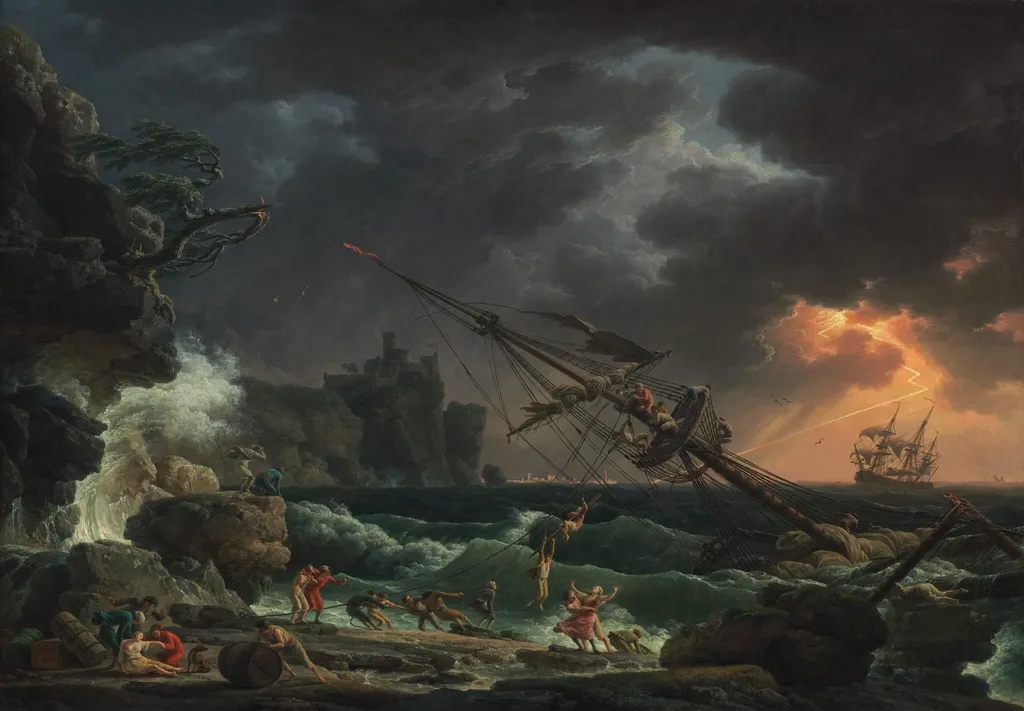
The Shipwreck is an oil painting by the Rococo painting artist Joseph Vernet. It dates from 1772 and is held in the collection of the National Gallery of Art.
- Inscription
- Inscribed:lower left: J. Vernet / F. 1772
About this work
Subject & Meaning
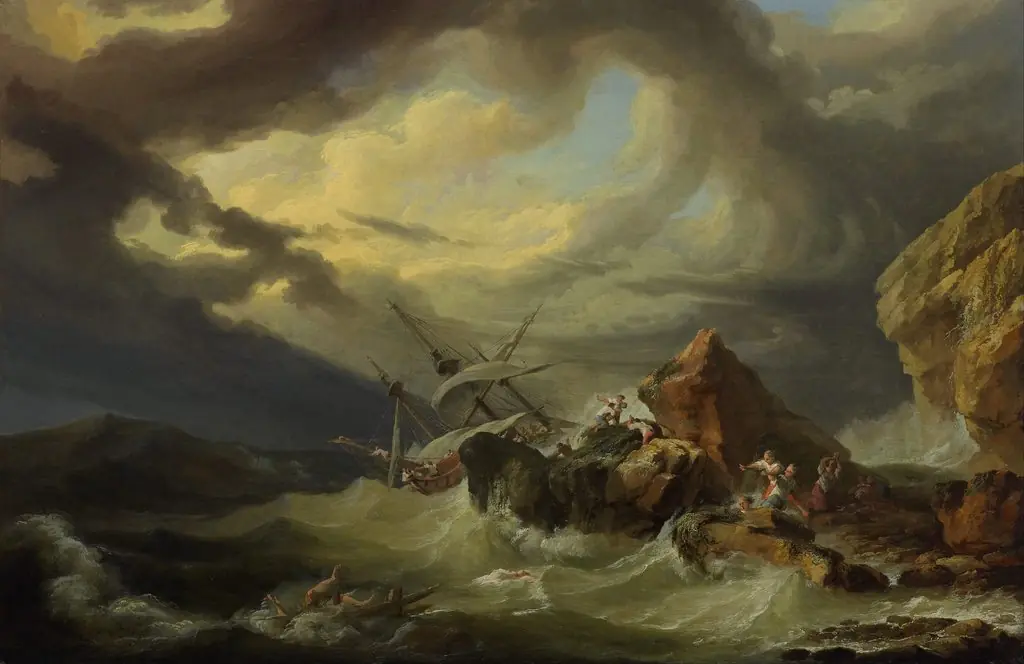
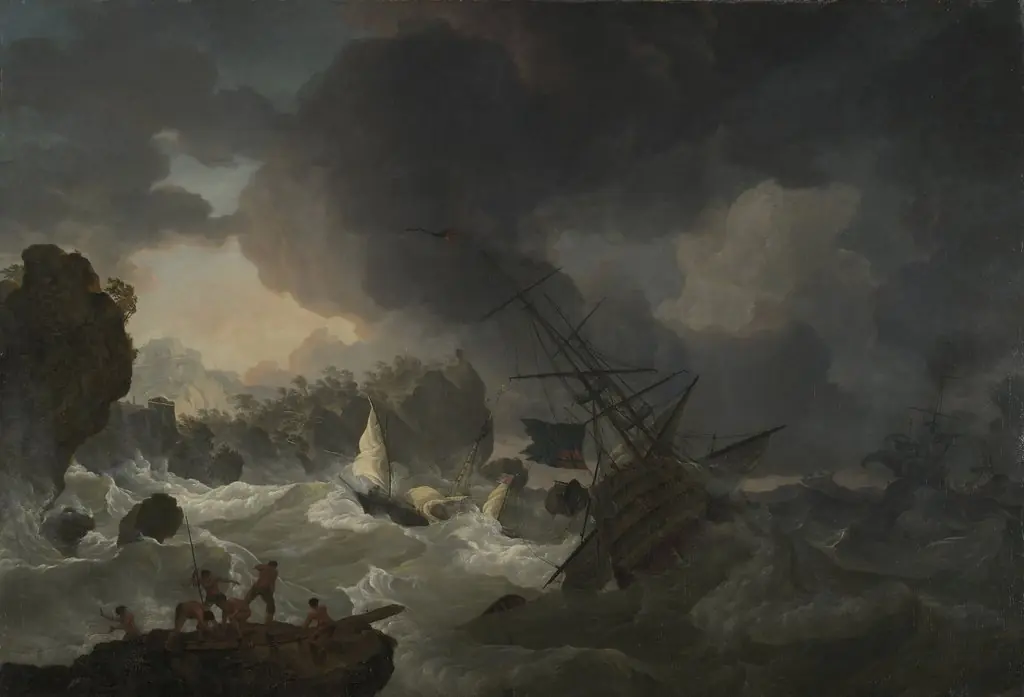
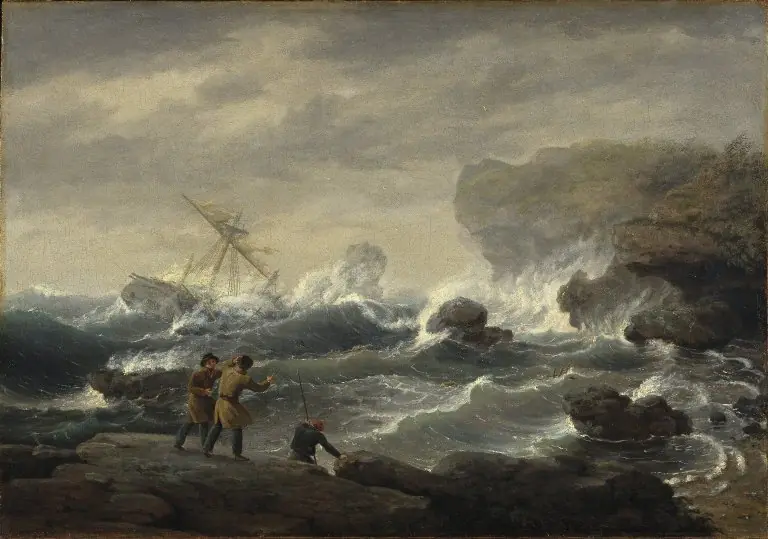
The painting shows a ship wrecked in a violent storm, its hull broken on a rocky coastline while crew and passengers scramble down a rope from the mast to reach shore. The tumultuous sea, dark clouds, and desperate figures convey humanity’s struggle against overwhelming natural forces, evoking the sublime and highlighting human fragility. This dramatic emphasis on emotion and nature’s power marks the work as a forerunner of Romanticism, contrasting with the restrained Neoclassicism dominant at the time.
Technique & Style
Stylistically, the work is classified as a landscape, and more specifically as marine art, depicting a ship being wrecked on a rocky coastline amid a storm.
The Shipwreck is executed in oil on canvas, a standard support for Vernet's marine compositions of this period. The painting is relatively modest in scale, measuring 113.5 by 162.9 centimeters, a horizontal format suited to its panoramic seascape composition. Stylistically, the work is classified as a landscape, and more specifically as marine art, depicting a ship being wrecked on a rocky coastline amid a storm.
Crew members and passengers are shown attempting to save themselves by climbing down a rope from the mast to the shore. The handling reflects Vernet's mature approach to atmospheric effects, rendering turbulent seas and dramatic weather with naturalistic detail. The painting has been characterized as a forerunner of Romanticism, standing in contrast to the ascendant Neoclassicism of the era. Its condition is not specifically documented in the available sources.
History & Provenance
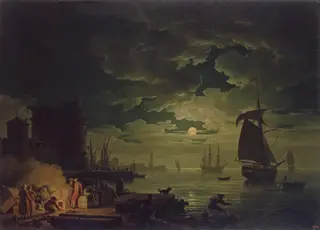
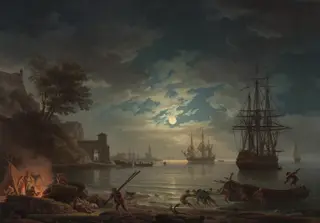
The Shipwreck was commissioned in November 1771 by Henry, 8th Lord Arundell of Wardour, for Wardour Castle in Tisbury, Wiltshire. The banker Henry Hoare II acted as agent and patron for Claude-Joseph Vernet on Lord Arundell's behalf, and the painting was completed and paid for by August 1772 as part of a pair with Moonlight. The work descended through the Arundell family line, which became extinct with the death of John Francis Arundell, 16th Baron Arundell of Wardour, killed in action on 25 September 1944.
Both paintings were offered at the Arundell sale at Wardour Castle on 10 September 1952, lot 144, under the title The Storm. By 1957 the canvas had passed through Galerie Popoff in Paris into a private French collection, and it subsequently went through Marc Blondeau in Paris before being offered at Sotheby's, New York. The National Gallery of Art purchased the painting on 17 February 2000.
Commissioned in November 1771 for Henry, 8th Lord Arundell of Wardour, the painting remained at Wardour Castle until the family's sale on September 10, 1952, where it appeared as lot 144 titled The Storm. Following the sale, the work passed through Galerie Popoff in Paris by 1957 and later entered a private French collection. It was subsequently handled by Marc Blondeau and Sotheby's New York before being acquired by the National Gallery of Art in Washington, D.C., on February 17, 2000.
While the paired companion piece Moonlight has an unknown location, The Shipwreck is currently held in the NGA's permanent collection. The provided sources detail the work's ownership lineage and acquisition but do not list specific public exhibition history prior to its museum accession.
Context
The Shipwreck (1772) by Claude-Joseph Vernet is an oil on canvas maritime painting held at the National Gallery of Art, Washington, D.C.. It was commissioned by Lord Arundell of Wardour for Wardour Castle and remained in the family until its 1952 sale. The work is recognized as an early Romantic piece that contrasts with contemporary Neoclassicism, portraying a storm‑tossed ship struggling ashore.
Scholars consider it a precursor to Romantic marine subjects and part of Vernet’s broader seascapes that influenced later artists such as his grandson Horace Vernet. Its acquisition by the National Gallery in 2000 underscores ongoing scholarly attention.
Legacy
Critics recognize The Shipwreck as a significant forerunner of Romanticism, distinguishing itself through its dramatic intensity against the prevailing Neoclassical trends of the late eighteenth century. The work's legacy extends directly into the next generation of French art through the artist's grandson, Horace Vernet. Drawing stylistic inspiration from this composition, Horace created an homage titled Tied to a Mast During a Storm, which he exhibited at the Paris Salon in 1822.
Originally commissioned for Wardour Castle, the painting remained within the Arundell family until the mid-twentieth century before entering the collection of the National Gallery of Art in Washington, D.C., where it continues to be studied as a pivotal example of marine art.
Overview
Claude-Joseph Vernet's The Shipwreck, an oil on canvas from 1772, depicts a dramatic maritime disaster. This painting, now part of the collection at the National Gallery of Art in Washington, D.C., showcases the French artist's characteristic engagement with powerful natural phenomena. It captures a moment of intense chaos as a vessel is overwhelmed by a violent storm, emphasizing the destructive force of the sea and the fragility of human existence.
Own this work as a print
Artist & collection

Artist
Claude-Joseph Vernet (French pronunciation: ; 14 August 1714 – 3 December 1789) was a French painter. His son Carle Vernet and daughter Marguerite Émilie Chalgrin were also painters.