Artwork
Odalisque
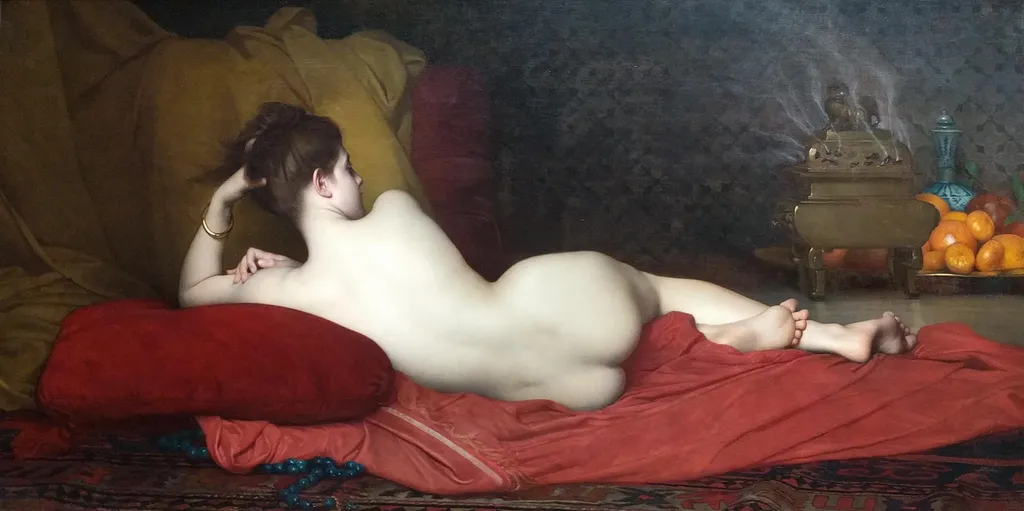
Odalisque is an oil painting by the Academic Art artist Jules Lefebvre. It dates from 1874 and is held in the collection of the Art Institute of Chicago.
About this work
Subject & Meaning
The composition deliberately evokes the reclining Venuses of the Renaissance tradition.
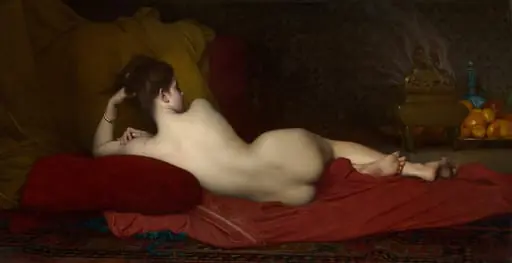
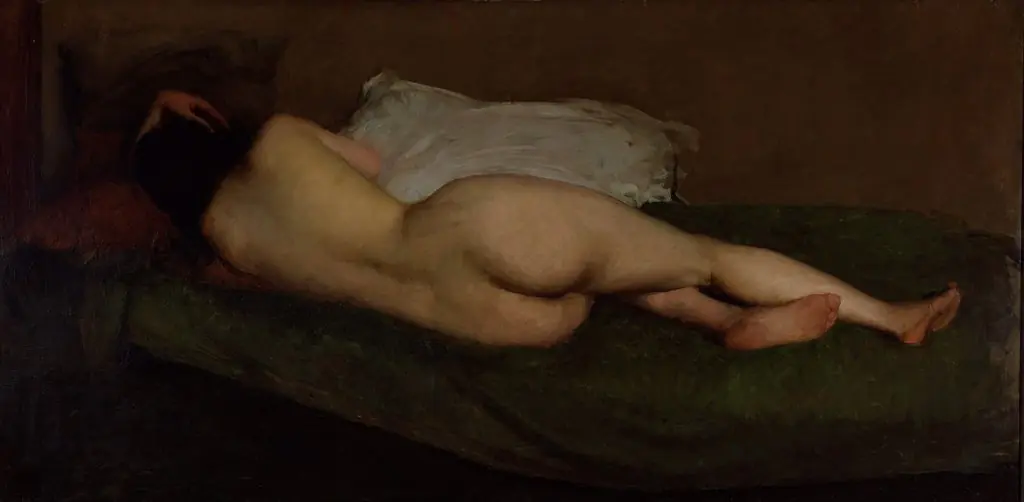
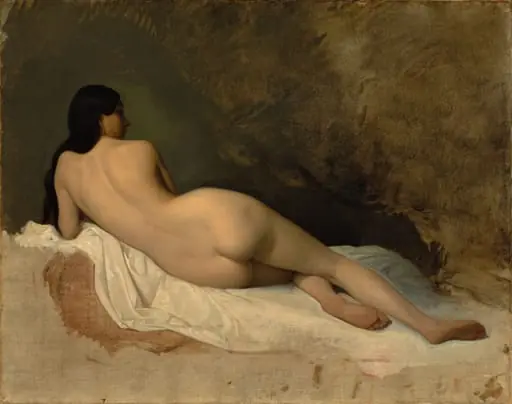
The painting depicts an odalisque, a concubine of an Ottoman harem, shown reclining nude on her left side along a red cloth that partially covers a carpet, her back turned to the viewer. She rests her arm on a large garnet-colored cushion in a dimly lit interior. Near her feet a brasero emits smoke, and behind it sits a tray of fruit.
Her chestnut, waist-length hair is gathered in a chignon, and she wears a bracelet. The composition deliberately evokes the reclining Venuses of the Renaissance tradition. As an Orientalist nude, the work reflects the academic practice of using the inaccessible harem setting to justify the female nude, a genre staple of European training, while presenting a romanticized image that diverged from the actual practice of clothed odalisques.
Technique & Style
Created in 1874, Odalisque is an oil painting on canvas executed in the Academic style with Orientalist themes. The work features a horizontal format measuring 102.4 by 200.7 centimeters. Lefebvre depicts a nude female figure viewed from the back, lying on a red drape over a carpet within a dimly lit interior.
The composition employs a palette of deep reds, including a garnet cushion and blanket, contrasted against the subject's chestnut hair styled in a chignon. Formal elements include the depiction of smoke rising from a brasero near a tray of fruit, alongside the figure's exposed buttocks and dimples of Venus. The handling of the medium emphasizes smooth academic modeling of the skin and drapery, referencing Renaissance traditions of the reclining Venus while adhering to 19th-century French academic standards for the nude.
History & Provenance
Odalisque was painted in 1874 by Jules Lefebvre as an oil on canvas work. The painting bears the artist’s signature and date in the upper right corner. Its early ownership passed from Vincent Astor to George F. Harding Jr., who in 1929 bequeathed the canvas to a Chicago art museum; the work was subsequently transferred to the Art Institute of Chicago in 1983, where it remains today.
Wikidata records the inception date as 1 January 1874. The sources do not mention a specific commission for the piece.
The painting Odalisque (1874) by Jules Lefebvre is held in the collection of the Art Institute of Chicago, where it has resided since its transfer to the museum in 1983. Prior to that, the work belonged to collector Vincent Astor and then to George F. Harding Jr., who bequeathed it to the Chicago art museum in 1929. The sources do not specify an accession or inventory number for the piece, nor do they record any exhibition history beyond its presence in the institute’s collection.
Legacy
The 1874 canvas entered the Art Institute of Chicago after George F. Harding Jr. bequeathed it in 1929; it was displayed there from 1983 onward. Its status as a quintessence of academic Orientalist nude has been repeatedly noted in scholarship, which links its composition to the tradition of Renaissance Venuses while highlighting the European fantasy of the harem. The work’s inclusion in the museum’s collection and its frequent citation in studies of late‑19th‑century academic art underscore its enduring reputation as an emblem of Orientalist aesthetics.
Overview
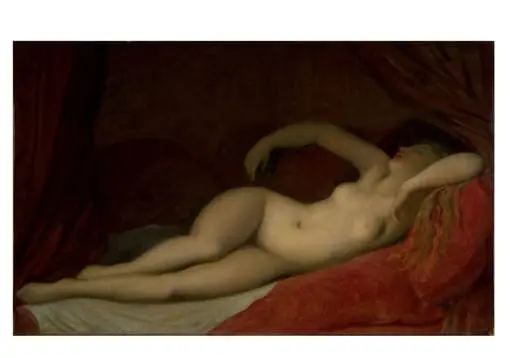
Painted in 1874, Jules Lefebvre's Odalisque is a quintessential example of French Academic art, depicting a reclining female nude in an exoticized interior setting. The composition centers on a woman with dark hair pulled back, resting on a red pillow against a backdrop of rich red drapery. Her pose is contrapposto, with her left arm supporting her upper body while her right arm is bent, her hand touching her head, creating a graceful S-curve that emphasizes the idealized anatomy characteristic of Lefebvre's training at the École des Beaux-Arts.
She wears a single gold bracelet on her right wrist, a detail that adds a touch of Orientalist ornamentation common in the genre. The lighting is soft and diffused, highlighting the smooth texture of her skin against the darker, shadowed surroundings. This work reflects Lefebvre's mastery of the human form and his adherence to the Salon tradition, where such idealized nudes were highly prized.
Created during the height of his career, the painting demonstrates his ability to blend classical technique with contemporary tastes for exotic subjects, securing his reputation as a leading figure in 19th-century French painting.
Artist & collection