Artwork
Ondine
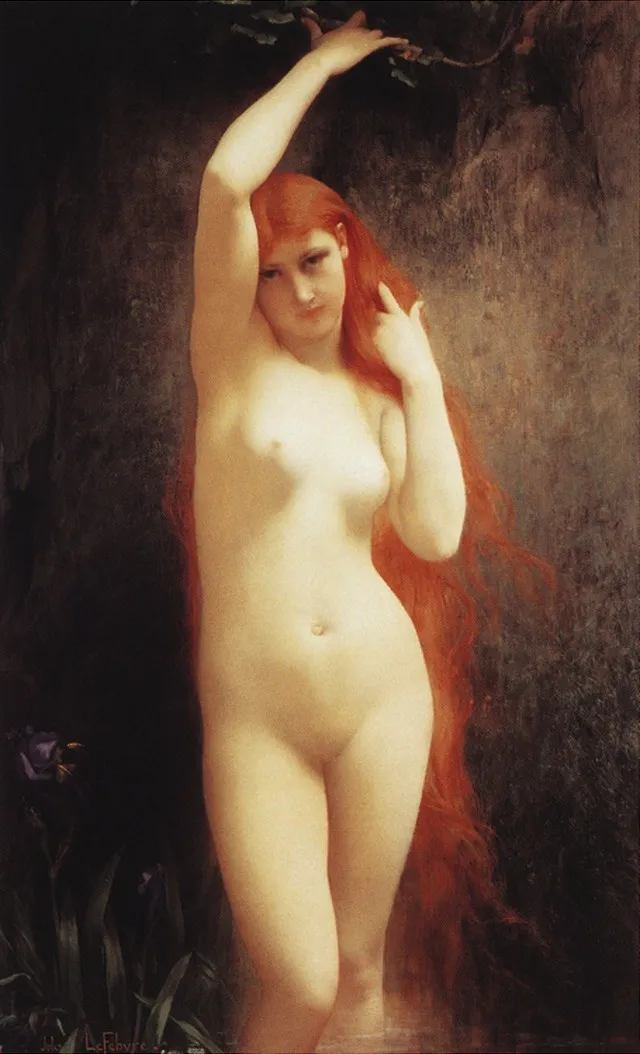
Ondine is an oil painting by Jules Lefebvre. It dates from 1892 and is held in the collection of the Hungarian National Gallery.
About this work
Subject & Meaning
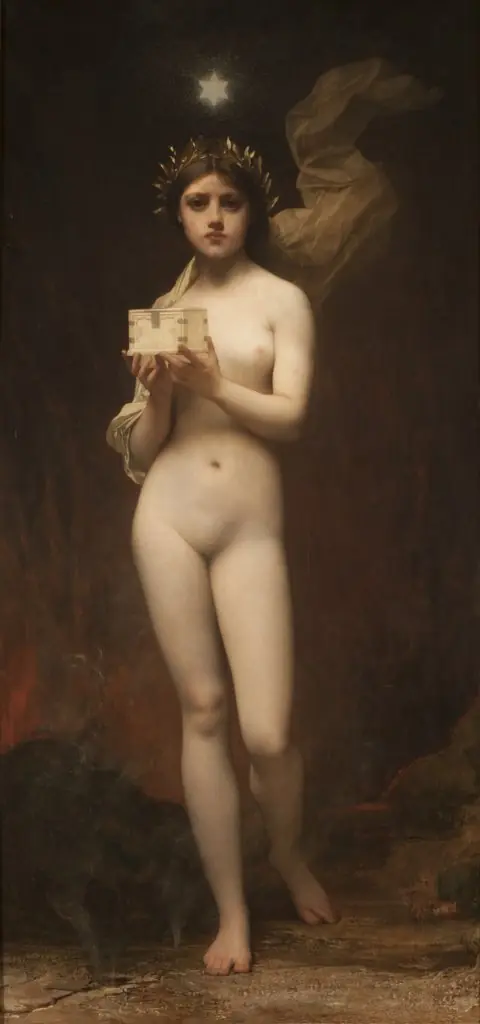
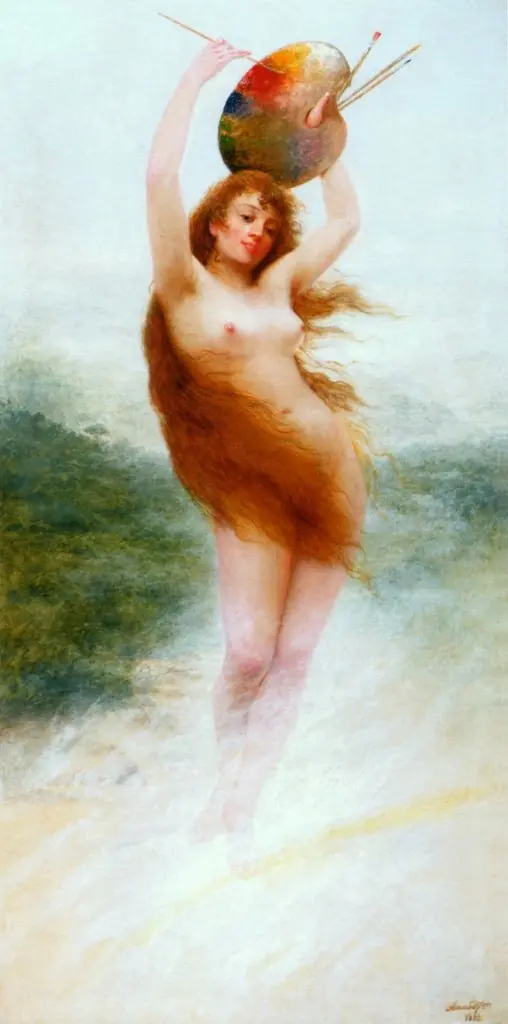
Jules Lefebvre's Ondine belongs to the genre of mythological painting, presenting a nude female figure identified as an undine, a water spirit drawn from European folklore and Paracelsian elemental tradition. The subject is depicted as a red-haired woman with waist-length hair, standing in contrapposto beside a body of water and surrounded by plants and flowers, motifs that link her to a natural, liminal aquatic realm. Her direct gaze toward the viewer, combined with the carefully rendered nude pose, gives the figure an inviting yet otherworldly presence, emphasizing the seductive and elusive nature traditionally ascribed to water nymphs in nineteenth-century academic art.
By combining classical nude conventions with the romantic legend of the undine, Lefebvre frames the work as a meditation on feminine beauty merged with the elemental mystery of water.
Technique & Style
The painting Ondine is executed in oil paint on canvas. Its formal qualities include a composition built on contrapposto, a pose that conveys dynamic balance, while the figure's red hair, exposed breast, and gaze toward the viewer heighten the sensuous, mythological narrative. The work depicts an undine in a state of partial nudity, rendered with anatomical precision, set against a backdrop of water, plants, and flowers that reinforce the aquatic mythic context.
History & Provenance
The painting is held in the collection of the Museum of Fine Arts, Budapest (associated with the Hungarian National Gallery).
Ondine is an oil-on-canvas painting by Jules Lefebvre dated 1892, depicting a mythological subject. It measures 151 cm in height by 92.5 cm in width.
The painting is held in the collection of the Museum of Fine Arts, Budapest (associated with the Hungarian National Gallery). No further details regarding an earlier ownership chain, commission, or intermediate provenance prior to its acquisition by the museum are documented in the available sources.
Overview
Jules Lefebvre's 'Ondine' (1892) depicts the water nymph from Germanic folklore, rendered in the artist's signature Academic style. The composition centers on a female figure with vibrant red hair, standing in a contrapposto pose with her body angled slightly toward the viewer while her head turns to meet the gaze directly. One arm is raised behind her head, a gesture that elongates the torso and emphasizes the classical idealization of the human form.
Lefebvre employs a dark, indistinct background to isolate the figure, allowing the warm, luminous tones of her skin to emerge with dramatic clarity. This technique highlights the artist's renowned mastery of flesh tones and his ability to create a sense of tactile realism. Painted during the height of his career, the work exemplifies the French Academic tradition's focus on mythological subjects executed with precise draftsmanship and polished finish.
The painting reflects Lefebvre's consistent exploration of female beauty and his role as a leading instructor at the Académie Julian, where he influenced generations of artists. The specific choice of Ondine, a spirit often associated with the dangers of water and unrequited love, adds a layer of narrative ambiguity to the otherwise serene presentation.
Context
Created at a time when mythological subjects were popular in academic circles, the painting reflects the era’s fascination with idealized beauty and classical themes. Lefebvre, a frequent exhibitor at the Paris Salon, often portrayed elegant female nudes, and Ondine exemplifies his consistent approach to composition, anatomy, and the nuanced rendering of light.
Artist & collection