Artwork
The Cicada
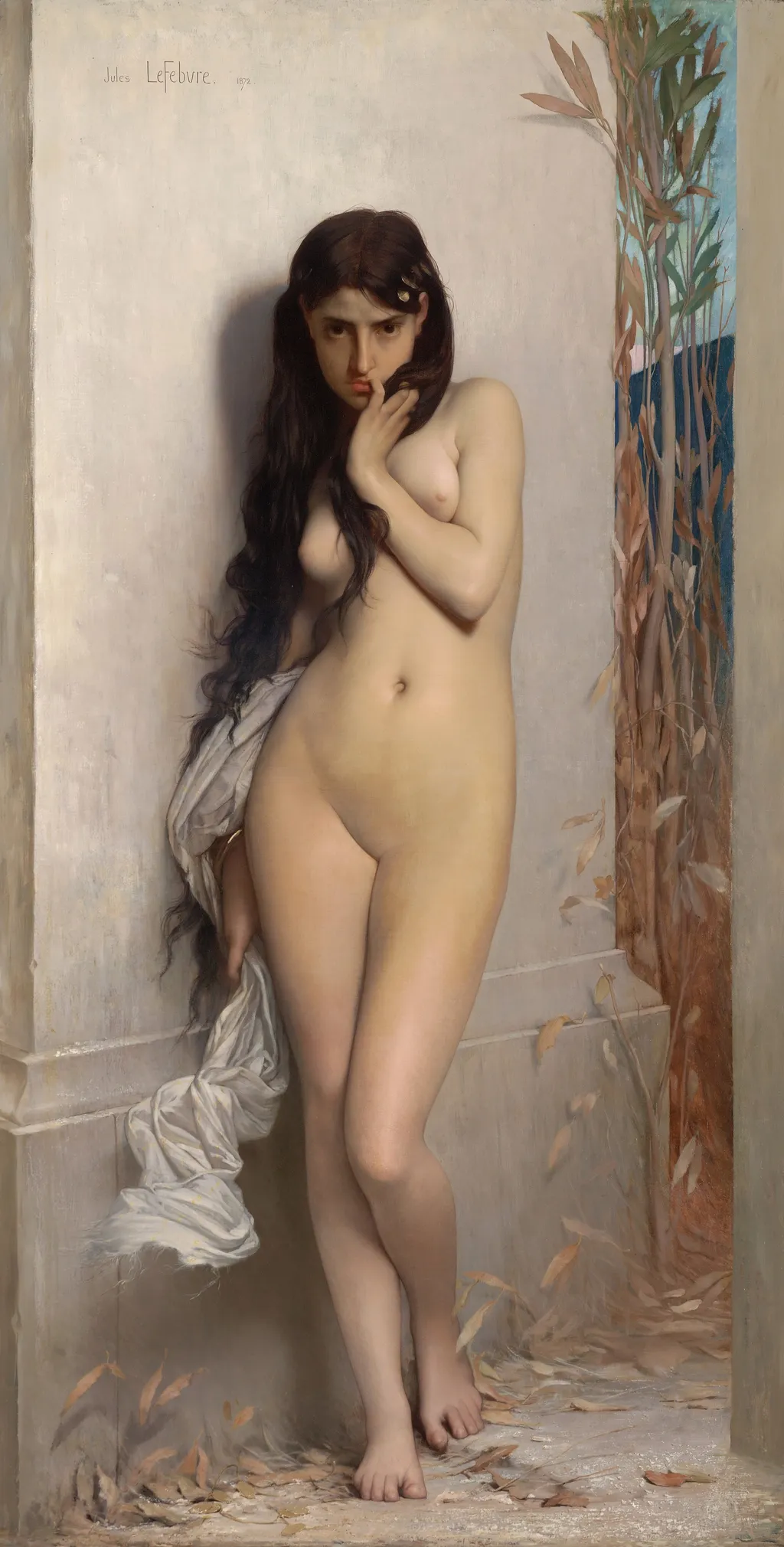
The Cicada is an oil painting by the Academic Art artist Jules Lefebvre. It dates from 1872 and is held in the collection of the National Gallery of Victoria.
About this work
Subject & Meaning
Her posture and exposed body reference the fable The Ant and the Grasshopper, symbolizing the consequences of unpreparedness for winter hardship.
The painting depicts a nude young woman standing against a bare wall, clutching a small white veil as she gazes directly at the viewer. Her posture and exposed body reference the fable The Ant and the Grasshopper, symbolizing the consequences of unpreparedness for winter hardship. The work is interpreted as an allegory of vulnerability and impending scarcity, drawing on themes of hunger and the approach of winter.
The figure’s slight hunger is suggested by her hand near her mouth and the barren plant beside her, while the autumnal setting reinforces the seasonal transition. The painting draws on the moral of La Fontaine’s fable, contrasting the carefree cicada with the diligent ant, and was inspired by contemporary French anxieties following the Franco‑Prussian War.
Technique & Style
The Cicada is an oil painting on canvas created in 1872 by French academic artist Jules Lefebvre. Executed in oil paint, the work measures 186.7 cm in height and 123.8 cm in width and depicts a nude woman in contrapposto, holding a small white veil while standing before a stark backdrop that includes a plant shedding autumn leaves, a stone baseboard, and a dark brown drapery. The composition draws on the fable The Ant and the Grasshopper, using the insect’s allegorical transformation into a vulnerable, unprotected figure to comment on winter’s approach and themes of poverty and impending hardship.
The painting was first exhibited at the Salon of 1872 in Paris and has been part of the National Gallery of Victoria’s collection since a 2005 bequest, acquired from a private sale reportedly valued at half a million dollars.
History & Provenance
The Cicada was painted by Jules Lefebvre in 1872 as an allegorical oil on canvas. Created during a period when the female nude was popular in the Paris Salon, the work was first exhibited at the Salon of 1872 in Paris, where Lefebvre accompanied it with a quotation from La Fontaine's version of the fable: "Quand la bise fut venue." After its Salon showing, the painting passed through a succession of private owners.
In 2005, the National Gallery of Victoria in Melbourne acquired the work, reportedly for 500,000 Australian dollars, and it has remained in that collection since.
The painting is held in the collection of the National Gallery of Victoria in Melbourne, Australia. The institution acquired the work in 2005 through a bequest, with records indicating a purchase price of $500,000. Prior to entering this public collection, the artwork circulated among various private owners following its debut.
The work was first exhibited at the Salon in Paris in 1872, the same year of its creation. This initial showing established the piece within the context of the French academic art scene before its eventual transfer to Australia.
Context
Exhibited at the Salon of 1872, Jules Lefebvre's work emerged during a period when the female nude was highly popular in Parisian academic circles. The painting serves as an allegorical illustration of Jean de La Fontaine's fable 'The Ant and the Grasshopper,' depicting the protagonist's vulnerability against an approaching winter. Scholars have suggested that Lefebvre's depiction of destitution may reflect contemporary French anxieties following the Franco-Prussian War and the Paris Commune.
The work remained in private hands for over a century before being acquired by the National Gallery of Victoria in 2005 for $500,000. Its inclusion in bibliographies by Earl Shinn and Claude Vento underscores its recognition within late nineteenth-century art discourse.
Legacy
Following its debut at the Salon of 1872, The Cicada became a touchstone for academic allegory in late nineteenth‑century France, cited in contemporary Salon criticism as a paradigmatic fusion of moral narrative and idealized nude. The painting’s reception was shaped by its alignment with La Fontaine’s fable and by its evocation of post‑1870 anxieties, a point underscored in later art‑historical writing that links the exposed, hungry figure to France’s political and economic crises after the Franco‑Prussian War and the Commune.
In the twentieth century, the work entered international museum discourse through its acquisition by the National Gallery of Victoria in 2005, an event noted in collection histories for returning a canonical Salon nude to public view. The painting has since been reproduced in surveys of academic art and cited as an example of Lefebvre’s influence on the allegorical tradition.
Overview
The Cicada, a painting by Jules Joseph Lefebvre, was created in 1872 using oil paint. It is a nude scene that references the fable 'The Ant and the Grasshopper' by Jean de La Fontaine, symbolizing the consequences of idleness.
Artist & collection