Artwork
冨嶽三十六景 江戸日本橋|Nihonbashi in Edo (Edo Nihonbashi), from the series Thirty-six Views of Mount Fuji (Fugaku sanjūrokkei)
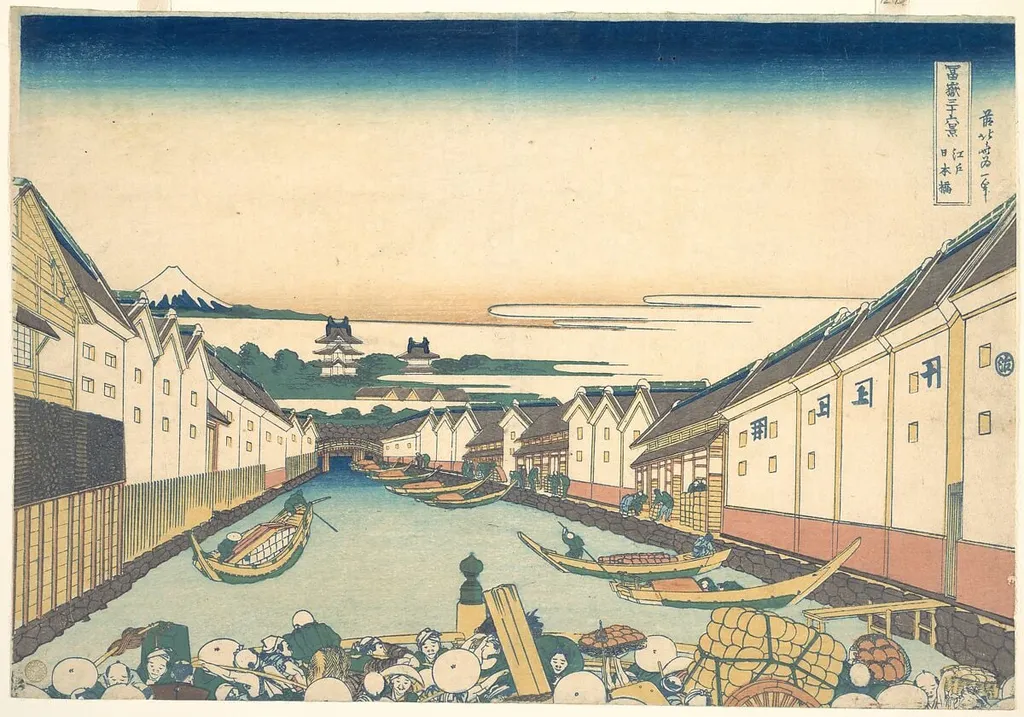
冨嶽三十六景 江戸日本橋|Nihonbashi in Edo (Edo Nihonbashi), from the series Thirty-six Views of Mount Fuji (Fugaku sanjūrokkei) is an ink print by the Japonisme artist Katsushika Hokusai. It dates from 1831 and is held in the collection of the Metropolitan Museum of Art.
About this work
Subject & Meaning
The composition juxtaposes everyday urban life, boats, buildings, and a canal, against the iconic mountain, a recurring motif throughout the series.
The print depicts the Nihonbashi bridge area in Edo, the bustling commercial heart of the city, with Mount Fuji rising in the distance. The composition juxtaposes everyday urban life, boats, buildings, and a canal, against the iconic mountain, a recurring motif throughout the series. By placing the sacred peak of Mount Fuji behind the lively bridge scene, Hokusai frames the mountain as a distant but ever-present backdrop to the rhythms of Edo's trade and travel.
The series as a whole uses Mount Fuji as a unifying symbol, and this view pairs that natural landmark with the man-made infrastructure of the capital, linking commerce and geography in a single image.
Technique & Style
Edo Nihonbashi is a polychrome woodblock print executed on paper, the defining medium of ukiyo-e. Hokusai’s design was carved into multiple cherry-wood blocks, one for each color, then printed in succession to build up the full palette. The support is thin, hand-made Japanese kozo paper, which absorbs the water-based ink and pigments without bleeding.
Stylistically, the print employs bold, flat areas of color bounded by crisp black outlines, a hallmark of nishiki-e (brocade prints). Linear perspective is compressed, while delicate bokashi (gradated shading) softens skies and water. The handling is precise yet dynamic, with fine cross-hatching in the boat sails and delicate stippling in the distant figures, conveying both immediacy and depth.
History & Provenance
The print Nihonbashi in Edo was created by Katsushika Hokusai in 1830 as part of his landmark series Thirty-six Views of Mount Fuji (Fugaku sanjūrokkei).
The work depicts the Nihonbashi bridge in Edo, framed by commercial activity along a canal with Mount Fuji visible in the background. It belongs to the ukiyo-e tradition, executed as a polychrome woodblock print using mineral pigments and indigo dyes on paper.
The Metropolitan Museum of Art holds an impression of this print, which entered the collection as part of the Rogers Fund in 1912 (accession JP1295).
The print is held by the Metropolitan Museum of Art, New York, accessioned as JP1295.
It has been exhibited at the Metropolitan Museum of Art in the 2019 reinstallation of Japanese prints and drawings, where it was shown under the series title Thirty-six Views of Mount Fuji.
Overview
This woodblock print is part of Katsushika Hokusai's series Thirty-six Views of Mount Fuji. Created around 1831, it showcases the artist's skill at capturing the relationship between everyday life and iconic landscapes.
Artist & collection

Artist
Katsushika Hokusai spent his life in Edo, now Tokyo, where he drew and carved prints for a living.

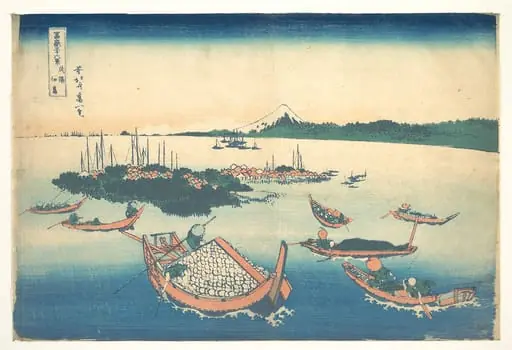
- 冨嶽三十六景 武陽佃島|Tsukudajima in Musashi Province (Buyō Tsukudajima), from the series Thirty-six Views of Mount Fuji (Fugaku sanjūrokkei)
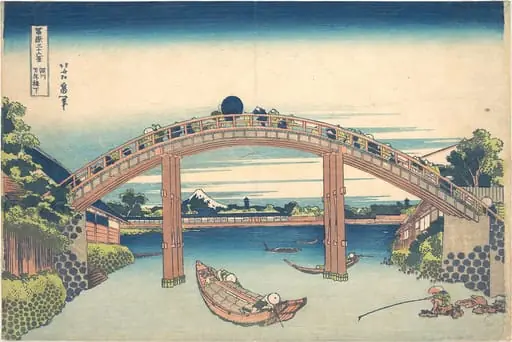 葛飾北斎画 冨嶽三十六景 深川万年橋下|Under the Mannen Bridge at Fukagawa (Fukagawa Mannenbashi shita), from the series Thirty-six Views of Mount Fuji (Fugaku sanjūrokkei)
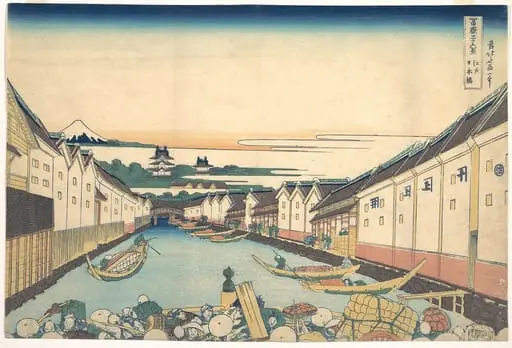 冨嶽三十六景 江戸日本橋|Nihonbashi in Edo (Edo Nihonbashi), from the series Thirty-six Views of Mount Fuji (Fugaku sanjūrokkei)
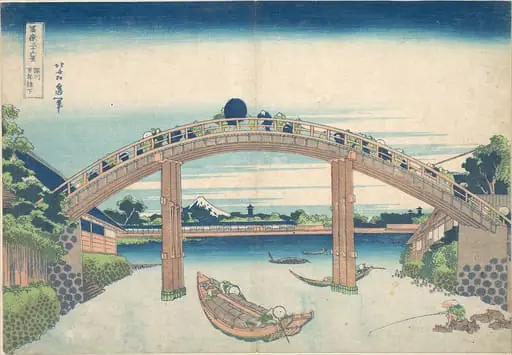 冨嶽三十六景 深川万年橋下|Under the Mannen Bridge at Fukagawa (Fukagawa Mannenbashi shita), from the series Thirty-six Views of Mount Fuji (Fugaku sanjūrokkei)
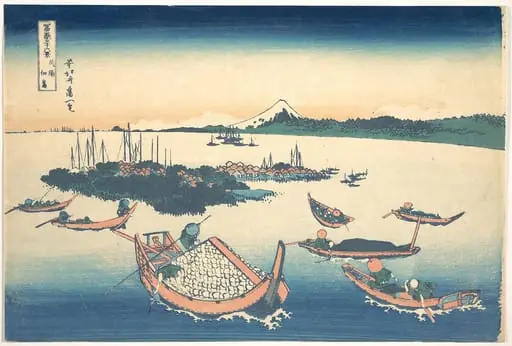 冨嶽三十六景 武陽佃島|Tsukudajima in Musashi Province (Buyō Tsukudajima), from the series Thirty-six Views of Mount Fuji (Fugaku sanjūrokkei)
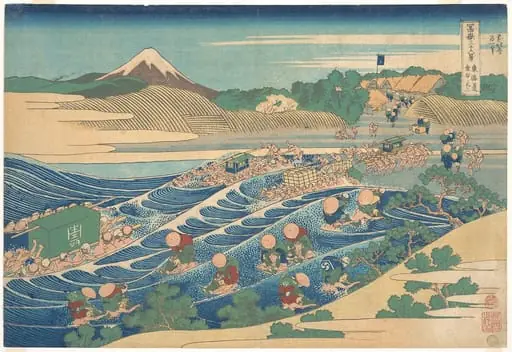 冨嶽三十六景 東海道金谷の不二|Fuji Seen from Kanaya on the Tōkaidō (Tōkaidō Kanaya no Fuji), from the series Thirty-six Views of Mount Fuji (Fugaku sanjūrokkei)
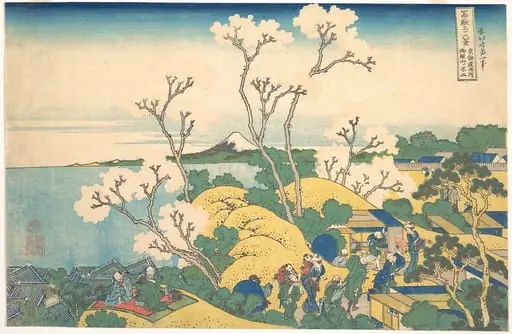 冨嶽三十六景 東海道品川御殿山の不二|Fuji from Gotenyama at Shinagawa on the Tōkaidō (Tōkaidō Shinagawa Gotenyama no Fuji), from the series Thirty-six Views of Mount Fuji (Fugaku sanjūrokkei)
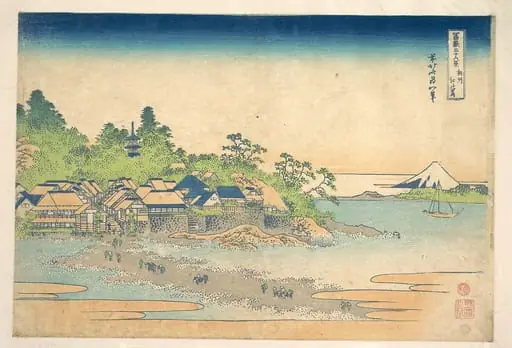 冨嶽三十六景 相州江の島|Enoshima in Sagami Province (Sōshū Enoshima), from the series Thirty-six Views of Mount Fuji (Fugaku sanjūrokkei)
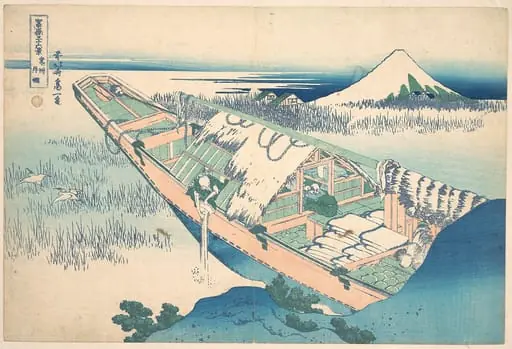 冨嶽三十六景 常州牛掘|Ushibori in Hitachi Province (Jōshū Ushibori), from the series Thirty-six Views of Mount Fuji (Fugaku sanjūrokkei)
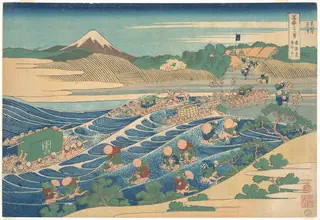 Compared in the Edo/Japonisme course