Artwork
粟に鶉図|Quail and Millet
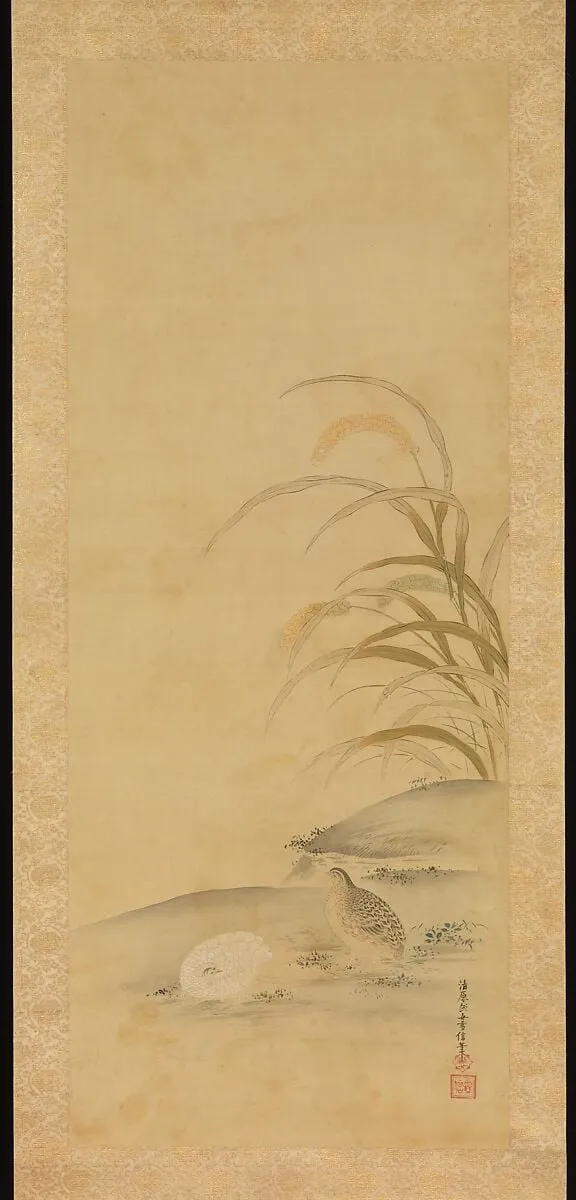
粟に鶉図|Quail and Millet is an ink painting by the Baroque artist Kiyohara Yukinobu. It is held in the collection of the Metropolitan Museum of Art. “Quail and Millet” (粟に鶉図) is a 17th-century Japanese painting rendered in ink and color on silk, presented as a hanging scroll.
About this work
Subject & Meaning
The bird and grain are traditional motifs that in East Asian art symbolize autumn and the harvest, conveying a seasonal and contemplative mood.
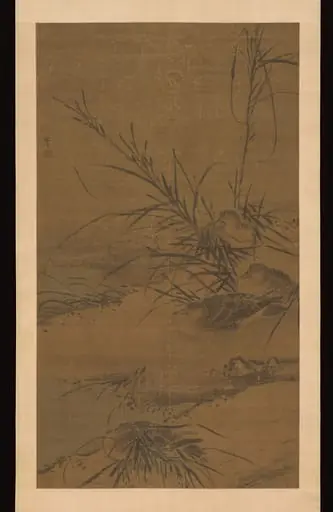
The painting shows a quail perched among stalks of millet and a few leaves, set against a simple background. The bird and grain are traditional motifs that in East Asian art symbolize autumn and the harvest, conveying a seasonal and contemplative mood. Kiyohara Yukinobu’s rendering combines realistic detail with an asymmetrical layout reminiscent of 12th‑century Chinese academic painting, emphasizing a quiet, naturalistic scene.
As a hanging scroll of ink and color on silk created in 1700, the work reflects both Chinese influence and Japanese decorative sensibility.
Technique & Style
Created in 1700, this hanging scroll by Kiyohara Yukinobu utilizes ink and color applied to a silk support. The composition features a quail positioned beneath millet stalks, arranged with a distinct asymmetry that evokes the realism of twelfth-century Chinese academic painting. Measuring approximately 118.4 by 47.6 centimeters, the work employs a still-life approach to depict birds and foliage, using the specific pairing of quail and grain to symbolize the autumn season. The handling of the medium achieves a tranquil atmosphere through its faithful representation of natural forms.
History & Provenance
The painting Quail and Millet (粟に鶉図) by Kiyohara Yukinobu is dated to 1700 and is executed in ink and color on silk as a hanging scroll. The work entered the collection of the Metropolitan Museum of Art, where it remains housed, with documented dimensions of 118.4 cm in height and 47.6 cm in width. The painting’s composition, featuring a quail beneath millet stalks, reflects twelfth-century Chinese academic traditions in its realism and asymmetrical arrangement, aligning with seasonal symbolism of autumn.
Quail and Millet by Kiyohara Yukinobu is held in the collection of the Metropolitan Museum of Art in New York, as documented in both the Wikipedia entry and the Wikidata record for the work. The painting, dated to 1700 and executed in ink and color on silk as a hanging scroll, entered the museum's holdings without a specific accession number cited in the available sources. The provided records do not document any prior ownership history or exhibition history for the work, nor do they specify a department or gallery location within the Metropolitan Museum of Art where it is currently displayed.
Overview
“Quail and Millet” (粟に鶉図) is a 17th-century Japanese painting rendered in ink and color on silk, presented as a hanging scroll. Created by Kiyohara Yukinobu, this artwork is housed in the collection of the Metropolitan Museum of Art in New York. It depicts a naturalistic scene of a bird amidst grain, characteristic of a particular genre of East Asian painting.
Context
Kiyohara Yukinobu was a notable female artist during a period when women's participation in professional art circles in Japan was uncommon. Her decision to sign this scroll with her own name further distinguishes her, as it was an unusual practice for women artists of her era. This act underscores her professional identity and individual contribution to the art historical record.
Artist & collection